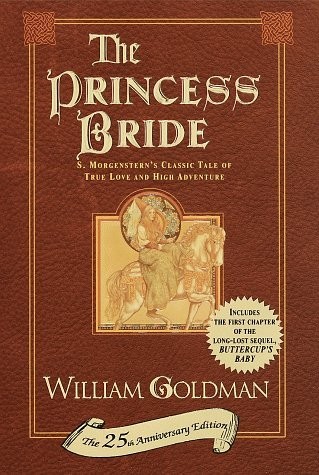
Talk to The Princess Bride like its author wrote you back.
Get the ideas that fit your life — not generic summaries.
- Chat with the book
- Audiobook-style main ideas
- Adapts to your life and goals
- Helps you take action
The Princess Bride, in detail
The Princess Bride presents itself as an abridgment: William Goldman claims he is cutting the "boring parts" from a dense historical novel by the fictional S. Morgenstern, leaving only the good parts — adventure, romance, giants, swordsmen, pirates, and a villain so confident in his own intelligence that he talks his way into defeat. The framing device, in which Goldman describes reading the book as a sick child and now abridging it for his own son, is itself fiction; there is no Morgenstern original. The whole apparatus is a trick, and knowing it is a trick doesn't diminish it at all.
What Goldman is actually writing is a meditation on the stories we love when we're young and what happens to that love when we grow up and stop believing things work out. Westley and Buttercup are deliberately thin archetypes — beautiful, devoted, interchangeable — because the point isn't them. The point is Inigo Montoya, whose single-minded quest for vengeance turns out to be both absurd and genuinely moving. The point is Fezzik, the gentle giant who doesn't fit anywhere. The point is every time a character says "as you wish" and means something more complicated than the words.
Goldman's voice is the book's real engine. The interjections, the "abridger's" complaints about Morgenstern's digressions, the fake footnotes — these should feel like gimmicks, and somehow they don't. They make the romance more romantic by undercutting it at regular intervals; the sentiment earns its weight because it keeps being tested. The ending, which refuses to be unambiguously happy, is the best decision Goldman makes. He insists on the version his father told him, not the version he made up.
The book is funnier than it has any right to be, and sadder. It's also one of the more honest accounts of what good popular storytelling does: it takes you seriously enough to admit that the world doesn't always pay off the way the story does, and then gives you the story anyway. Readers who need their fantasy to be internally consistent and world-built to within an inch of its life will find this too silly. Readers who want to feel like a kid reading under the covers with a flashlight, but who also want the thing to be smart, are in the right place.
The big ideas
- 1.
Goldman uses the fake-abridgment framing not as a gimmick but as a way of being honest about what popular storytelling actually does — it edits reality toward meaning.
- 2.
Inigo Montoya's arc works because it's absurd and earnest simultaneously — his twenty-year quest is both a joke and an actual psychological portrait of what obsession costs.
- 3.
The refusal of a clean happy ending is the book's most mature move; Goldman insists the world interrupts stories, and that's why stories matter in the first place.
