Self-help · Book club
The Productivity Project book club questions
Here are 12 book club questions for The Productivity Project by Chris Bailey, ordered to open easily and end somewhere worth arguing about. Copy them, print them, or bring them up one at a time.
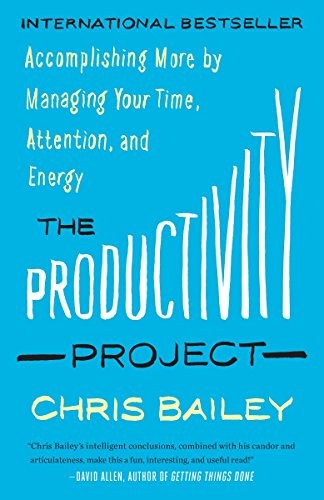
The Productivity Project emerged from Chris Bailey's year-long self-experiment immediately after graduating from university.
Chris Bailey · 2016 · 4h 40m
Full summary and key takeaways →The 12 questions
- 1.
Bailey frames productivity around time, attention, and energy. Which of the three is your biggest constraint right now — the one that, if improved, would most change your output?
- 2.
When are your peak biological hours — the time of day when your attention and energy are highest? Is your current schedule actually protecting that time for your most important work?
- 3.
What are your three most important outcomes for this week? If you had to pick just three, what would they be?
- 4.
Bailey spent a week working ninety-hour weeks and another working twenty-hour weeks, producing roughly the same output. Does that match your experience? What would you find if you ran the same experiment?
- 5.
Which maintenance task most reliably expands to fill your productive time? Email, meetings, administrative work? What would batching it look like in your schedule?
- 6.
The book treats internet access as the primary attention thief in modern knowledge work. What is the specific access point — the app, the site, the notification — that most reliably derails your focus?
- 7.
Bailey describes his meditations and cold-shower experiments. What's the most uncomfortable productivity experiment you've ever run on yourself? What did you learn?
- 8.
He distinguishes between being busy and being productive. On a scale of one to ten, how would you rate your ratio of productive output to busy activity in a typical week?
- 9.
How much sleep do you actually get versus how much you think you need? What would a two-week experiment of eight hours per night show you?
- 10.
Bailey's approach is explicitly experimental rather than prescriptive. What is one productivity tactic you've read about but never actually tested? What would a two-week experiment with it look like?
- 11.
He talks about his period of working ninety hours a week and discovering diminishing returns past a certain point. At what point in your workday or workweek does your output quality noticeably drop?
- 12.
Which of the energy-management levers — sleep, exercise, diet, alcohol, caffeine — is most underused in your current routine? What's one small experiment you could run this week?
How to run the discussion
- Pick six to eight, not all of them. An hour of real discussion covers fewer questions than anyone expects, and racing the list is what makes a book club feel like homework.
- Open with what people noticed, not what they concluded. Asking for a verdict first hardens opinions before anyone has heard each other.
- Let the disagreement run. The questions below that split a room are the ones worth the time; the ones everyone answers the same way can be skipped.
- Ask the quiet person a specific question. A direct, narrow question is far easier to answer than an open invitation to contribute.
Themes worth steering toward
If the conversation stalls, these are the threads that usually restart it.
Common questions
What are good book club questions for The Productivity Project?
Here are 12 book club questions for The Productivity Project by Chris Bailey, ordered to open easily and end somewhere worth arguing about. The strongest openers ask what each reader noticed rather than what they concluded, and the discussion usually turns on productivity, time management, attention.
How long should a book club discussion of The Productivity Project last?
Most groups run 60 to 90 minutes of actual discussion. That is roughly six to eight questions, not all of them, so pick the ones that suit your group rather than working down the list in order.
What are the main themes in The Productivity Project?
Productivity, Time management, Attention, Energy, Self-experimentation. Those are the threads most likely to divide a room, which makes them the useful places to steer a discussion that has gone quiet.
Picking the next one? See books like The Productivity Project or questions for other book club picks.
