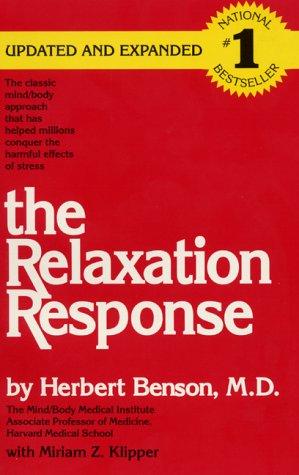
Talk to The Relaxation Response like its author wrote you back.
Get the ideas that fit your life — not generic summaries.
- Chat with the book
- Audiobook-style main ideas
- Adapts to your life and goals
- Helps you take action
The Relaxation Response, in detail
In 1975, Harvard cardiologist Herbert Benson published a compact, research-backed argument that the body carries a built-in counterforce to stress — one that medicine had largely ignored. He called it the relaxation response: a physiological state, measurable in blood pressure, heart rate, and oxygen consumption, that is the mirror image of the fight-or-flight response. Where stress accelerates the body, the relaxation response quiets it. Benson's claim was that any person could elicit this state deliberately, in minutes, without drugs.
The book is part science and part instruction manual. Benson draws on his research at Harvard Medical School, where he and his colleagues studied transcendental meditators and found that meditation produced consistent, reproducible physiological changes. Blood pressure fell. Breathing slowed. The metabolic rate dropped. He then stripped out the religious and commercial packaging of TM and reduced the technique to four elements: a quiet environment, a mental device (a single word or phrase repeated silently), a passive attitude toward intruding thoughts, and a comfortable position. The simplicity is the point.
The practical half of the book walks through how to elicit the response: sit quietly, close your eyes, relax your muscles progressively, breathe naturally, and with each exhalation silently repeat a word of your choosing — "one" is the example Benson gives. When other thoughts come, acknowledge them and return to the word. Do this for ten to twenty minutes, once or twice a day. Benson reviews evidence that regular practice reduces hypertension, anxiety, and some forms of chronic pain, and he discusses the mechanism by which hypothalamic activity shifts when the response is elicited.
What Benson doesn't do is oversell. The relaxation response is a tool, not a cure. He acknowledges that it works best as a complement to conventional medicine, not a replacement. The book is deliberately plain: no mysticism, no guru, no expensive program. Fifty years later, the core finding has held up across thousands of subsequent studies. It remains one of the cleaner examples in medicine of a behavioral intervention with a measurable, replicable physiological effect.
The big ideas
- 1.
The relaxation response is the body's built-in physiological counterpart to the fight-or-flight response, characterized by lower blood pressure, slower breathing, and reduced metabolic rate.
- 2.
Any repetitive mental focus — a word, sound, phrase, or prayer — can elicit the response. The religious or cultural packaging is optional; the mechanism is physiological.
- 3.
Regular practice, ten to twenty minutes once or twice a day, produces measurable reductions in hypertension in many patients, often reducing the need for medication.
