History · Book club
The Road to Unfreedom: Russia, Europe, America book club questions
Here are 12 book club questions for The Road to Unfreedom: Russia, Europe, America by Timothy Snyder, ordered to open easily and end somewhere worth arguing about. Copy them, print them, or bring them up one at a time.
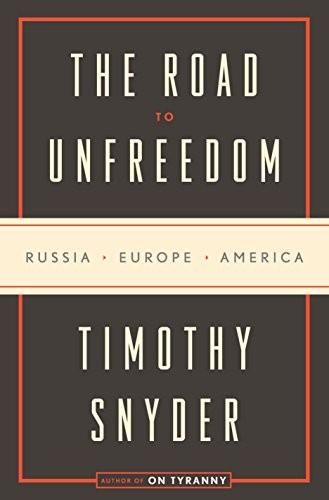
The Road to Unfreedom is Timothy Snyder's analysis of how Russia developed a new form of authoritarian politics under Vladimir Putin and began exporting it to Europe and the United States in the 2010s.
Timothy Snyder · 2018 · 6h 45m
Full summary and key takeaways →The 12 questions
- 1.
Snyder distinguishes the 'politics of inevitability' from the 'politics of eternity.' Do you recognize either pattern in current political discourse in your own country?
- 2.
Ivan Ilyin's ideas were marginal in his lifetime but central to Kremlin ideology fifty years after his death. What does this tell us about how political ideas travel and why ideas that seem defeated can resurface?
- 3.
Snyder argues that Russia's information operations worked partly because Western publics were already primed by their own media environment to distrust institutions. Do you find this argument persuasive?
- 4.
The book traces Russian influence operations in the 2016 US election and European politics in detail. How should a democracy balance transparency about foreign interference with the risk of undermining confidence in its own institutions?
- 5.
Snyder describes the use of anti-LGBTQ politics as a technology for building transnational political coalitions. What does it mean when a policy position functions primarily as a tool for coalition building rather than as a sincere policy preference?
- 6.
Russia's intervention in Ukraine was framed in Russia as a defense of Russian-speakers and as resistance to Western imposition. How do we evaluate competing historical narratives about a living conflict when both sides claim victimhood?
- 7.
The annexation of Crimea was widely condemned but not reversed. What does that outcome suggest about the enforceability of international norms about sovereignty?
- 8.
Snyder is a historian writing about very recent events, including some still in progress at the time of writing. What are the risks and benefits of this kind of contemporary historical analysis?
- 9.
The book was written in 2017–18. Which of its analyses have held up, and which have been complicated or contradicted by subsequent events?
- 10.
Snyder argues that the erosion of factual journalism is a structural vulnerability, not just a media problem. What would it take to rebuild civic infrastructure capable of resisting information operations?
- 11.
How do you distinguish a healthy politics of national identity and tradition from the 'politics of eternity' Snyder describes?
- 12.
The Road to Unfreedom ends with a call to defend institutions and restore a sense of possibility. Is this call to action persuasive, or does it underestimate the scale of what Snyder has described?
How to run the discussion
- Pick six to eight, not all of them. An hour of real discussion covers fewer questions than anyone expects, and racing the list is what makes a book club feel like homework.
- Open with what people noticed, not what they concluded. Asking for a verdict first hardens opinions before anyone has heard each other.
- Let the disagreement run. The questions below that split a room are the ones worth the time; the ones everyone answers the same way can be skipped.
- Ask the quiet person a specific question. A direct, narrow question is far easier to answer than an open invitation to contribute.
Themes worth steering toward
If the conversation stalls, these are the threads that usually restart it.
Common questions
What are good book club questions for The Road to Unfreedom: Russia, Europe, America?
Here are 12 book club questions for The Road to Unfreedom: Russia, Europe, America by Timothy Snyder, ordered to open easily and end somewhere worth arguing about. The strongest openers ask what each reader noticed rather than what they concluded, and the discussion usually turns on authoritarianism, propaganda, russian politics.
How long should a book club discussion of The Road to Unfreedom: Russia, Europe, America last?
Most groups run 60 to 90 minutes of actual discussion. That is roughly six to eight questions, not all of them, so pick the ones that suit your group rather than working down the list in order.
What are the main themes in The Road to Unfreedom: Russia, Europe, America?
Authoritarianism, Propaganda, Russian politics, Democracy, Geopolitics. Those are the threads most likely to divide a room, which makes them the useful places to steer a discussion that has gone quiet.
Picking the next one? See books like The Road to Unfreedom: Russia, Europe, America or questions for other book club picks.
