Historical fiction · Book club
The Rose Code book club questions
Here are 12 book club questions for The Rose Code by Kate Quinn, ordered to open easily and end somewhere worth arguing about. Copy them, print them, or bring them up one at a time.
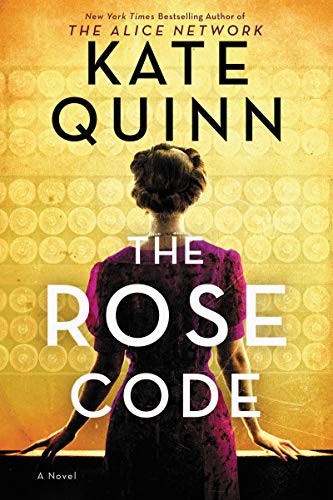
Three women meet at Bletchley Park in 1940: Osla, a glamorous debutante with a secret German-speaking talent; Mab, a working-class girl from Bethnal Green who wants more than her origins allow; and Beth, a shy, brilliant eccentric from a controlling family who turns out to be one of the best codebreakers on the estate.
Kate Quinn · 2021 · 12h 0m
Full summary and key takeaways →The 12 questions
- 1.
Beth's confinement in a psychiatric institution in 1947 is presented as unjust and ideologically motivated. How much does the novel distinguish between bad intentions and the limits of mid-century medicine?
- 2.
The three women come from very different class backgrounds. How does Quinn use those differences to drive conflict, and does she ultimately flatten them in the service of friendship?
- 3.
The novel's central secret — the traitor's identity — is withheld for most of the book. Did you figure it out early? Did it matter to your enjoyment?
- 4.
Bletchley Park kept its secrets for decades after the war. How do you think about the real women who did this work and couldn't speak of it? What does enforced invisibility do to a person's sense of self?
- 5.
Osla is engaged to a man who will become central to British royal history. Quinn handles that material carefully. Did you find it distracting or did it add texture?
- 6.
The betrayal at the heart of the novel involves someone choosing safety over loyalty. Given the circumstances, can you understand that choice even if you don't excuse it?
- 7.
Quinn writes three distinct female protagonists across class lines. Which of the three felt most fully realized to you, and why?
- 8.
How does The Rose Code compare to The Alice Network — both in what it's attempting and in how well it succeeds?
- 9.
The psychiatric institution scenes are deliberately disturbing. Did Quinn go far enough in indicting the system, or did she pull back to keep the plot moving?
- 10.
The novel insists that the three women's friendship was worth preserving despite the betrayal. Is that a satisfying conclusion, or does it feel unearned?
- 11.
Codebreaking is inherently abstract — patterns in text, statistical analysis, logical inference. How does Quinn make it feel gripping? Where did she succeed or struggle?
- 12.
The frame narrative is set during the days before Princess Elizabeth's wedding. How does that choice — a moment of national celebration — contrast with Beth's situation in the asylum?
How to run the discussion
- Pick six to eight, not all of them. An hour of real discussion covers fewer questions than anyone expects, and racing the list is what makes a book club feel like homework.
- Open with what people noticed, not what they concluded. Asking for a verdict first hardens opinions before anyone has heard each other.
- Let the disagreement run. The questions below that split a room are the ones worth the time; the ones everyone answers the same way can be skipped.
- Ask the quiet person a specific question. A direct, narrow question is far easier to answer than an open invitation to contribute.
Themes worth steering toward
If the conversation stalls, these are the threads that usually restart it.
Common questions
What are good book club questions for The Rose Code?
Here are 12 book club questions for The Rose Code by Kate Quinn, ordered to open easily and end somewhere worth arguing about. The strongest openers ask what each reader noticed rather than what they concluded, and the discussion usually turns on bletchley park and codebreaking, female friendship and betrayal, wartime secrets.
How long should a book club discussion of The Rose Code last?
Most groups run 60 to 90 minutes of actual discussion. That is roughly six to eight questions, not all of them, so pick the ones that suit your group rather than working down the list in order.
What are the main themes in The Rose Code?
Bletchley Park and codebreaking, Female friendship and betrayal, Wartime secrets, Mental illness and stigma, Class and gender in wartime Britain. Those are the threads most likely to divide a room, which makes them the useful places to steer a discussion that has gone quiet.
Picking the next one? See books like The Rose Code or questions for other book club picks.
