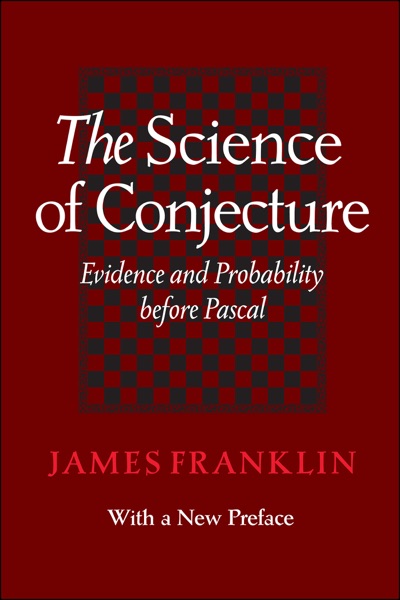
Talk to The Science of Conjecture like its author wrote you back.
Get the ideas that fit your life — not generic summaries.
- Chat with the book
- Audiobook-style main ideas
- Adapts to your life and goals
- Helps you take action
The Science of Conjecture, in detail
The Science of Conjecture is James Franklin's history of probable reasoning from classical antiquity through the seventeenth century, the period traditionally treated as the starting point for mathematical probability. Franklin's argument is that the focus on mathematical probability has obscured a rich pre-mathematical tradition of qualitative reasoning about evidence, risk, and degrees of belief — a tradition that includes Roman law, medieval theology, Renaissance merchants, and the first insurance markets. Mathematical probability did not invent reasoning under uncertainty; it formalized a practice already centuries old.
The book is a work of intellectual history rather than mathematics or philosophy. Franklin traces how Greek and Roman lawyers developed concepts like "half-proof" and "violent presumption" to reason about testimony and circumstantial evidence. He shows how medieval scholastics grappled with moral uncertainty — when is a person permitted to act on a belief that might be wrong? — and developed casuistry as a system for reasoning about probable obligation. He traces the development of life tables and annuity pricing in medieval and Renaissance Europe, which required actuarial reasoning about risk long before Bernoulli formalized it.
The transition to mathematical probability in the 1660s, covered in the final chapters, is contextualized as a shift in method rather than the invention of an idea. Pascal's and Huygens's work on games of chance was new mathematics applied to an old problem: how much is an uncertain prospect worth? The qualitative traditions in law and theology had been asking structurally similar questions for centuries in domains where mathematics was not applicable.
The Science of Conjecture is a challenging book in the best sense. It requires attention and some familiarity with the history of law and philosophy helps. But it rewards readers who engage with it carefully. Franklin's central claim — that we have a much longer and richer history of probabilistic thinking than the standard narrative acknowledges — changes how one reads the history of science, and has implications for contemporary debates about evidence, testimony, and rational belief.
The big ideas
- 1.
Mathematical probability, invented in the 1660s, formalized qualitative practices of probable reasoning that had existed in law, theology, and commerce for over a thousand years.
- 2.
Roman law developed nuanced concepts — degrees of proof, the weight of testimony, circumstantial inference — that constitute a pre-mathematical theory of evidence.
- 3.
Medieval casuistry, often dismissed as sophistry, was a serious attempt to reason about moral obligation under uncertainty: when is a person justified in acting on a belief that might be wrong?
