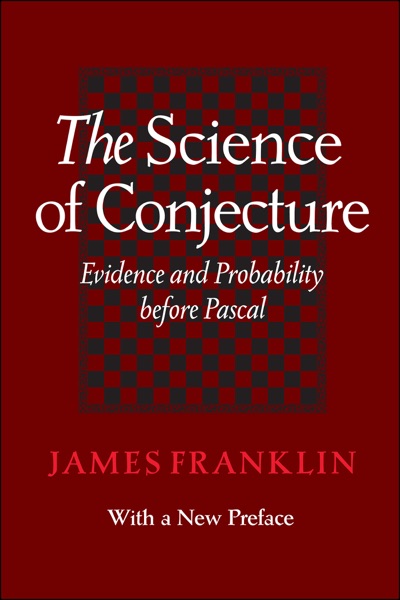
The Science of Conjecture by James Franklin is a 2001 history book about probability, reasoning under uncertainty, history of ideas. Mathematical probability, invented in the 1660s, formalized qualitative practices of probable reasoning that had existed in law, theology, and commerce for over a thousand years.
Summary
The Science of Conjecture is James Franklin's history of probable reasoning from classical antiquity through the seventeenth century, the period traditionally treated as the starting point for mathematical probability. Franklin's argument is that the focus on mathematical probability has obscured a rich pre-mathematical tradition of qualitative reasoning about evidence, risk, and degrees of belief — a tradition that includes Roman law, medieval theology, Renaissance merchants, and the first insurance markets. Mathematical probability did not invent reasoning under uncertainty; it formalized a practice already centuries old.
The book is a work of intellectual history rather than mathematics or philosophy. Franklin traces how Greek and Roman lawyers developed concepts like "half-proof" and "violent presumption" to reason about testimony and circumstantial evidence. He shows how medieval scholastics grappled with moral uncertainty — when is a person permitted to act on a belief that might be wrong? — and developed casuistry as a system for reasoning about probable obligation. He traces the development of life tables and annuity pricing in medieval and Renaissance Europe, which required actuarial reasoning about risk long before Bernoulli formalized it.
The transition to mathematical probability in the 1660s, covered in the final chapters, is contextualized as a shift in method rather than the invention of an idea. Pascal's and Huygens's work on games of chance was new mathematics applied to an old problem: how much is an uncertain prospect worth? The qualitative traditions in law and theology had been asking structurally similar questions for centuries in domains where mathematics was not applicable.
The Science of Conjecture is a challenging book in the best sense. It requires attention and some familiarity with the history of law and philosophy helps. But it rewards readers who engage with it carefully. Franklin's central claim — that we have a much longer and richer history of probabilistic thinking than the standard narrative acknowledges — changes how one reads the history of science, and has implications for contemporary debates about evidence, testimony, and rational belief.
Talk to The Science of Conjecture like its author wrote you back.
Get the ideas that fit your life — not generic summaries.
- Chat with the book
- Audiobook-style main ideas
- Adapts to your life and goals
- Helps you take action
Key takeaways
- 1.
Mathematical probability, invented in the 1660s, formalized qualitative practices of probable reasoning that had existed in law, theology, and commerce for over a thousand years.
- 2.
Roman law developed nuanced concepts — degrees of proof, the weight of testimony, circumstantial inference — that constitute a pre-mathematical theory of evidence.
- 3.
Medieval casuistry, often dismissed as sophistry, was a serious attempt to reason about moral obligation under uncertainty: when is a person justified in acting on a belief that might be wrong?
- 4.
The first insurance and annuity markets in medieval and Renaissance Europe required actuarial thinking about risk even before formal probability theory existed.
- 5.
Franklin argues that the history of probability is not just about quantification but about how human reasoning handles uncertainty — a question that was live long before anyone could write down a number.
- 6.
The legal tradition's emphasis on the weight and credibility of testimony is a practical theory of epistemic probability that philosophers of science have largely ignored.
- 7.
The transition to mathematical probability in the seventeenth century did not replace these earlier qualitative traditions — it ran parallel to them in different domains.
Discussion questions
Use these on your own, with a book club, or as chat starters in Superbook. Book club version, ready to copy or print →
- 1.
Franklin argues that mathematical probability formalized reasoning that had existed for centuries. Does knowing this history change how you think about the relationship between formal and informal reasoning?
- 2.
Roman law's concepts of 'half-proof' and 'violent presumption' were practical tools for courts. How do contemporary legal standards of evidence — beyond reasonable doubt, balance of probabilities — relate to these older concepts?
- 3.
Medieval casuistry asked when a person is morally permitted to act on an uncertain belief. Is that a question philosophy takes seriously enough today?
- 4.
The book argues that focusing on mathematical probability has caused us to miss a rich tradition of qualitative reasoning about evidence. Does the standard history of science have a systematic bias toward quantitative methods?
- 5.
Insurance markets required actuarial reasoning before probability theory existed. What does that suggest about the relationship between formal theory and practical innovation?
- 6.
Franklin covers law, theology, commerce, and science as parallel traditions of probable reasoning. Which of these fields do you think has developed the most sophisticated tools for reasoning under uncertainty?
- 7.
The history of probability is often told as intellectual heroism — Pascal's wager, the problem of points. Does Franklin's longer view change the cast of characters who deserve credit?
- 8.
Casuistry fell into disrepute as a word after Jesuit confessors were accused of using it to rationalize anything. Is that reputation deserved, or is it a smear of a legitimate practice?
- 9.
Franklin is an Australian mathematician and philosopher, and the book does not have an easy genre. How does work that falls between disciplines — history, philosophy, mathematics — get read and evaluated?
- 10.
The book covers a period from classical antiquity to the seventeenth century. What would a companion volume covering the eighteenth century to the present look like?
- 11.
Franklin's thesis has implications for how we think about AI systems that reason under uncertainty. If probabilistic reasoning is not just mathematical but also qualitative, what does that say about current approaches?
- 12.
What surprised you most about the pre-mathematical history of probability? Which figure or tradition covered in the book seemed most important to you?
Themes
Frequently asked questions
-
Is The Science of Conjecture accessible to non-specialists?
It is demanding but accessible. Franklin explains historical and legal contexts clearly and does not require mathematical background. Readers with some familiarity with intellectual history or philosophy of science will get more from it; those without can still follow the main argument.
-
How long is The Science of Conjecture?
About 500 pages with extensive notes. It takes eight to ten hours to read carefully. The density varies — the legal and commercial history sections are more narrative; the theological chapters require more concentration.
-
What is the book's main contribution?
Demonstrating that the standard history of probability, which starts with Pascal in 1654, misses a thousand years of serious probabilistic reasoning in law, theology, and commerce. That longer view changes how we understand where mathematical probability came from.
-
Who should read this book?
Historians of science and ideas, philosophers of probability, and readers with serious interest in how reasoning under uncertainty developed. It is not for casual readers seeking accessible popular science. It rewards specialists and serious generalists.
-
Does the book cover Bayesian probability?
The book ends at the seventeenth century and does not directly cover Bayes, whose theorem appeared in the eighteenth century. Franklin's earlier history is important context for understanding what Bayesianism was responding to and building on, but readers looking for coverage of modern probability theory will need to look elsewhere.
Similar books
Against the Gods: The Remarkable Story of Risk
Peter L. Bernstein
Thinking in Bets: Making Smarter Decisions When You Don't Have All the Facts
Annie Duke
The Signal and the Noise
Nate Silver
Fooled by Randomness
Nassim Nicholas Taleb
