Literary fiction · Book club
The Sellout book club questions
Here are 12 book club questions for The Sellout by Paul Beatty, ordered to open easily and end somewhere worth arguing about. Copy them, print them, or bring them up one at a time.
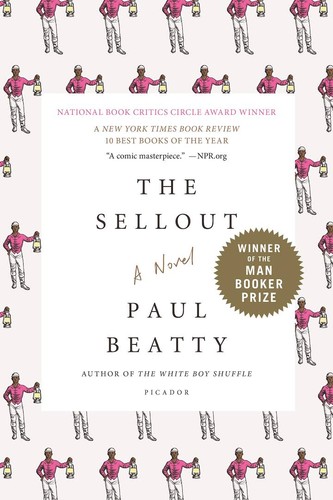
The Sellout opens with its unnamed narrator — Me, a Black farmer from the fictional Los Angeles suburb of Dickens — appearing before the Supreme Court of the United States, charged with reintroducing slavery and segregation.
Paul Beatty · 2015 · 6h 20m
Full summary and key takeaways →The 12 questions
- 1.
Hominy Jenkins insists on being enslaved and refuses freedom when it's offered. What is the novel saying about him — and is that argument offensive, or is offense the point?
- 2.
The town of Dickens is a fictional place made real by the narrator's map and then unmade by municipal decree. What is Beatty arguing about the relationship between place and community?
- 3.
The novel wins the Man Booker Prize for a book about the complete failure of American racial progress. Is there something uncomfortable about that irony, or is it appropriate?
- 4.
Beatty is equally contemptuous of Black nationalism, white liberalism, and respectability politics. Does that equal contempt feel like clarity or cynicism?
- 5.
The prose is extremely dense and allusive. Did you find yourself stopping to unpack references, and did that break the rhythm, or is the density part of the experience?
- 6.
The narrator's father raised him as a social experiment. What does the novel say about the relationship between theory and family — between treating people as data and treating them as kin?
- 7.
The Supreme Court scenes frame the novel as a case about the limits of civil rights. By the end, what do you think the novel's verdict is — on the narrator, on the Court, on the country?
- 8.
The novel is funny — genuinely, laugh-out-loud funny. Does the comedy make the serious argument easier to receive, or does it give readers permission to avoid the discomfort?
- 9.
Beatty has said that The Sellout was not well-received in the US when it first came out but was celebrated in Britain. What does that reception history say?
- 10.
The narrator never gets a name. What does the unnamed first person accomplish in a novel that is specifically about the invisibility and fungibility of Black identity?
- 11.
How does The Sellout compare to other satires of American racism you've read or watched — Get Out, Erasure, Bamboozled? Where does Beatty land hardest?
- 12.
By the end, has the narrator accomplished anything? And does the novel think accomplishment is possible?
How to run the discussion
- Pick six to eight, not all of them. An hour of real discussion covers fewer questions than anyone expects, and racing the list is what makes a book club feel like homework.
- Open with what people noticed, not what they concluded. Asking for a verdict first hardens opinions before anyone has heard each other.
- Let the disagreement run. The questions below that split a room are the ones worth the time; the ones everyone answers the same way can be skipped.
- Ask the quiet person a specific question. A direct, narrow question is far easier to answer than an open invitation to contribute.
Themes worth steering toward
If the conversation stalls, these are the threads that usually restart it.
Common questions
What are good book club questions for The Sellout?
Here are 12 book club questions for The Sellout by Paul Beatty, ordered to open easily and end somewhere worth arguing about. The strongest openers ask what each reader noticed rather than what they concluded, and the discussion usually turns on race and satire, american identity, segregation and memory.
How long should a book club discussion of The Sellout last?
Most groups run 60 to 90 minutes of actual discussion. That is roughly six to eight questions, not all of them, so pick the ones that suit your group rather than working down the list in order.
What are the main themes in The Sellout?
Race and satire, American identity, Segregation and memory, Absurdity and politics, Father and son. Those are the threads most likely to divide a room, which makes them the useful places to steer a discussion that has gone quiet.
Picking the next one? See books like The Sellout or questions for other book club picks.
