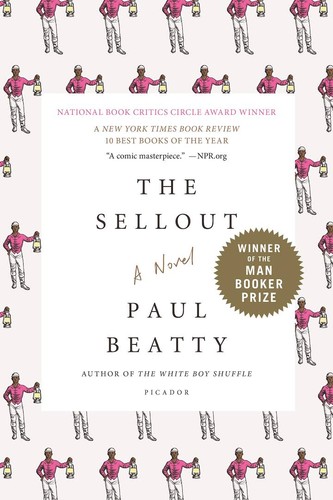
The Sellout by Paul Beatty is a 2015 literary fiction book about race and satire, american identity, segregation and memory. Satire is not irresponsibility. The novel's absurdity — reinstating slavery, redrawing segregation lines — is a precise diagnostic tool, not a dodge.
Summary
The Sellout opens with its unnamed narrator — Me, a Black farmer from the fictional Los Angeles suburb of Dickens — appearing before the Supreme Court of the United States, charged with reintroducing slavery and segregation. The novel then proceeds, via flashback, to explain how he got there. His father, a radical social scientist, has been killed by the police. The town of Dickens has been literally erased from the map. And the narrator, in an act of absurdist protest, decides to reinstate the geographical and social boundaries of the town — including by acquiring an elderly Black man named Hominy Jenkins, who insists on being his slave.
The novel is a satire of American racial politics in the tradition of Swift and Twain — fierce, unsparing, and deeply committed to the proposition that there is no position in the American racial conversation that cannot be made to look ridiculous. Beatty skewers Black nationalism, white liberalism, respectability politics, therapeutic approaches to race, and the performative politics of the post-civil-rights generation with equal contempt. The novel's argument, to the extent a satire has an argument, seems to be that America has so thoroughly confused symbol with substance in its approach to race that remedying the confusion requires absurdity of a very particular kind.
The prose is dense, allusive, and frequently hilarious — genuinely funny in ways that literary fiction rarely manages. Jokes arrive in long, cascading paragraphs that loop through cultural references from hip-hop to social science to the Little Rascals. The book won the 2016 Man Booker Prize, becoming the first American novel to do so, and the recognition reflects a critical consensus that this is a significant, demanding, and genuinely uncomfortable novel about race in America.
The Sellout is not easy. The jokes are layered, the cultural references are dense, and the satirical mode means the novel never offers the emotional relief of straightforward feeling. Readers who want to be moved in conventional ways — to sympathize with a protagonist who overcomes obstacles — will struggle. But for those who can follow the joke and the argument at the same time, it is one of the most pointed and original novels about American racial politics in decades.
Talk to The Sellout like its author wrote you back.
Get the ideas that fit your life — not generic summaries.
- Chat with the book
- Audiobook-style main ideas
- Adapts to your life and goals
- Helps you take action
Key takeaways
- 1.
Satire is not irresponsibility. The novel's absurdity — reinstating slavery, redrawing segregation lines — is a precise diagnostic tool, not a dodge.
- 2.
The American conversation about race has become so performative that it can no longer address the actual conditions of Black American life. The novel's absurdism names that gap.
- 3.
Hominy Jenkins, who demands to be enslaved, embodies a dark argument about internalized oppression — what happens when people identify with the conditions of their own degradation.
- 4.
The erasure of Dickens from the map literalizes something the novel says happens constantly: the physical and administrative erasure of poor Black communities from official America.
- 5.
Beatty's narrator inherits his father's radicalism but is skeptical of all inherited positions. The novel is suspicious of the idea that having the right politics is the same as doing anything.
- 6.
The novel's comedy is not relief from the horror. It is the method by which the horror is examined — which makes it both funnier and more disturbing than straight tragedy.
- 7.
White liberal discomfort is a target as much as white conservative hostility. The novel is equally contemptuous of both.
- 8.
By the time the narrator reaches the Supreme Court, the reader understands that the absurdity of his crime is indistinguishable from the absurdity of the system that put him there.
Discussion questions
Use these on your own, with a book club, or as chat starters in Superbook. Book club version, ready to copy or print →
- 1.
Hominy Jenkins insists on being enslaved and refuses freedom when it's offered. What is the novel saying about him — and is that argument offensive, or is offense the point?
- 2.
The town of Dickens is a fictional place made real by the narrator's map and then unmade by municipal decree. What is Beatty arguing about the relationship between place and community?
- 3.
The novel wins the Man Booker Prize for a book about the complete failure of American racial progress. Is there something uncomfortable about that irony, or is it appropriate?
- 4.
Beatty is equally contemptuous of Black nationalism, white liberalism, and respectability politics. Does that equal contempt feel like clarity or cynicism?
- 5.
The prose is extremely dense and allusive. Did you find yourself stopping to unpack references, and did that break the rhythm, or is the density part of the experience?
- 6.
The narrator's father raised him as a social experiment. What does the novel say about the relationship between theory and family — between treating people as data and treating them as kin?
- 7.
The Supreme Court scenes frame the novel as a case about the limits of civil rights. By the end, what do you think the novel's verdict is — on the narrator, on the Court, on the country?
- 8.
The novel is funny — genuinely, laugh-out-loud funny. Does the comedy make the serious argument easier to receive, or does it give readers permission to avoid the discomfort?
- 9.
Beatty has said that The Sellout was not well-received in the US when it first came out but was celebrated in Britain. What does that reception history say?
- 10.
The narrator never gets a name. What does the unnamed first person accomplish in a novel that is specifically about the invisibility and fungibility of Black identity?
- 11.
How does The Sellout compare to other satires of American racism you've read or watched — Get Out, Erasure, Bamboozled? Where does Beatty land hardest?
- 12.
By the end, has the narrator accomplished anything? And does the novel think accomplishment is possible?
Themes
Frequently asked questions
-
Is The Sellout worth reading?
Yes, if you have patience for demanding satirical prose and are prepared to be made uncomfortable rather than reassured. It is one of the most genuinely original novels about American race in recent decades, and it is funnier than most literary fiction manages. It won the Booker for a reason.
-
Is The Sellout hard to read?
It's demanding. The prose is dense with cultural reference, the jokes are layered, and Beatty's satirical mode means the novel never slows down to explain itself. Many readers need to re-read paragraphs to catch what just happened. But the difficulty is earned — this is not obscurity for its own sake.
-
Why did The Sellout win the Man Booker Prize?
The Booker jury in 2016 praised it as a 'dazzling' and 'unapologetic' work that used comedy to address serious material with unusual precision. The first American novel to win, it represented a shift in the prize's scope and a recognition of American literary satire at its most ambitious.
-
Who shouldn't read The Sellout?
Readers who want emotional clarity, sympathetic protagonists, or clear moral positions. The novel is satirical throughout and offers no relief in the form of a character who is simply right or simply good. It also moves at a demanding pace and rewards close reading in ways that casual readers may not find enjoyable.
-
Is The Sellout offensive?
Deliberately so, in multiple directions. Beatty is an equal-opportunity satirist and the novel makes everyone uncomfortable, which is its method. The offensiveness is the point — the novel argues that America has so mystified race that only provocation can disrupt the mystification.