Talk to The Shape of Content like its author wrote you back.
Get the ideas that fit your life — not generic summaries.
- Chat with the book
- Audiobook-style main ideas
- Adapts to your life and goals
- Helps you take action
What it argues
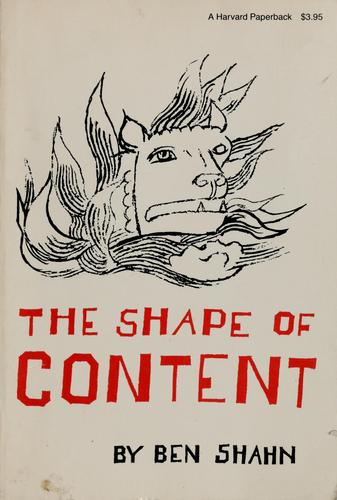
The Shape of Content collects six lectures Ben Shahn delivered at Harvard in 1956 as part of the Charles Eliot Norton Lectures series. Shahn, one of the most prominent American social realist painters of the twentieth century, uses the talks to argue a single sustained position: that form and content in art are inseparable, and that any attempt to divide them — to treat form as merely decorative, or content as merely illustrative — produces dead work on both sides.
Shahn builds the argument against two opposing errors he saw in mid-century art. The first is pure formalism: the idea that how a painting is made matters and what it depicts does not, an attitude he connects to the academic separation of art from life. The second is pure didacticism: the kind of politically motivated art that uses painting as a poster, where the message overwhelms any genuine visual feeling. Both, he argues, produce work that is dishonest. The form a work takes is itself a kind of content — it embodies an attitude toward experience, not just a technique.
What it gets right
- 1.
Form and content are not separable in any work of genuine art. The way something is made is part of what it says.
- 2.
Pure formalism produces elegant emptiness. Pure didacticism produces eloquent posters. Neither is art in the fullest sense.
- 3.
Shahn argues that art is a form of knowledge — a way of understanding experience that cannot be translated into prose without loss.
What it covers
Who wrote it
Ben Shahn (1898–1969) was a Lithuanian-born American painter, graphic artist, and social commentator whose work documented Depression-era poverty, the trial of Sacco and Vanzetti, and American labor history. He worked as a photographer for the Farm Security Administration and as a poster designer during World War II. His paintings combine photographic realism with strong graphic sensibility. The Shape of Content, drawn from his 1956–57 Norton Lectures at Harvard, remains one of the most direct statements of a practicing artist's philosophy of making and meaning in the twentieth century.
