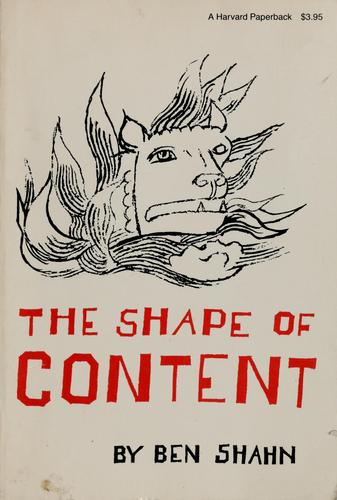
Talk to The Shape of Content like its author wrote you back.
Get the ideas that fit your life — not generic summaries.
- Chat with the book
- Audiobook-style main ideas
- Adapts to your life and goals
- Helps you take action
The Shape of Content, in detail
The Shape of Content collects six lectures Ben Shahn delivered at Harvard in 1956 as part of the Charles Eliot Norton Lectures series. Shahn, one of the most prominent American social realist painters of the twentieth century, uses the talks to argue a single sustained position: that form and content in art are inseparable, and that any attempt to divide them — to treat form as merely decorative, or content as merely illustrative — produces dead work on both sides.
Shahn builds the argument against two opposing errors he saw in mid-century art. The first is pure formalism: the idea that how a painting is made matters and what it depicts does not, an attitude he connects to the academic separation of art from life. The second is pure didacticism: the kind of politically motivated art that uses painting as a poster, where the message overwhelms any genuine visual feeling. Both, he argues, produce work that is dishonest. The form a work takes is itself a kind of content — it embodies an attitude toward experience, not just a technique.
The book's strongest passages deal with the artist's relationship to society. Shahn is suspicious of the idea that serious art must be hermetic and private, addressed only to other artists. He insists that art has a public function without being propaganda. The artist can engage the world — can paint poverty, injustice, ordinary life — and still produce work of the highest order. The criterion is not the subject but the quality of attention brought to it. Shahn draws on his own work documenting the Depression, the Sacco and Vanzetti case, and the labor movement to illustrate how socially committed work can be formally rich.
This is a short book, more essay than treatise, and it reads quickly. Shahn writes as a practitioner, not an academic, and the prose is direct and occasionally caustic. The argument may feel less urgent to readers far from the formalism debates of the 1950s, but the core point — that art is a way of knowing, not just a way of decorating — still cuts against the constant pressure in commercial design to separate the surface from the meaning it carries.
The big ideas
- 1.
Form and content are not separable in any work of genuine art. The way something is made is part of what it says.
- 2.
Pure formalism produces elegant emptiness. Pure didacticism produces eloquent posters. Neither is art in the fullest sense.
- 3.
Shahn argues that art is a form of knowledge — a way of understanding experience that cannot be translated into prose without loss.
