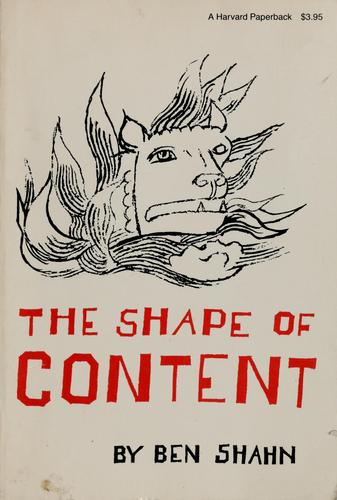
The Shape of Content by Ben Shahn is a 1957 philosophy book about art and meaning, creativity, form and content. Form and content are not separable in any work of genuine art. The way something is made is part of what it says.
Summary
The Shape of Content collects six lectures Ben Shahn delivered at Harvard in 1956 as part of the Charles Eliot Norton Lectures series. Shahn, one of the most prominent American social realist painters of the twentieth century, uses the talks to argue a single sustained position: that form and content in art are inseparable, and that any attempt to divide them — to treat form as merely decorative, or content as merely illustrative — produces dead work on both sides.
Shahn builds the argument against two opposing errors he saw in mid-century art. The first is pure formalism: the idea that how a painting is made matters and what it depicts does not, an attitude he connects to the academic separation of art from life. The second is pure didacticism: the kind of politically motivated art that uses painting as a poster, where the message overwhelms any genuine visual feeling. Both, he argues, produce work that is dishonest. The form a work takes is itself a kind of content — it embodies an attitude toward experience, not just a technique.
The book's strongest passages deal with the artist's relationship to society. Shahn is suspicious of the idea that serious art must be hermetic and private, addressed only to other artists. He insists that art has a public function without being propaganda. The artist can engage the world — can paint poverty, injustice, ordinary life — and still produce work of the highest order. The criterion is not the subject but the quality of attention brought to it. Shahn draws on his own work documenting the Depression, the Sacco and Vanzetti case, and the labor movement to illustrate how socially committed work can be formally rich.
This is a short book, more essay than treatise, and it reads quickly. Shahn writes as a practitioner, not an academic, and the prose is direct and occasionally caustic. The argument may feel less urgent to readers far from the formalism debates of the 1950s, but the core point — that art is a way of knowing, not just a way of decorating — still cuts against the constant pressure in commercial design to separate the surface from the meaning it carries.
Talk to The Shape of Content like its author wrote you back.
Get the ideas that fit your life — not generic summaries.
- Chat with the book
- Audiobook-style main ideas
- Adapts to your life and goals
- Helps you take action
Key takeaways
- 1.
Form and content are not separable in any work of genuine art. The way something is made is part of what it says.
- 2.
Pure formalism produces elegant emptiness. Pure didacticism produces eloquent posters. Neither is art in the fullest sense.
- 3.
Shahn argues that art is a form of knowledge — a way of understanding experience that cannot be translated into prose without loss.
- 4.
Socially committed work is not automatically lesser art. The criterion is the quality of attention, not the prestige of the subject.
- 5.
Every artistic decision — scale, color, line, rhythm — is already a statement of values, whether the artist intends it or not.
- 6.
The audience for serious art should not be limited to other artists. Retreating into hermeticism is its own kind of cowardice.
- 7.
Shahn's lectures are partly a defense of his own practice, which makes them more honest and more useful than purely theoretical accounts of art.
Discussion questions
Use these on your own, with a book club, or as chat starters in Superbook. Book club version, ready to copy or print →
- 1.
Shahn says form and content are inseparable. Can you think of a work of design or art where the form and the content seem to be fighting each other?
- 2.
Where do you currently draw the line between art made to communicate and art made to be itself? Does Shahn's argument shift that line for you?
- 3.
Shahn was suspicious of pure abstraction as evasion. Is that a fair criticism, or does it misunderstand what abstract art is trying to do?
- 4.
He argues that art serves a public function without being propaganda. What distinguishes the two in practice?
- 5.
The book came out of lectures at Harvard in 1957. How much of the debate it enters — formalism versus social realism — still applies to the work you make or consume?
- 6.
Shahn drew on labor movements, poverty, and political injustice as subject matter. What subjects in your own time do you think are being avoided by serious art?
- 7.
He argues that the quality of attention brought to a subject matters more than the prestige of the subject. Do you believe that?
- 8.
The book is partly a defense of his own choices as a painter. Does knowing that change how you read the argument?
- 9.
What does Shahn mean when he says art is a form of knowledge? Can you point to a work that taught you something that couldn't have been taught any other way?
- 10.
If every formal decision is a statement of values, what values does your own work — visual, written, or otherwise — currently express?
- 11.
Shahn writes as a practitioner, not a theorist. Does that make the argument more persuasive or less rigorous to you?
Themes
Frequently asked questions
-
What is The Shape of Content about?
It's Ben Shahn's argument, drawn from lectures at Harvard in 1957, that form and content in art are inseparable — that how a work is made is part of what it means, and that separating them produces either dead formalism or mere propaganda.
-
Is The Shape of Content worth reading for designers?
Yes, especially for anyone working in graphic design or visual communication. Shahn's argument that every formal decision carries meaning is directly applicable to design practice, even though he writes primarily about painting.
-
How long is The Shape of Content?
It's a short book — around 130 pages. It reads in two to three hours. The six lectures are self-contained but build a single sustained argument across them.
-
Who should read The Shape of Content?
Practitioners in any visual field — designers, illustrators, photographers, painters — who want a serious short argument about what art is for and what makes it honest. It rewards rereading more than most books its length.
-
What is Shahn's main criticism of modern art in the book?
He criticizes both pure formalism (which treats subject matter as irrelevant) and pure social didacticism (which sacrifices visual quality for the message). His target is any work that dishonestly separates what a thing looks like from what it means.