History · Book club
The Shock Doctrine: The Rise of Disaster Capitalism book club questions
Here are 12 book club questions for The Shock Doctrine: The Rise of Disaster Capitalism by Naomi Klein, ordered to open easily and end somewhere worth arguing about. Copy them, print them, or bring them up one at a time.
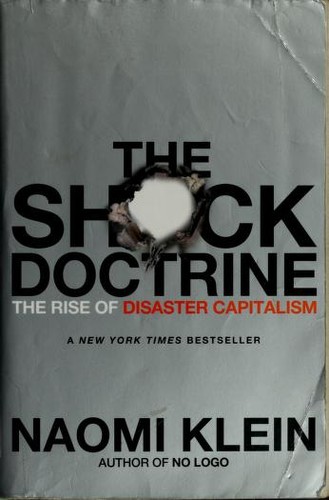
Naomi Klein's The Shock Doctrine, published in 2007, argues that free-market economic policies — privatization, deregulation, cuts to social spending — have historically been implemented not through democratic persuasion but by exploiting crises and disasters that leave populations too disoriented and traumatized to resist.
Naomi Klein · 2007 · 13h 30m
Full summary and key takeaways →The 12 questions
- 1.
Klein argues that radical free-market reforms require shock to be implemented. How much of the historical evidence she presents do you find convincing, and where does the argument feel overstretched?
- 2.
She uses the parallel between psychological shock therapy and economic shock therapy as an organizing metaphor. How far does that parallel illuminate her argument, and where does it break down?
- 3.
Milton Friedman was not personally complicit in the violence of Pinochet's Chile, but his economic framework was. How should we evaluate the relationship between an economic doctrine and the political conditions required to implement it?
- 4.
Which of Klein's case studies — Chile, Russia, Iraq, New Orleans — do you find most and least convincing as evidence for the shock doctrine pattern?
- 5.
Economists who have criticized the book argue that many of her examples involved reforms that reduced economic distortions regardless of how they were implemented. How do you weigh the process against the outcome?
- 6.
Klein claims free markets and democratic freedom are in structural tension. Defenders of free markets claim they are mutually reinforcing. What evidence would settle that debate?
- 7.
The book was published in 2007, before the 2008 financial crisis. How would the crisis and its aftermath fit into Klein's framework? Did the crash produce another round of shock doctrine policies?
- 8.
Klein is explicitly a political advocate, not a neutral analyst. Does her openness about her position make the book more or less reliable than if she claimed objectivity?
- 9.
What does the book imply about how economic policy should be made in normal times, before crises create conditions for shock doctrine application?
- 10.
How does the reconstruction of Iraq as described by Klein compare to what you knew or believed about it before reading?
- 11.
Klein describes the post-Katrina rebuilding of New Orleans as a disaster capitalism case study. Do you find that characterization fair, or does it miss important features of that situation?
- 12.
The book generated intense criticism from economists across the political spectrum. What do you think are the strongest objections to her argument, and how successfully does she answer them?
How to run the discussion
- Pick six to eight, not all of them. An hour of real discussion covers fewer questions than anyone expects, and racing the list is what makes a book club feel like homework.
- Open with what people noticed, not what they concluded. Asking for a verdict first hardens opinions before anyone has heard each other.
- Let the disagreement run. The questions below that split a room are the ones worth the time; the ones everyone answers the same way can be skipped.
- Ask the quiet person a specific question. A direct, narrow question is far easier to answer than an open invitation to contribute.
Themes worth steering toward
If the conversation stalls, these are the threads that usually restart it.
Common questions
What are good book club questions for The Shock Doctrine: The Rise of Disaster Capitalism?
Here are 12 book club questions for The Shock Doctrine: The Rise of Disaster Capitalism by Naomi Klein, ordered to open easily and end somewhere worth arguing about. The strongest openers ask what each reader noticed rather than what they concluded, and the discussion usually turns on capitalism, political economy, disaster exploitation.
How long should a book club discussion of The Shock Doctrine: The Rise of Disaster Capitalism last?
Most groups run 60 to 90 minutes of actual discussion. That is roughly six to eight questions, not all of them, so pick the ones that suit your group rather than working down the list in order.
What are the main themes in The Shock Doctrine: The Rise of Disaster Capitalism?
Capitalism, Political economy, Disaster exploitation, Neoliberalism, Power. Those are the threads most likely to divide a room, which makes them the useful places to steer a discussion that has gone quiet.
Picking the next one? See books like The Shock Doctrine: The Rise of Disaster Capitalism or questions for other book club picks.
