Science · Book club
The Signal and the Noise book club questions
Here are 12 book club questions for The Signal and the Noise by Nate Silver, ordered to open easily and end somewhere worth arguing about. Copy them, print them, or bring them up one at a time.
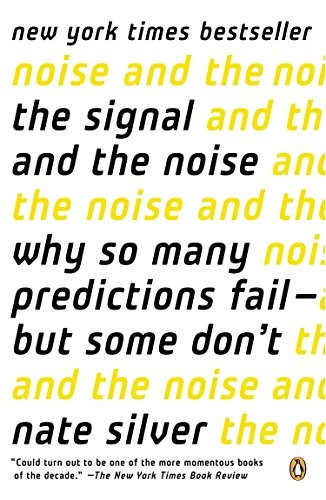
Nate Silver made his reputation predicting baseball statistics and then political elections.
Nate Silver · 2012 · 8h 45m
Full summary and key takeaways →The 12 questions
- 1.
Silver argues calibration is more valuable than conviction. In what domains of your own life do you project more certainty than the evidence warrants?
- 2.
Think about a prediction you made that turned out to be wrong. Was the failure caused by bad reasoning or by genuine unknowability?
- 3.
Silver is harshest on political pundits. Why do you think the incentive structure of public commentary punishes honesty about uncertainty?
- 4.
What prior beliefs do you hold that you rarely update because you don't seek out contradicting evidence?
- 5.
Weather forecasts have become significantly more accurate over decades. What does that tell us about what makes prediction improvable?
- 6.
Silver says poker trains probabilistic thinking better than most intellectual pursuits. Do you find games or competitive activities have changed how you think about odds?
- 7.
What's the difference between a domain where better models will eventually predict well and one where genuine chaos makes prediction impossible in principle?
- 8.
Silver writes about the 2008 financial crisis as a failure to recognize uncertainty. What similar blind spots might exist in fields we trust today?
- 9.
How do you personally handle communicating uncertainty to people who want a definitive answer?
- 10.
Silver distinguishes foxes (who know many small things) from hedgehogs (who know one big thing) as forecasters. Which are you?
- 11.
What's a domain where you've noticed experts perform worse than simple rules or base rates?
- 12.
If most predictions are noise dressed up as signal, what habits of consumption should change in how you read news or analysis?
How to run the discussion
- Pick six to eight, not all of them. An hour of real discussion covers fewer questions than anyone expects, and racing the list is what makes a book club feel like homework.
- Open with what people noticed, not what they concluded. Asking for a verdict first hardens opinions before anyone has heard each other.
- Let the disagreement run. The questions below that split a room are the ones worth the time; the ones everyone answers the same way can be skipped.
- Ask the quiet person a specific question. A direct, narrow question is far easier to answer than an open invitation to contribute.
Themes worth steering toward
If the conversation stalls, these are the threads that usually restart it.
Common questions
What are good book club questions for The Signal and the Noise?
Here are 12 book club questions for The Signal and the Noise by Nate Silver, ordered to open easily and end somewhere worth arguing about. The strongest openers ask what each reader noticed rather than what they concluded, and the discussion usually turns on prediction, probability, data analysis.
How long should a book club discussion of The Signal and the Noise last?
Most groups run 60 to 90 minutes of actual discussion. That is roughly six to eight questions, not all of them, so pick the ones that suit your group rather than working down the list in order.
What are the main themes in The Signal and the Noise?
Prediction, Probability, Data analysis, Uncertainty, Decision-making. Those are the threads most likely to divide a room, which makes them the useful places to steer a discussion that has gone quiet.
Picking the next one? See books like The Signal and the Noise or questions for other book club picks.
