Science · Book club
The Singularity Is Near book club questions
Here are 12 book club questions for The Singularity Is Near by Ray Kurzweil, ordered to open easily and end somewhere worth arguing about. Copy them, print them, or bring them up one at a time.
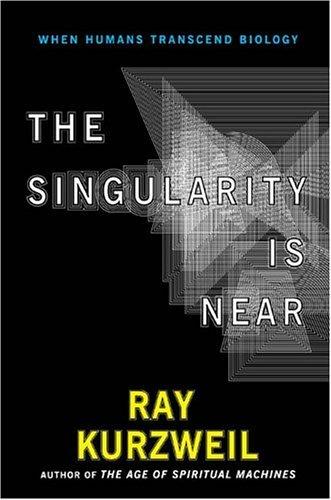
The Singularity Is Near is Ray Kurzweil's forecast that the exponential growth of information technology — computing power, storage, bandwidth, and the reverse-engineering of the human brain — will produce a technological singularity around 2045: a point at which artificial intelligence surpasses human intelligence in all relevant domains, beyond which we cannot reliably predict what happens.
Ray Kurzweil · 2005 · 14h 45m
Full summary and key takeaways →The 12 questions
- 1.
Kurzweil extrapolates from hardware trends to conclude that human-level AI will arrive around 2045. Is extrapolation from past trends a sound method for predicting fundamental technological discontinuities?
- 2.
The law of accelerating returns has correctly predicted hardware trends. Does that track record support applying it to much harder problems like general intelligence?
- 3.
He argues that the brain is a pattern-recognition hierarchy that can be fully reverse-engineered. Does that seem like a complete account of what the brain does?
- 4.
Kurzweil is optimistic about the singularity; other thinkers — Bostrom, Musk, Hawking — are alarmed. What accounts for the difference in outlook?
- 5.
What would it mean for intelligence to 'merge' with AI? Is that the same as uploading your mind?
- 6.
The book was published in 2005. How has the subsequent development of AI — deep learning, large language models, GPT-4 — affected its specific predictions?
- 7.
Kurzweil responds to many critics in the book. Does reading those responses change your assessment of the specific objections?
- 8.
If the singularity is coming regardless of what any individual or government does, what are the implications for how we should invest in AI safety research?
- 9.
Kurzweil expects to merge with AI and potentially live indefinitely. How do you respond to that ambition — is it inspiring, disturbing, or simply implausible?
- 10.
The book is very long and covers economics, biology, physics, and philosophy, not just AI. Does that breadth strengthen or dilute the central argument?
- 11.
Moore's Law has slowed in recent years. Does that slow the singularity, or does Kurzweil's law of accelerating returns allow for hardware paradigm shifts that restart the trend?
- 12.
What specific prediction in the book do you now know turned out correct or incorrect?
How to run the discussion
- Pick six to eight, not all of them. An hour of real discussion covers fewer questions than anyone expects, and racing the list is what makes a book club feel like homework.
- Open with what people noticed, not what they concluded. Asking for a verdict first hardens opinions before anyone has heard each other.
- Let the disagreement run. The questions below that split a room are the ones worth the time; the ones everyone answers the same way can be skipped.
- Ask the quiet person a specific question. A direct, narrow question is far easier to answer than an open invitation to contribute.
Themes worth steering toward
If the conversation stalls, these are the threads that usually restart it.
Common questions
What are good book club questions for The Singularity Is Near?
Here are 12 book club questions for The Singularity Is Near by Ray Kurzweil, ordered to open easily and end somewhere worth arguing about. The strongest openers ask what each reader noticed rather than what they concluded, and the discussion usually turns on artificial intelligence, technological progress, transhumanism.
How long should a book club discussion of The Singularity Is Near last?
Most groups run 60 to 90 minutes of actual discussion. That is roughly six to eight questions, not all of them, so pick the ones that suit your group rather than working down the list in order.
What are the main themes in The Singularity Is Near?
Artificial intelligence, Technological progress, Transhumanism, Future, Exponential growth. Those are the threads most likely to divide a room, which makes them the useful places to steer a discussion that has gone quiet.
Picking the next one? See books like The Singularity Is Near or questions for other book club picks.
