Economics · Book club
The Sovereign Individual book club questions
Here are 12 book club questions for The Sovereign Individual by James Dale Davidson & William Rees-Mogg, ordered to open easily and end somewhere worth arguing about. Copy them, print them, or bring them up one at a time.
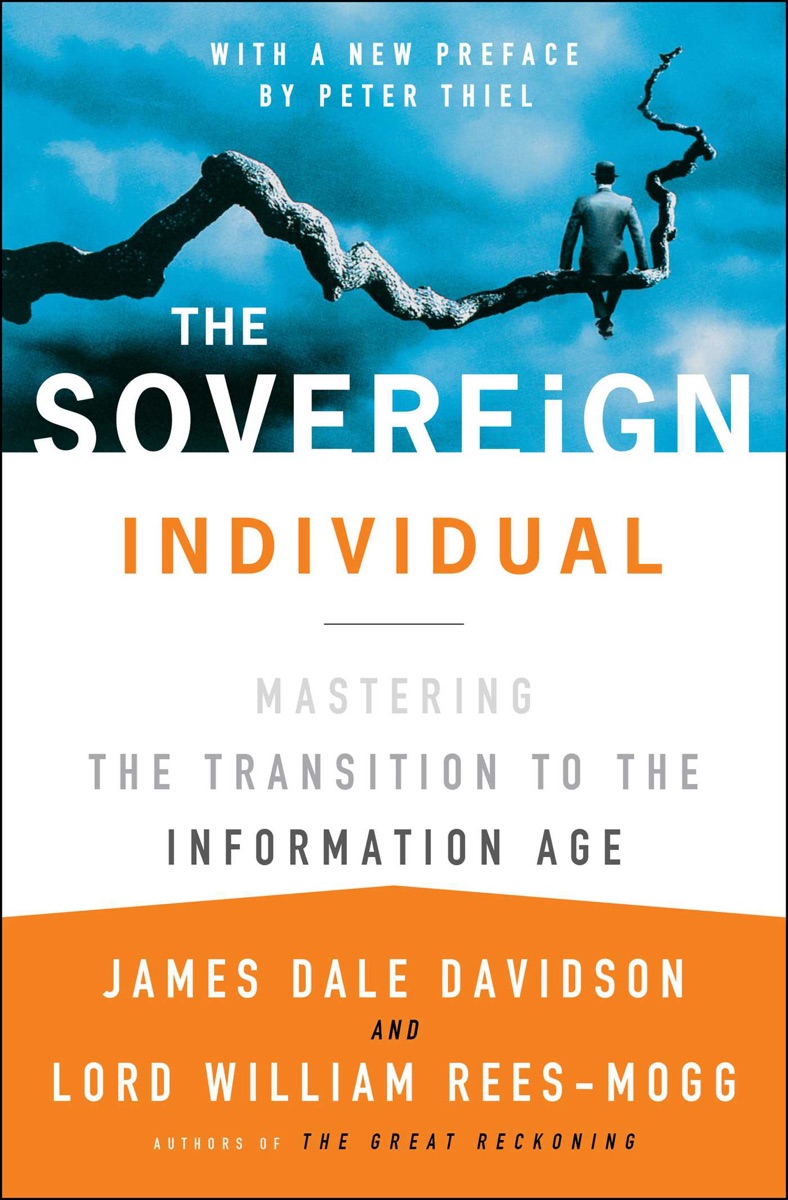
The Sovereign Individual, published in 1997, is a sweeping argument that the rise of digital technology and cryptographic money will break the monopoly nation-states have held over taxation, violence, and the terms of economic life.
James Dale Davidson & William Rees-Mogg · 1997 · 8h 0m
Full summary and key takeaways →The 12 questions
- 1.
Davidson and Rees-Mogg argue that every political institution is contingent on physical and technological realities. What current institutions seem most vulnerable to this kind of disruption?
- 2.
Their prediction of cryptographic money arrived roughly on schedule. Which of their other forecasts from 1997 look accurate from where you stand today?
- 3.
The book describes the coming backlash from those who lose under this transition. Does the populist politics of the past decade look more like the backlash they predicted, or something different?
- 4.
Is the 'sovereign individual' a vision of freedom or of responsibility offloaded onto people who lack the means to exercise it? Who gets left out?
- 5.
If nation-states lose their ability to tax the most mobile wealth, what institutions — if any — could coordinate the provision of public goods like healthcare, infrastructure, and environmental protection?
- 6.
The authors treat the decline of the nation-state as historically inevitable. Does historical inevitability change how you think about whether something is desirable?
- 7.
Their framework treats democracy as a byproduct of industrial economics rather than a fundamental value. Do you agree? What does democracy owe to conditions, and what does it owe to principle?
- 8.
The book was written in 1997. How does reading it now — knowing what cryptocurrencies and the internet actually became — change how you weight its remaining predictions?
- 9.
Davidson and Rees-Mogg write from a perspective that is broadly favorable to the sovereign individual. Who would write the version of this book that takes the opposite moral stance, and what would it argue?
- 10.
The authors claim skilled individuals will be able to opt out of coercive jurisdictions. In practice, how many people have that option today, and what would it take to exercise it?
- 11.
If the violence monopoly of the nation-state erodes, what replaces it? The book gestures at private security and voluntary associations. Are those adequate substitutes?
- 12.
The book is sometimes called a founding text of crypto-libertarianism. Is that a fair characterization, or does it flatten the argument?
How to run the discussion
- Pick six to eight, not all of them. An hour of real discussion covers fewer questions than anyone expects, and racing the list is what makes a book club feel like homework.
- Open with what people noticed, not what they concluded. Asking for a verdict first hardens opinions before anyone has heard each other.
- Let the disagreement run. The questions below that split a room are the ones worth the time; the ones everyone answers the same way can be skipped.
- Ask the quiet person a specific question. A direct, narrow question is far easier to answer than an open invitation to contribute.
Themes worth steering toward
If the conversation stalls, these are the threads that usually restart it.
Common questions
What are good book club questions for The Sovereign Individual?
Here are 12 book club questions for The Sovereign Individual by James Dale Davidson & William Rees-Mogg, ordered to open easily and end somewhere worth arguing about. The strongest openers ask what each reader noticed rather than what they concluded, and the discussion usually turns on technology and power, nation-states, cryptography.
How long should a book club discussion of The Sovereign Individual last?
Most groups run 60 to 90 minutes of actual discussion. That is roughly six to eight questions, not all of them, so pick the ones that suit your group rather than working down the list in order.
What are the main themes in The Sovereign Individual?
Technology and power, Nation-states, Cryptography, Wealth, Future of governance. Those are the threads most likely to divide a room, which makes them the useful places to steer a discussion that has gone quiet.
Picking the next one? See books like The Sovereign Individual or questions for other book club picks.
