Literary fiction · Book club
The Sparrow book club questions
Here are 12 book club questions for The Sparrow by Mary Doria Russell, ordered to open easily and end somewhere worth arguing about. Copy them, print them, or bring them up one at a time.
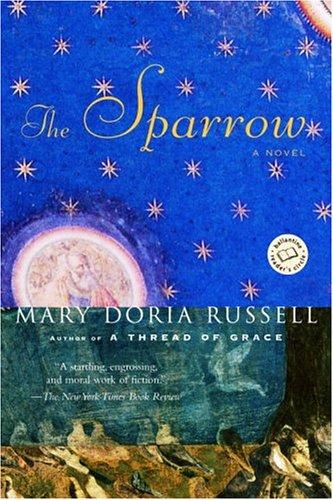
The Sparrow opens with its ending: Father Emilio Sandoz, a Jesuit priest and linguist, has returned to Earth as the sole survivor of humanity's first contact mission to the planet Rakhat, broken in body and will in ways the novel withholds until the final chapters.
Mary Doria Russell · 1996 · 9h 40m
Full summary and key takeaways →The 12 questions
- 1.
The Jesuits believe they are guided to Rakhat by divine providence. By the end, has the novel argued against that reading, or has it left the question genuinely open?
- 2.
Emilio Sandoz is presented as the most spiritually gifted and the most utterly broken. Is his suffering random, or does the novel suggest it has a structure, even if not a reason?
- 3.
Russell has said the book came from thinking about what would happen to a Jesuit mission if it made first contact — the Jesuits were historically the intellectual missionaries. How does that framing change what kind of novel this is?
- 4.
The mission is organized with unusual competence and care. Does the novel's insistence on their competence make the disaster more or less tolerable to read?
- 5.
The relationship between the two Rakhat species turns out to be one of predation and exploitation. Did you read this as allegory for anything specific, or did you hold it more loosely?
- 6.
The pre-mission section is genuinely funny and warm. Did the comedy feel like it was working against the later tragedy, or did it make the grief more effective?
- 7.
Anne and George Edwards are the emotional center of the ensemble. Does their relationship model something about faith and partnership that the novel wants to affirm?
- 8.
Father Sandoz's return to the Church is the structural frame. How did you read the Vatican's interrogation scenes — as fair investigation, or institutional self-protection?
- 9.
The novel ends without theological resolution. Is that a failure of nerve, or the only honest thing it could do?
- 10.
Compare The Sparrow to other first-contact fiction you know — Solaris, Contact, Arrival. What does this book do that those don't?
- 11.
The harm done to Sandoz is extreme and deliberate. Some readers find it gratuitous. What do you think it is doing narratively, and does it earn its place?
- 12.
If you have a religious background, did the book land differently because of it? If you don't, did the characters' faith feel legible to you?
How to run the discussion
- Pick six to eight, not all of them. An hour of real discussion covers fewer questions than anyone expects, and racing the list is what makes a book club feel like homework.
- Open with what people noticed, not what they concluded. Asking for a verdict first hardens opinions before anyone has heard each other.
- Let the disagreement run. The questions below that split a room are the ones worth the time; the ones everyone answers the same way can be skipped.
- Ask the quiet person a specific question. A direct, narrow question is far easier to answer than an open invitation to contribute.
Themes worth steering toward
If the conversation stalls, these are the threads that usually restart it.
Common questions
What are good book club questions for The Sparrow?
Here are 12 book club questions for The Sparrow by Mary Doria Russell, ordered to open easily and end somewhere worth arguing about. The strongest openers ask what each reader noticed rather than what they concluded, and the discussion usually turns on faith and doubt, cultural encounter, trauma and survival.
How long should a book club discussion of The Sparrow last?
Most groups run 60 to 90 minutes of actual discussion. That is roughly six to eight questions, not all of them, so pick the ones that suit your group rather than working down the list in order.
What are the main themes in The Sparrow?
Faith and doubt, Cultural encounter, Trauma and survival, Good intentions and harm, The nature of God. Those are the threads most likely to divide a room, which makes them the useful places to steer a discussion that has gone quiet.
Picking the next one? See books like The Sparrow or questions for other book club picks.
