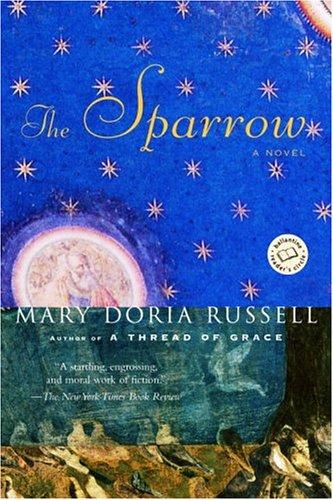
The Sparrow by Mary Doria Russell is a 1996 literary fiction book about faith and doubt, cultural encounter, trauma and survival. The novel's central wound: good intentions carried out with competence and love can still cause irreversible harm. There is no moral exemption from consequence.
Summary
The Sparrow opens with its ending: Father Emilio Sandoz, a Jesuit priest and linguist, has returned to Earth as the sole survivor of humanity's first contact mission to the planet Rakhat, broken in body and will in ways the novel withholds until the final chapters. The book then tells two interleaved stories — the gradual unfolding of how the mission went catastrophically wrong, and the warmth and intelligence of the group of scientists and priests who set out with the purest motives imaginable.
Russell's central argument is essentially theological: that good intentions, competence, and genuine love are not enough to protect you — or others — from disaster. The Jesuits are drawn to Rakhat by music broadcast from the planet, and their mission is organized with care, courage, and deep faith. The horror that results is not the product of negligence or arrogance. That's the point. The novel explores the problem of suffering not as an abstraction but as a plot mechanism: why does God allow the worst to happen to the most devoted?
What makes the book distinctive is its willingness to be warmly human before it destroys you. Russell writes the pre-mission section with genuine comedy and tenderness — the ensemble of characters who eventually form the crew are charming, funny, and carefully individuated. The reader invests in them precisely because the frame has already told us they will not survive. This structural decision — grief before loss — is unusual and works almost devastatingly well.
The Sparrow is not easy reading, and its final act contains content that requires a content warning. Readers who need fiction to protect its protagonists, or who cannot engage with unresolved theodicy, will be miserable. For everyone else — particularly those who wrestle with religious faith, or who are interested in first-contact fiction that takes anthropology seriously — it remains one of the most emotionally ambitious novels of the 1990s.
Talk to The Sparrow like its author wrote you back.
Get the ideas that fit your life — not generic summaries.
- Chat with the book
- Audiobook-style main ideas
- Adapts to your life and goals
- Helps you take action
Key takeaways
- 1.
The novel's central wound: good intentions carried out with competence and love can still cause irreversible harm. There is no moral exemption from consequence.
- 2.
Russell structures the narrative so readers grieve the characters before witnessing their destruction — the warmth of the ensemble is a deliberate trap.
- 3.
The Jesuits' faith is presented as genuine and intellectually serious, not as a target for ridicule. The novel's critique is from inside belief, not outside it.
- 4.
Rakhat's two intelligent species model a relationship of exploitation that mirrors colonialism without being allegory — Russell is too careful a writer for one-to-one correspondence.
- 5.
Emilio Sandoz's suffering is framed as the purest form of the theodicy question: if God directs, what does it mean when the faithful are utterly destroyed?
- 6.
The novel argues that cultural encounter almost always involves asymmetric harm, and that the asymmetry isn't usually the product of malice.
- 7.
Russell trained as a paleoanthropologist, and the anthropological rigor with which she constructs Rakhat's cultures — their economics, hierarchies, food systems — gives the contact scenario unusual weight.
- 8.
The ending refuses consolation. Emilio's final state is not redemption; it is survival, which may be the most honest thing Russell could have written.
Discussion questions
Use these on your own, with a book club, or as chat starters in Superbook. Book club version, ready to copy or print →
- 1.
The Jesuits believe they are guided to Rakhat by divine providence. By the end, has the novel argued against that reading, or has it left the question genuinely open?
- 2.
Emilio Sandoz is presented as the most spiritually gifted and the most utterly broken. Is his suffering random, or does the novel suggest it has a structure, even if not a reason?
- 3.
Russell has said the book came from thinking about what would happen to a Jesuit mission if it made first contact — the Jesuits were historically the intellectual missionaries. How does that framing change what kind of novel this is?
- 4.
The mission is organized with unusual competence and care. Does the novel's insistence on their competence make the disaster more or less tolerable to read?
- 5.
The relationship between the two Rakhat species turns out to be one of predation and exploitation. Did you read this as allegory for anything specific, or did you hold it more loosely?
- 6.
The pre-mission section is genuinely funny and warm. Did the comedy feel like it was working against the later tragedy, or did it make the grief more effective?
- 7.
Anne and George Edwards are the emotional center of the ensemble. Does their relationship model something about faith and partnership that the novel wants to affirm?
- 8.
Father Sandoz's return to the Church is the structural frame. How did you read the Vatican's interrogation scenes — as fair investigation, or institutional self-protection?
- 9.
The novel ends without theological resolution. Is that a failure of nerve, or the only honest thing it could do?
- 10.
Compare The Sparrow to other first-contact fiction you know — Solaris, Contact, Arrival. What does this book do that those don't?
- 11.
The harm done to Sandoz is extreme and deliberate. Some readers find it gratuitous. What do you think it is doing narratively, and does it earn its place?
- 12.
If you have a religious background, did the book land differently because of it? If you don't, did the characters' faith feel legible to you?
Themes
Frequently asked questions
-
Is The Sparrow worth reading?
Yes, though it demands full emotional commitment. If you want a first-contact novel that takes faith, anthropology, and the problem of suffering seriously rather than using them as backdrop, this is one of the best available. The final act is genuinely harrowing, but the journey to it is one of the warmest ensembles in contemporary fiction.
-
How dark does The Sparrow get?
Very. The final reveal involves sexual violence and extreme trauma. Russell does not sensationalize it, but she does not look away. If you need to know specifics before reading, look up content warnings. The novel earns the darkness structurally, but you should go in knowing it is there.
-
Is The Sparrow science fiction?
Technically yes — it involves interstellar travel and alien life. But the experience of reading it is much closer to literary fiction than to genre SF. Russell is not interested in technology or adventure. The alien planet is a setting for a sustained meditation on faith, cultural encounter, and the nature of God.
-
Do I need to read the sequel, Children of God?
The Sparrow is complete on its own, and the ending is not a cliffhanger. Children of God continues Emilio's story and answers some questions the first book leaves open, but it's less widely loved. Read The Sparrow first and decide.
-
Who shouldn't read The Sparrow?
Readers who need their protagonists protected, who require narrative resolution of theological questions, or who cannot engage with depictions of extreme suffering. The novel ends without catharsis and without God answering. That's the point. Not everyone finds that tolerable.