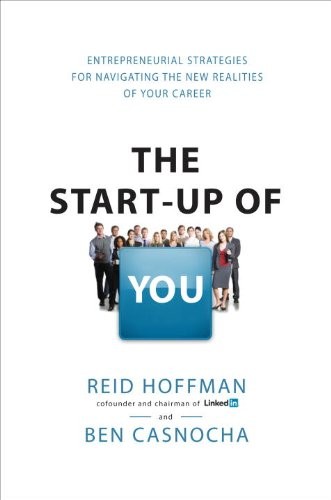
The Startup of You by Reid Hoffman and Ben Casnocha is a 2012 business book about career strategy, entrepreneurship, networking. In a rapidly changing economy, every professional needs to manage their career like a startup: with a strategy, a competitive advantage, and the willingness to pivot when circumstances change.
Summary
The Startup of You is Reid Hoffman and Ben Casnocha's argument that in a world of permanent change, every professional needs to think about their career the way entrepreneurs think about their companies — with a deliberate strategy, a specific competitive advantage, and a willingness to pivot when circumstances change. Hoffman is the co-founder of LinkedIn and has observed how the best career builders operate. Casnocha is an entrepreneur and writer. Together they argue that the era of lifetime employment and linear career progression is over, and that the professionals who thrive will treat themselves as a startup of one.
The book's core framework rests on three elements. Competitive advantage is the combination of your assets (skills, knowledge, networks), your aspirations and values, and the market realities of which assets are valuable to employers or customers right now. The intersection of all three defines your competitive position. Most people develop assets without asking whether those assets are genuinely rare and valuable in their market, or focus on aspirations without understanding what the market will pay for.
The second element is the ABZ planning framework: Plan A is your current direction, Plan B is the adjacent pivot you'd make if Plan A stops working, and Plan Z is the safe fallback — the reliable lifeboat that lets you take intelligent risks without catastrophic downside. Hoffman argues that most people either don't have a Plan B thought out in advance or mistake Plan Z for a plan rather than a safety net.
The third element is networks. Hoffman is one of the world's experts on professional networks — he built LinkedIn to study and facilitate them — and his argument here is that weak ties (acquaintances and professional connections) produce most of the valuable opportunities in a career, while most people overinvest in deep relationships with a small circle. The book also distinguishes between relationships of convenience, trust, and deep mutual investment.
Some sections, particularly the networking advice, are more nuanced in subsequent books by Hoffman. The Startup of You is most valuable as a framing device — the career-as-startup mindset — rather than as a detailed operational guide.
Talk to The Startup of You like its author wrote you back.
Get the ideas that fit your life — not generic summaries.
- Chat with the book
- Audiobook-style main ideas
- Adapts to your life and goals
- Helps you take action
Key takeaways
- 1.
In a rapidly changing economy, every professional needs to manage their career like a startup: with a strategy, a competitive advantage, and the willingness to pivot when circumstances change.
- 2.
Competitive advantage is the intersection of three factors: your assets (skills, experience, network), your aspirations and values, and the market realities of what is currently valued.
- 3.
ABZ planning: Plan A is your current direction, Plan B is the adjacent pivot, Plan Z is the safe fallback. Having all three prevents career crises when Plan A stops working.
- 4.
Your network is your net worth in the career economy — not because connections substitute for skill, but because most valuable opportunities move through networks, not job boards.
- 5.
Weak ties produce most of the valuable career opportunities. Acquaintances know different things and move in different circles than your close friends, which is precisely what makes them valuable.
- 6.
Invest in relationships before you need them. Calling someone for a favor you've never done anything for rarely works. Network maintenance is ongoing, not transactional.
- 7.
Taking intelligent risks requires a safety net. Professional risk-taking is not bravery — it is calibrating the size of the bet to the strength of your fallback position.
- 8.
Breakout opportunities usually come from network connections, not direct applications. The people who make introductions for you are often as important as the opportunity itself.
Discussion questions
Use these on your own, with a book club, or as chat starters in Superbook. Book club version, ready to copy or print →
- 1.
Hoffman argues that your competitive advantage is the intersection of assets, aspirations, and market realities. Which of these three is currently the weakest link in your own career positioning?
- 2.
What is your Plan B? If your current career direction stopped working tomorrow, what is the adjacent pivot you would make, and how prepared are you to execute it?
- 3.
What is the difference between a weak tie and a superficial relationship? Hoffman says weak ties produce the most career opportunities — how do you develop weak ties intentionally without it feeling transactional?
- 4.
The Startup of You assumes the career market is a market — that your skills and experience have supply and demand characteristics. Where does that analogy work well, and where does it break down?
- 5.
Most people have strong assets in some areas and weak ones in others. Hoffman advocates for building on strengths rather than eliminating weaknesses. Do you agree with that career strategy?
- 6.
What does 'taking intelligent risks' look like compared to 'taking big risks'? What is the role of the fallback in making a risk intelligent?
- 7.
LinkedIn has changed how professional networks operate since this book was published. What has changed in the decade since, and what remains the same about network dynamics?
- 8.
Hoffman and Casnocha describe people who invest in relationships transactionally — only reaching out when they need something — versus those who invest continuously. Have you seen both types? What was the difference in their careers?
- 9.
The book was written in 2012, before the gig economy, remote work normalization, and AI disruption of professional roles. How does the Startup of You framework apply differently today?
- 10.
If you were to audit your own career like an investor auditing a startup, what would you say about its competitive position, its growth trajectory, and its key risks?
- 11.
What is the relationship between personal brand and the competitive advantage Hoffman describes? Are they the same thing or different aspects of career strategy?
Themes
Frequently asked questions
-
Is The Startup of You still relevant?
Yes. The core framework — competitive advantage, ABZ planning, network investment — is timeless. Some specific networking tactics are dated, and the LinkedIn-centric examples feel dated. The mindset shift, treating your career as a startup, remains useful.
-
What is the ABZ planning framework?
Plan A is your current career direction. Plan B is the adjacent pivot you'd make if Plan A doesn't work. Plan Z is the safe fallback — the reliable income source or living situation that lets you take intelligent risks without catastrophic downside. Having all three makes you able to act rather than freeze when circumstances change.
-
Does The Startup of You apply to people who are not entrepreneurs?
Yes. The startup metaphor is used to illustrate strategic thinking about career positioning, not to suggest everyone should start companies. The framework applies to employees, freelancers, and entrepreneurs alike.
-
How do you build a valuable network without it feeling transactional?
Hoffman's advice is to invest in relationships continuously rather than only when you need something. This means making introductions, sharing useful information, and helping people before any specific need arises. The relationship becomes its own reward rather than a means to an end.
-
What is the main difference between The Startup of You and career books focused on resumes and job searching?
Traditional career books focus on getting jobs. The Startup of You focuses on building career capital over time — the skills, networks, and strategic positioning that make you valuable in the long run. The two are complementary but the Startup of You is about strategy, not tactics.
Similar books

Blitzscaling: The Lightning-Fast Path to Building Massively Valuable Companies
Reid Hoffman and Chris Yeh
Zero to One: Notes on Startups, or How to Build the Future
Peter Thiel

The Hard Thing About Hard Things
Ben Horowitz
Competitive Strategy
Michael E. Porter
