Business · Book club
The Startup of You book club questions
Here are 11 book club questions for The Startup of You by Reid Hoffman and Ben Casnocha, ordered to open easily and end somewhere worth arguing about. Copy them, print them, or bring them up one at a time.
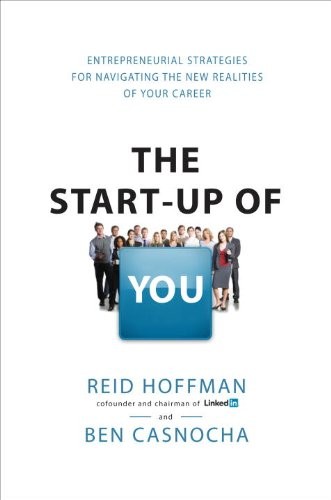
The Startup of You is Reid Hoffman and Ben Casnocha's argument that in a world of permanent change, every professional needs to think about their career the way entrepreneurs think about their companies — with a deliberate strategy, a specific competitive advantage, and a willingness to pivot when circumstances change.
Reid Hoffman and Ben Casnocha · 2012 · 4h 40m
Full summary and key takeaways →The 11 questions
- 1.
Hoffman argues that your competitive advantage is the intersection of assets, aspirations, and market realities. Which of these three is currently the weakest link in your own career positioning?
- 2.
What is your Plan B? If your current career direction stopped working tomorrow, what is the adjacent pivot you would make, and how prepared are you to execute it?
- 3.
What is the difference between a weak tie and a superficial relationship? Hoffman says weak ties produce the most career opportunities — how do you develop weak ties intentionally without it feeling transactional?
- 4.
The Startup of You assumes the career market is a market — that your skills and experience have supply and demand characteristics. Where does that analogy work well, and where does it break down?
- 5.
Most people have strong assets in some areas and weak ones in others. Hoffman advocates for building on strengths rather than eliminating weaknesses. Do you agree with that career strategy?
- 6.
What does 'taking intelligent risks' look like compared to 'taking big risks'? What is the role of the fallback in making a risk intelligent?
- 7.
LinkedIn has changed how professional networks operate since this book was published. What has changed in the decade since, and what remains the same about network dynamics?
- 8.
Hoffman and Casnocha describe people who invest in relationships transactionally — only reaching out when they need something — versus those who invest continuously. Have you seen both types? What was the difference in their careers?
- 9.
The book was written in 2012, before the gig economy, remote work normalization, and AI disruption of professional roles. How does the Startup of You framework apply differently today?
- 10.
If you were to audit your own career like an investor auditing a startup, what would you say about its competitive position, its growth trajectory, and its key risks?
- 11.
What is the relationship between personal brand and the competitive advantage Hoffman describes? Are they the same thing or different aspects of career strategy?
How to run the discussion
- Pick six to eight, not all of them. An hour of real discussion covers fewer questions than anyone expects, and racing the list is what makes a book club feel like homework.
- Open with what people noticed, not what they concluded. Asking for a verdict first hardens opinions before anyone has heard each other.
- Let the disagreement run. The questions below that split a room are the ones worth the time; the ones everyone answers the same way can be skipped.
- Ask the quiet person a specific question. A direct, narrow question is far easier to answer than an open invitation to contribute.
Themes worth steering toward
If the conversation stalls, these are the threads that usually restart it.
Common questions
What are good book club questions for The Startup of You?
Here are 11 book club questions for The Startup of You by Reid Hoffman and Ben Casnocha, ordered to open easily and end somewhere worth arguing about. The strongest openers ask what each reader noticed rather than what they concluded, and the discussion usually turns on career strategy, entrepreneurship, networking.
How long should a book club discussion of The Startup of You last?
Most groups run 60 to 90 minutes of actual discussion. That is roughly six to eight questions, not all of them, so pick the ones that suit your group rather than working down the list in order.
What are the main themes in The Startup of You?
Career strategy, Entrepreneurship, Networking, Competitive advantage, Adaptability. Those are the threads most likely to divide a room, which makes them the useful places to steer a discussion that has gone quiet.
Picking the next one? See books like The Startup of You or questions for other book club picks.
