The Subtle Art of Not Giving a F*ck by Mark Manson is a 2016 self-help book about values, responsibility, acceptance. Caring about everything is not the same as caring about the right things. The goal is to be more deliberate about what you give your attention and energy to, not to stop caring altogether.
Summary
Mark Manson's argument is that the relentless pursuit of positivity is itself a source of misery. The self-help industry, he contends, has it backwards: telling people to feel good about everything, to stay optimistic, to believe they are special, produces fragility rather than strength. Manson's alternative is to be more selective about what you care about — to give fewer, better-placed f*cks — and to accept that a meaningful life is defined not by avoiding problems but by choosing which problems are worth having.
The book's central framework is values. Most of our unhappiness, Manson argues, comes from holding bad values — things like fame, status, or always being right — that are outside our control or measured against other people. Good values are process-based and internally controlled: honesty, creativity, contributing to others. When you organize your life around good values, failure becomes data rather than disaster. Manson draws on his own early struggles, internet writing career, and travels to illustrate these points in a voice that is deliberately unpolished and occasionally crude.
Several chapters tackle specific psychological traps. The "do something" principle argues that action comes before motivation, not after — you move first, and feeling follows. The chapter on failure pushes back on the idea that pain should be avoided; instead, Manson asks what kind of pain you are willing to sustain, because that question more honestly reveals what you actually value. There is also a serious treatment of death, leaning on Ernest Becker's work to argue that awareness of mortality clarifies what actually matters and strips away the pretense around what doesn't.
The book's limitations are real. The contrarian tone can tip into provocation for its own sake, and some of the philosophical points are stated more confidently than the evidence warrants. Readers who want rigorous citations or careful distinctions will be disappointed. What Manson delivers instead is a readable, often funny reframe: that accepting constraints, uncertainty, and responsibility for your own choices is not defeat but the precondition for living well. The ideas are not new — the Stoics covered most of this ground — but Manson packages them for an audience that would never pick up Marcus Aurelius.
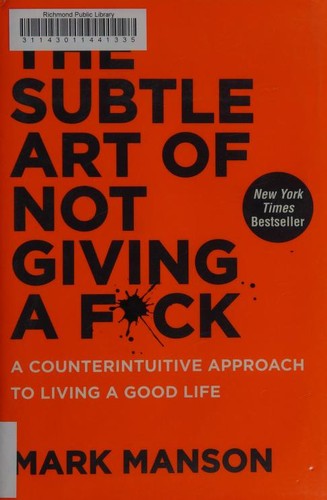
Talk to The Subtle Art of Not Giving a F*ck like its author wrote you back.
Get the ideas that fit your life — not generic summaries.
- Chat with the book
- Audiobook-style main ideas
- Adapts to your life and goals
- Helps you take action
Key takeaways
- 1.
Caring about everything is not the same as caring about the right things. The goal is to be more deliberate about what you give your attention and energy to, not to stop caring altogether.
- 2.
Your values determine your problems. Bad values — chasing status, needing constant validation, always being right — guarantee suffering because they are never fully satisfied.
- 3.
You are not special. Manson argues that the cult of exceptionalism creates fragile people who collapse when reality fails to confirm their self-image.
- 4.
The 'do something' principle: action comes before motivation. You don't wait until you feel ready. You do something, however small, and the feeling follows.
- 5.
Responsibility is not the same as blame. Even when bad things happen to you that aren't your fault, how you respond to them remains your responsibility.
- 6.
Failure is part of any meaningful pursuit. The better question is not how to avoid failure but which failures you are willing to accept in service of what you value.
- 7.
Certainty is the enemy of growth. Manson argues that being committed to being right prevents you from updating your beliefs when reality conflicts with them.
- 8.
Confronting your own mortality clarifies priorities. Manson draws on Becker's idea that most human behavior is a defense against awareness of death, and that accepting it loosens that grip.
Discussion questions
Use these on your own, with a book club, or as chat starters in Superbook. Book club version, ready to copy or print →
- 1.
Manson says we choose our problems by choosing our values. What problems are you currently living with, and what values do they point to?
- 2.
He distinguishes good values (process-based, internally controlled) from bad ones (outcome-based, dependent on others). Where in your own life do you hold a bad value that's causing predictable frustration?
- 3.
The book argues that the self-help industry makes people worse by constantly telling them to feel better. Do you think that's fair? Have you encountered self-help that made you more anxious rather than less?
- 4.
Manson claims that being ordinary is not a failure — that the pressure to be exceptional is itself a source of suffering. How much does the need to feel special shape your decisions?
- 5.
The 'do something' principle says you act first and motivation follows. Think of a time when you waited to feel ready before starting. What happened?
- 6.
He argues that you are always choosing what to give your attention to, even when it feels like the choice is being made for you. Where in your life do you feel like a passive recipient of your own circumstances?
- 7.
What would it mean in practice to take full responsibility for your emotional reactions — not blaming yourself, but also not outsourcing your response to what other people did?
- 8.
Manson has a chapter on the value of saying no. What are you currently tolerating — a commitment, a relationship, a standard — that you have quietly decided isn't worth the cost?
- 9.
He uses his own failed music career and early adulthood as examples. Does the personal, confessional style make the ideas more convincing for you, or does it make the book feel less rigorous?
- 10.
The chapter on death argues that confronting mortality clarifies what matters. Has a personal experience with loss or near-loss changed what you give your attention to?
- 11.
Manson argues that choosing a problem you're willing to struggle with is more important than pursuing happiness directly. What struggle are you currently choosing, and is it one you'd choose again?
- 12.
He credits the Stoics without much attribution. How much of this material felt genuinely new to you versus recognizable under a different style?
Themes
Frequently asked questions
-
Is The Subtle Art of Not Giving a F*ck worth reading?
Yes, with caveats. If you are burned out on conventional positive-thinking self-help, Manson's contrarian framing is a useful corrective. The core ideas — choose your values carefully, accept responsibility for your responses, stop optimizing for feeling good — are genuinely useful. The book is light on rigor and heavy on personal anecdote, so readers wanting citations or careful argument will find it thin.
-
What is The Subtle Art of Not Giving a F*ck actually about?
It's a values-based self-help book arguing that suffering comes not from bad circumstances but from caring about the wrong things. Manson's prescription is to identify what you actually value, accept that a meaningful life involves problems rather than their absence, and take responsibility for your responses to what happens to you.
-
How long does it take to read The Subtle Art of Not Giving a F*ck?
Around four to four and a half hours at average reading pace. The chapters are short, the tone is informal, and the 224 pages move quickly. Most readers finish it in a few evenings.
-
Who should read this book?
People who feel ground down by the pressure to be positive, exceptional, or constantly improving. It's also useful for anyone stuck in a pattern of blaming circumstances for their unhappiness. Readers who already have a background in Stoic philosophy or have read Ryan Holiday's work will find much of the content familiar.
-
What is the most actionable idea in the book?
The 'do something' principle: stop waiting for motivation or clarity before acting. Pick the smallest possible next action on something that matters to you and do it now. Motivation and confidence follow action; they rarely precede it.
Similar books

The Subtle Art of Not Giving a F*ck vs.
Deciding between two books? The Subtle Art of Not Giving a F*ck vs 12 Rules for Life .
