Business · Book club
The Success Equation book club questions
Here are 12 book club questions for The Success Equation by Michael Mauboussin, ordered to open easily and end somewhere worth arguing about. Copy them, print them, or bring them up one at a time.
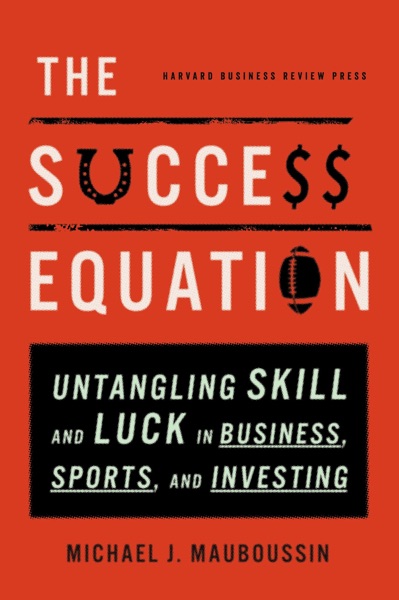
The Success Equation is Michael Mauboussin's attempt to solve a practical problem: how do you know whether a result came from skill or from luck?
Michael Mauboussin · 2012 · 4h 20m
Full summary and key takeaways →The 12 questions
- 1.
Which domains in your own work or life are closer to the luck end of the continuum than you typically admit?
- 2.
Mauboussin uses reversion to the mean as a diagnostic for luck. Where have you seen it play out in business or sports in a way that surprised you at the time?
- 3.
Have you ever made a bad decision that turned out well, or a good decision that turned out badly? How did you interpret the outcome at the time?
- 4.
How does knowing that mutual fund performance is largely luck-driven change how you think about the managers who pitch you on their track records?
- 5.
What would better feedback systems look like in your profession for separating skill from luck?
- 6.
Mauboussin argues that experts in luck-heavy domains often underperform base-rate models. Where in your work are you relying on narrative judgment that might be worse than a simple statistical rule?
- 7.
The book distinguishes position (the accumulated advantage of past decisions) from process (the quality of current decisions). How does that framing apply to a career you've observed?
- 8.
If you ran a performance review system at your organization, how would you change it given this book's framework?
- 9.
Where in your life are you currently measuring results when you should be measuring process?
- 10.
Mauboussin notes that in sports, the team with the best record often doesn't win the championship because playoff samples are small. How does this reframe your view of a recent competitive outcome?
- 11.
Where have you been guilty of overfitting — finding a compelling narrative in what was probably noise?
- 12.
If you could redesign one decision-making process in your organization to better account for luck, what would you change first?
How to run the discussion
- Pick six to eight, not all of them. An hour of real discussion covers fewer questions than anyone expects, and racing the list is what makes a book club feel like homework.
- Open with what people noticed, not what they concluded. Asking for a verdict first hardens opinions before anyone has heard each other.
- Let the disagreement run. The questions below that split a room are the ones worth the time; the ones everyone answers the same way can be skipped.
- Ask the quiet person a specific question. A direct, narrow question is far easier to answer than an open invitation to contribute.
Themes worth steering toward
If the conversation stalls, these are the threads that usually restart it.
Common questions
What are good book club questions for The Success Equation?
Here are 12 book club questions for The Success Equation by Michael Mauboussin, ordered to open easily and end somewhere worth arguing about. The strongest openers ask what each reader noticed rather than what they concluded, and the discussion usually turns on luck vs. skill, decision-making, statistics.
How long should a book club discussion of The Success Equation last?
Most groups run 60 to 90 minutes of actual discussion. That is roughly six to eight questions, not all of them, so pick the ones that suit your group rather than working down the list in order.
What are the main themes in The Success Equation?
Luck vs. skill, Decision-making, Statistics, Performance, Investing. Those are the threads most likely to divide a room, which makes them the useful places to steer a discussion that has gone quiet.
Picking the next one? See books like The Success Equation or questions for other book club picks.
