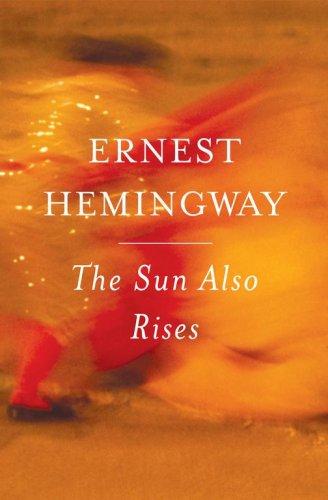
The Sun Also Rises by Ernest Hemingway is a 1926 literary fiction book about disillusionment, lost generation, masculinity. The iceberg theory in practice: Jake's impotence, the source of the novel's central anguish, is barely named. The emotion lives in the white space.
Summary
The Sun Also Rises is Hemingway's first novel, published in 1926, and it remains the sharpest portrait of the "Lost Generation" — the young Americans and British expatriates who drifted through Paris and Spain in the years after World War I, drinking heavily and searching for something they couldn't name. The narrator, Jake Barnes, is an American journalist living in Paris; he loves Lady Brett Ashley, a beautiful, restless Englishwoman; and he cannot have her, for a war wound has left him impotent. That wound, mostly undescribed, hangs over every page.
What the book is really about is people trying to outrun feeling. Jake and his circle — Brett, the Jewish writer Robert Cohn, the dissolute Mike Campbell, the earnest Bill Gorton — move from café to café in Paris and then to Pamplona for the running of the bulls. They drink too much. They quarrel. Cohn punches people. Brett goes off with a young bullfighter named Romero, who is the one figure in the novel who has genuine skill and dignity. The fiesta is vivid and brutal; the corrida sequences are some of the finest writing Hemingway ever did. Then it all ends, as these things do, in anticlimax.
The novel's power is almost entirely in what it doesn't say. Hemingway's iceberg theory — that the dignity of movement of an iceberg is due to only one-eighth of it being above water — is here practiced at the level of character psychology. Jake's wound is emotional as much as physical. The code of behavior that Jake and Bill share — understatement, competence, not whining — is both admirable and a defense mechanism. The prose is declarative, deceptively simple, endlessly imitated and rarely matched.
Readers who want plot will find this novel frustratingly event-light. But readers who are drawn to mood, to the texture of being young and aimless and vaguely damaged in a beautiful city, will find it almost unbearably true. It pairs naturally with Hemingway's memoir A Moveable Feast and sits in dialogue with Fitzgerald's The Great Gatsby as a document of the 1920s. Anyone who has lived abroad, or been in love with someone they couldn't have, will recognize something in Jake Barnes.
Talk to The Sun Also Rises like its author wrote you back.
Get the ideas that fit your life — not generic summaries.
- Chat with the book
- Audiobook-style main ideas
- Adapts to your life and goals
- Helps you take action
Key takeaways
- 1.
The iceberg theory in practice: Jake's impotence, the source of the novel's central anguish, is barely named. The emotion lives in the white space.
- 2.
The Lost Generation was lost in a specific way — not directionless but undone by the war's erasure of the values they'd been raised to believe in.
- 3.
Brett Ashley is not a femme fatale; she is as damaged as Jake, using charm and beauty to manage the same void everyone else drinks through.
- 4.
Hemingway's code hero — competent, stoic, facing pain without complaint — is both an ideal and a coping mechanism. Jake and Bill model it; Cohn fails it.
- 5.
The bullfight chapters are a rare zone of genuine meaning in the novel: Romero performs real craft and courage while the expatriates watch and consume without producing.
- 6.
Drinking in the novel is not background color. It is a collective technology for avoiding direct emotional confrontation, and the novel tracks its costs.
- 7.
The novel's title (from Ecclesiastes) frames meaninglessness as universal and ancient, not modern. The generations rise and fall; the sun still rises.
- 8.
Hemingway's declarative prose is emotional compression, not simplicity. Each flat statement carries weight proportional to what it refuses to explain.
Discussion questions
Use these on your own, with a book club, or as chat starters in Superbook. Book club version, ready to copy or print →
- 1.
Jake never fully articulates what the war did to him beyond the physical wound. Does the novel suggest that he himself understands it, or is the silence a form of unknowing?
- 2.
Brett is described through male gazes throughout — Jake's, Cohn's, Mike's. Do you think Hemingway gives her an interior life, or is she primarily a symbol of unattainability?
- 3.
Robert Cohn is the novel's designated outsider and takes considerable punishment for it. Is the treatment of Cohn antisemitic, or is Hemingway critiquing the group's antisemitism, or both?
- 4.
The bullfighting sections are extended and detailed. What function does the corrida serve in the novel beyond scene-setting? What does Romero represent that the other characters lack?
- 5.
Jake's 'code' — competence, stoicism, not complaining — is presented as admirable. Is it? Or is it another form of emotional evasion?
- 6.
The novel ends with Brett and Jake in a taxi, and Brett says 'Oh, Jake, we could have had such a damned good time together.' Jake replies, 'Yes. Isn't it pretty to think so?' Is that line tragic, resigned, wise, or cruel?
- 7.
Compare this novel to A Moveable Feast, Hemingway's memoir of the same period. What does the fiction let Hemingway do that the memoir can't?
- 8.
All-Quiet on the Western Front covers the same historical moment from the German side. What's shared between the two visions of the war's aftermath, and what's different?
- 9.
The sun also rises, the wind goeth toward the south and turneth about unto the north. Does the Ecclesiastes epigraph make the novel feel more resigned, or does it provide a kind of comfort?
- 10.
Which character in your group do you think comes closest to understanding what they actually want? Does anyone?
- 11.
Hemingway was 26 when this was published. Does that change how you read the novel's authority on loss and disillusionment?
- 12.
The novel was scandalous in 1926. What specifically scandalized contemporary readers — and does any of it still land?
Themes
Frequently asked questions
-
What is The Sun Also Rises about, without spoilers?
A group of American and British expatriates in 1920s Paris and Spain — drinking, traveling to Pamplona for the bullfights, tangled in a love triangle they can't resolve. At its center is Jake Barnes, who loves Lady Brett Ashley and cannot have her. Not much happens in terms of plot; everything happens in terms of feeling.
-
Is The Sun Also Rises hard to read?
No — the prose is extremely clean and fast. The difficulty, if any, is that very little is explained. Characters' inner states are implied through behavior and dialogue, not stated. Readers who want psychological exposition can find it thin; readers comfortable with inference usually love it.
-
Why is The Sun Also Rises considered a classic?
It captured a specific historical mood — the post-WWI disillusionment of young expatriates — with more precision and economy than anything else from that period. It also established a prose style that became one of the defining voices of American literature. And its emotional core, love frustrated by damage, hasn't aged.
-
Who shouldn't read this book?
Readers who want plot or redemption arcs will find it deeply frustrating. The novel is all texture and subtext; nothing is resolved. If you want things to happen and characters to grow, look elsewhere.
-
Is there a film adaptation?
Several, including a 1957 version with Tyrone Power and Ava Gardner. None are considered definitive, largely because Hemingway's style is so dependent on what's unsaid — which film doesn't translate well.