Historical fiction · Book club
The Tattooist of Auschwitz book club questions
Here are 12 book club questions for The Tattooist of Auschwitz by Heather Morris, ordered to open easily and end somewhere worth arguing about. Copy them, print them, or bring them up one at a time.
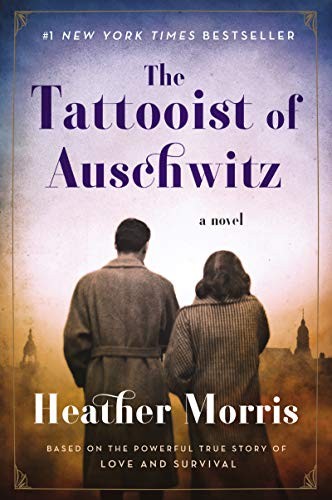
The Tattooist of Auschwitz is based on the true story of Ludwig (Lale) Sokolov, a Slovakian Jew who arrived at Auschwitz-Birkenau in 1942 and survived in part by becoming the camp's Tätowierer — the prisoner assigned to tattoo identification numbers onto incoming deportees.
Heather Morris · 2018 · 5h 20m
Full summary and key takeaways →The 12 questions
- 1.
Lale survived partly by becoming useful to the SS as the Tätowierer. Does his privileged position change how you see his heroism, his love story, or his survival?
- 2.
Morris made composite characters and dramatized unverifiable scenes. Where is the line between historical fiction and falsification of the historical record?
- 3.
The novel is told almost entirely from Lale's perspective. What do you think Gita's experience of the same events looked like — and why might Morris have stayed with Lale's viewpoint?
- 4.
Lale and Gita fall in love in the worst possible circumstances. Do you find that love story believable, or does the setting make it feel forced?
- 5.
How does The Tattooist of Auschwitz compare to Night by Elie Wiesel in terms of emotional impact, historical depth, and what each achieves as a piece of writing?
- 6.
The book was originally a screenplay. Do you feel that origin in the prose? What specifically reads as cinematic rather than literary?
- 7.
Lale bartered food and valuables to improve conditions for himself and others. Is that self-interest, altruism, or something the novel doesn't fully distinguish?
- 8.
Several characters help Lale without apparent self-interest — SS officers who look the other way, civilians who pass food. How does the novel handle moral complexity among the perpetrators?
- 9.
The novel sold over eight million copies and made Auschwitz's story accessible to readers who might not pick up more demanding accounts. Does commercial scale of Holocaust education justify narrative simplification?
- 10.
Lale wanted his story told, and he chose Morris to tell it. What does it mean for the author of a survivor's story to be a non-Jewish outsider? Does it matter?
- 11.
By the end of the novel, what has Lale paid for his survival? Is there an accounting the book presents explicitly or only implicitly?
- 12.
Scholars have criticized the historical inaccuracies. Did that affect your reading? Should readers approach this as fiction, memoir, or something else?
How to run the discussion
- Pick six to eight, not all of them. An hour of real discussion covers fewer questions than anyone expects, and racing the list is what makes a book club feel like homework.
- Open with what people noticed, not what they concluded. Asking for a verdict first hardens opinions before anyone has heard each other.
- Let the disagreement run. The questions below that split a room are the ones worth the time; the ones everyone answers the same way can be skipped.
- Ask the quiet person a specific question. A direct, narrow question is far easier to answer than an open invitation to contribute.
Themes worth steering toward
If the conversation stalls, these are the threads that usually restart it.
Common questions
What are good book club questions for The Tattooist of Auschwitz?
Here are 12 book club questions for The Tattooist of Auschwitz by Heather Morris, ordered to open easily and end somewhere worth arguing about. The strongest openers ask what each reader noticed rather than what they concluded, and the discussion usually turns on survival, love under extremity, moral compromise.
How long should a book club discussion of The Tattooist of Auschwitz last?
Most groups run 60 to 90 minutes of actual discussion. That is roughly six to eight questions, not all of them, so pick the ones that suit your group rather than working down the list in order.
What are the main themes in The Tattooist of Auschwitz?
Survival, Love under extremity, Moral compromise, Memory and testimony, Human dignity. Those are the threads most likely to divide a room, which makes them the useful places to steer a discussion that has gone quiet.
Picking the next one? See books like The Tattooist of Auschwitz or questions for other book club picks.
