Memoir · Book club
The Things They Carried book club questions
Here are 12 book club questions for The Things They Carried by Tim O'Brien, ordered to open easily and end somewhere worth arguing about. Copy them, print them, or bring them up one at a time.
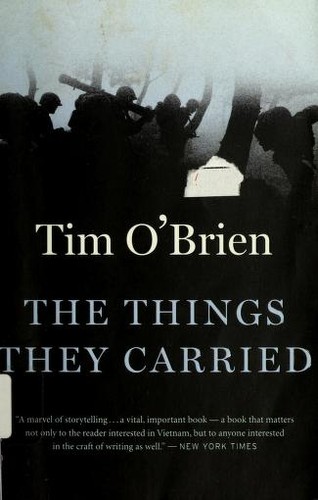
Tim O'Brien served as a foot soldier in Vietnam in 1969 and 1970.
Tim O'Brien · 1990 · 5h 0m
Full summary and key takeaways →The 12 questions
- 1.
O'Brien claims that a story can be 'true' even if the events it describes never happened. Do you find that argument convincing? What are its limits?
- 2.
The opening inventory of what soldiers carry moves from physical objects to emotional and psychological weight. What does that formal choice accomplish?
- 3.
O'Brien writes that he stayed in Vietnam partly because he was afraid of what people back home would think if he deserted. How does social pressure function differently from moral conviction as a motivation for military service?
- 4.
Several stories center on a specific act of killing — the young Vietnamese man, the execution of Kiowa's killer. How does O'Brien approach the moral weight of killing without reaching simple verdicts?
- 5.
The book includes a chapter in which O'Brien tells his daughter about the war and she responds with incomprehension. What does that failure of communication say about the transmission of war experience across generations?
- 6.
How does the book's treatment of truth and fiction compare to other works of creative nonfiction you've read? Where does O'Brien's approach feel honest and where does it feel like evasion?
- 7.
Kiowa's death is returned to multiple times in different stories. What does the repetition accomplish that a single account would not?
- 8.
O'Brien's Vietnam platoon is a cross-section of American society in 1969. How does the book use that cross-section to represent something larger about the war's social costs?
- 9.
The book was published in 1990, fifteen years after the fall of Saigon. How does that temporal distance shape what O'Brien can see that a contemporary account might not?
- 10.
The Things They Carried is often taught in high schools. What does assigning it to young readers who have no direct experience of war accomplish? What risks does it carry?
- 11.
O'Brien describes the experience of killing — even inadvertently — as leaving a mark that does not fade. Does his treatment of that experience feel honest to you, and why?
- 12.
How does the relationship between imagination and memory in the book compare to how you experience your own memories of significant events?
How to run the discussion
- Pick six to eight, not all of them. An hour of real discussion covers fewer questions than anyone expects, and racing the list is what makes a book club feel like homework.
- Open with what people noticed, not what they concluded. Asking for a verdict first hardens opinions before anyone has heard each other.
- Let the disagreement run. The questions below that split a room are the ones worth the time; the ones everyone answers the same way can be skipped.
- Ask the quiet person a specific question. A direct, narrow question is far easier to answer than an open invitation to contribute.
Themes worth steering toward
If the conversation stalls, these are the threads that usually restart it.
Common questions
What are good book club questions for The Things They Carried?
Here are 12 book club questions for The Things They Carried by Tim O'Brien, ordered to open easily and end somewhere worth arguing about. The strongest openers ask what each reader noticed rather than what they concluded, and the discussion usually turns on vietnam war, truth and storytelling, memory and trauma.
How long should a book club discussion of The Things They Carried last?
Most groups run 60 to 90 minutes of actual discussion. That is roughly six to eight questions, not all of them, so pick the ones that suit your group rather than working down the list in order.
What are the main themes in The Things They Carried?
Vietnam War, Truth and storytelling, Memory and trauma, Moral injury, Courage and fear. Those are the threads most likely to divide a room, which makes them the useful places to steer a discussion that has gone quiet.
Picking the next one? See books like The Things They Carried or questions for other book club picks.
