Science fiction · Book club
The Three-Body Problem book club questions
Here are 12 book club questions for The Three-Body Problem by Liu Cixin, ordered to open easily and end somewhere worth arguing about. Copy them, print them, or bring them up one at a time.
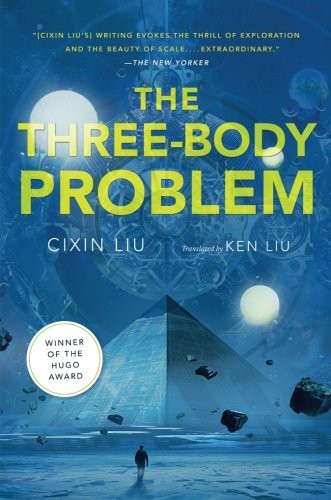
The Three-Body Problem begins during China's Cultural Revolution, where a young astrophysicist witnesses her father's murder at the hands of Red Guard cadres and subsequently makes a decision that will determine the fate of humanity.
Liu Cixin · 2008 · 10h 45m
Full summary and key takeaways →The 12 questions
- 1.
Ye Wenjie's decision to respond to the alien signal is motivated by her experience of the Cultural Revolution. Does the novel frame this as understandable, tragic, or wrong?
- 2.
Dark forest theory says every civilization must eventually destroy every other. Does that logic hold up, or does it require assumptions about scarcity and communication that might not apply universally?
- 3.
The novel suggests that ideological fanaticism and cold utilitarian logic lead to similar outcomes. Do you find that equivalence convincing?
- 4.
The scientists who receive the Trisolaran warning and commit suicide — are they cowards, or is their reasoning defensible?
- 5.
Liu is an engineer by training and it shows in the prose. Does the technical precision enhance the novel's themes, or does it create emotional distance?
- 6.
The three-body problem is real and genuinely unsolvable. How does that fact — that Liu is working with real physics — change how you read the novel?
- 7.
The Cultural Revolution is depicted with enough distance that it functions almost as myth. Does that mythic treatment serve the novel or sanitize something that should remain specific?
- 8.
Wang Miao is in many ways a viewpoint character rather than a protagonist — things happen to him and around him. Is that a weakness or an intentional structural choice?
- 9.
The novel ends with the Trisolarans' fleet launched toward Earth, 400 years away. It ends on dread rather than resolution. Was that the right ending?
- 10.
Compare the Trisolarans' logic to the logic of any historical empire you know. How far does the analogy hold?
- 11.
The sequels develop dark forest theory much further. Having read the first book, do you want to continue? What would change your answer?
- 12.
Liu wrote this book in China, and it was published there before being translated. Does knowing that change how you read the Cultural Revolution sections?
How to run the discussion
- Pick six to eight, not all of them. An hour of real discussion covers fewer questions than anyone expects, and racing the list is what makes a book club feel like homework.
- Open with what people noticed, not what they concluded. Asking for a verdict first hardens opinions before anyone has heard each other.
- Let the disagreement run. The questions below that split a room are the ones worth the time; the ones everyone answers the same way can be skipped.
- Ask the quiet person a specific question. A direct, narrow question is far easier to answer than an open invitation to contribute.
Themes worth steering toward
If the conversation stalls, these are the threads that usually restart it.
Common questions
What are good book club questions for The Three-Body Problem?
Here are 12 book club questions for The Three-Body Problem by Liu Cixin, ordered to open easily and end somewhere worth arguing about. The strongest openers ask what each reader noticed rather than what they concluded, and the discussion usually turns on first contact and civilization, cultural revolution and ideology, scientific progress.
How long should a book club discussion of The Three-Body Problem last?
Most groups run 60 to 90 minutes of actual discussion. That is roughly six to eight questions, not all of them, so pick the ones that suit your group rather than working down the list in order.
What are the main themes in The Three-Body Problem?
First contact and civilization, Cultural Revolution and ideology, Scientific progress, Survival and betrayal, Cosmic pessimism. Those are the threads most likely to divide a room, which makes them the useful places to steer a discussion that has gone quiet.
Picking the next one? See books like The Three-Body Problem or questions for other book club picks.
