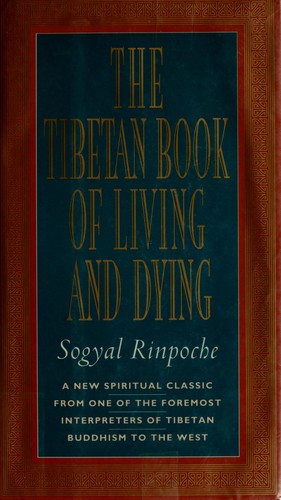
The Tibetan Book of Living and Dying by Sogyal Rinpoche is a 1992 religion & spirituality book about death, impermanence, consciousness. The quality of death is determined by the quality of life: the meditation practices, the cultivation of awareness and compassion, are preparation for the moment of death.
Summary
The Tibetan Book of Living and Dying is Sogyal Rinpoche's comprehensive introduction to the Tibetan Buddhist understanding of death and the dying process, written for a Western audience unfamiliar with the tradition. First published in 1992, it became an unexpected bestseller and remains the standard modern gateway to teachings that were once confined to highly trained practitioners. It draws on the Bardo Thodol (the Tibetan Book of the Dead), the wisdom of Sogyal's own teachers, and practical guidance for living and for supporting the dying.
The book's central premise is that how we die is determined by how we live, and that understanding death is the key to living fully. Sogyal argues that Western culture's denial of death — its relentless focus on youth, productivity, and distraction — is not just a practical failure but a spiritual one. The Tibetan tradition invites practitioners to contemplate impermanence and death not as morbid exercises but as the most direct path to understanding what matters. If we lived knowing we would die today, most of what we treat as urgent would dissolve, and most of what we neglect would come into clear focus.
The teaching on the bardos — the transitional states between death and rebirth — forms the metaphysical core. The moment of death is described as an extraordinary opportunity: the ground luminosity arises, a clear light of pure consciousness. The practitioner who recognizes this light can achieve liberation. Those who do not recognize it pass through a series of visions and encounters shaped by the accumulated karma of their life, eventually leading to rebirth. The practices described — phowa (transference of consciousness), meditation on compassion and awareness — are preparation for that moment and for this life.
The book is also a practical guide for those caring for the dying. Sogyal gives specific guidance on how to be present, what to say and not say, how to read to a dying person, and how to help create conditions for a peaceful transition. This section has influenced hospice and palliative care work and has been read alongside secular approaches to death and dying.
Talk to The Tibetan Book of Living and Dying like its author wrote you back.
Get the ideas that fit your life — not generic summaries.
- Chat with the book
- Audiobook-style main ideas
- Adapts to your life and goals
- Helps you take action
Key takeaways
- 1.
The quality of death is determined by the quality of life: the meditation practices, the cultivation of awareness and compassion, are preparation for the moment of death.
- 2.
Impermanence is not a problem to be solved but the fundamental nature of conditioned existence; recognizing it fully changes everything about how we live.
- 3.
The bardos are transitional states — in dying, between death and rebirth — where the nature of mind is directly accessible to the practitioner.
- 4.
The ground luminosity at the moment of death is pure consciousness itself, unobstructed by thought or concept; recognizing it is liberation.
- 5.
Most people die as they have lived: those who have not practiced recognition of awareness are likely to miss the liberation opportunity the death moment offers.
- 6.
Compassion — the heartfelt response to suffering — is both an ethical practice and a spiritual one; cultivating it loosens the grip of ego and opens the practitioner to liberation.
- 7.
Phowa (transference of consciousness) is a specific practice for directing awareness at the moment of death toward a realm of liberation rather than confused wandering.
- 8.
How we accompany the dying matters: presence, peace, and spiritual support can significantly ease the dying process and support positive transitions.
Discussion questions
Use these on your own, with a book club, or as chat starters in Superbook. Book club version, ready to copy or print →
- 1.
Sogyal argues that Western culture's denial of death prevents genuine living. Do you see that denial at work in your own life or environment?
- 2.
The teaching suggests that fully accepting impermanence changes your priorities. If you took impermanence seriously this week, what would change?
- 3.
The Tibetan understanding of death involves extensive spiritual preparation over a lifetime. Is that kind of preparation possible within a secular life, or does it require a religious framework?
- 4.
The book describes near-death experiences and their parallels to Tibetan teaching on the bardos. How do you evaluate that kind of cross-cultural convergence as evidence for the teaching?
- 5.
Sogyal gives practical guidance on supporting the dying. Has the book changed how you think about what you would want or what you would offer to someone at the end of life?
- 6.
The ground luminosity is described as pure consciousness arising at death. Is that a meaningful concept to you, or does it require more background in Buddhist metaphysics to evaluate?
- 7.
The idea that how we die reflects how we have lived is both comforting (it rewards a good life) and terrifying (it demands accountability). Which response do you have?
- 8.
Tibetan Buddhism preserves detailed maps of consciousness at death. Is that a feature of Tibetan wisdom, a cultural construction, or something in between?
- 9.
The book has been influential in hospice work. What does it offer to secular caregivers that conventional training might miss?
- 10.
If you knew you would die in six months, what would you do with the time? How does your answer compare to how you're actually living?
- 11.
The book treats death as the supreme teacher. Is there a less extreme version of that teaching available to someone who is not near death?
Themes
Frequently asked questions
-
What is The Tibetan Book of Living and Dying about?
Tibetan Buddhist teachings on death, impermanence, the bardos (transitional states), and how to live and die with awareness and compassion. It includes practical guidance for the dying and for caregivers, grounded in the Tibetan tradition but addressed to a Western audience.
-
Do I need to be Buddhist to benefit from this book?
No. Many readers engage with the teachings on impermanence, compassion, and presence without accepting the Buddhist metaphysics of rebirth. The practical guidance on caregiving and dying is useful regardless of religious background.
-
What is the bardo?
A transitional state between death and rebirth in Tibetan Buddhist cosmology. The moment of death, the period after death, and the process of approaching rebirth are each a bardo. Tibetan practice prepares the practitioner to remain aware and oriented through these states.
-
How is this related to the Tibetan Book of the Dead?
It draws on the Bardo Thodol (Tibetan Book of the Dead) but translates and contextualizes those teachings for contemporary Western readers. The original text is a liturgical guide read aloud to the dying; this book is a comprehensive meditation and teaching around the same core.
-
Should I read this even if I'm not thinking about death?
Especially then, Sogyal would say. The premise of the book is that contemplating death is the surest path to understanding what matters in life. Most readers report that it changed not how they think about dying but how they think about living.