Philosophy · Book club
The True Believer book club questions
Here are 11 book club questions for The True Believer by Eric Hoffer, ordered to open easily and end somewhere worth arguing about. Copy them, print them, or bring them up one at a time.
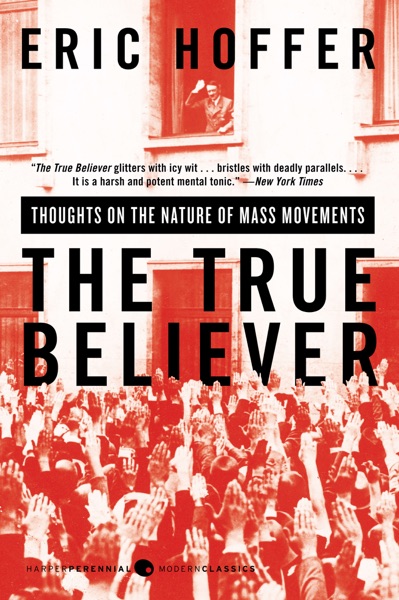
The True Believer, published in 1951, is Eric Hoffer's essay on the psychological makeup of the fanatic and the conditions under which mass movements arise.
Eric Hoffer · 1951 · 3h 45m
Full summary and key takeaways →The 11 questions
- 1.
Hoffer argues that the appeal of mass movements is not about ideology but about escape from self. Does that match your understanding of why people join extreme movements today?
- 2.
He claims the 'new poor' — people who have improved their position slightly and feel the gap most sharply — are the most susceptible recruits. Where do you see that dynamic playing out in contemporary politics?
- 3.
Hoffer draws equivalences between religious movements and secular ones, between left and right. Does that equivalence feel true to you, or does it erase important distinctions?
- 4.
The book argues that hatred of an enemy is more effective than love of a cause as a unifying force. What evidence can you think of that supports or contradicts this?
- 5.
Hoffer was a longshoreman who read widely but had no academic credentials. How does that background show up in the book? Does it make the argument stronger or weaker?
- 6.
If the true believer's loyalty is to the movement form rather than the content, what does that imply about how to respond to radicalization — is the argument or the community more important?
- 7.
Hoffer distinguishes the true believer from the 'man of words' (intellectuals who prepare movements) and the 'practical men of action' who eventually take control. Does that three-stage model match historical examples you know?
- 8.
The book was published in 1951 with Nazism and Stalinism in view. Which parts of Hoffer's analysis feel most applicable to political movements you've watched in your own lifetime?
- 9.
Hoffer argues that mass movements are interchangeable in their psychological appeal. Does that mean they are equally harmful, or does ideology still matter?
- 10.
What conditions in modern life — social isolation, economic anxiety, digital media — seem to create the vulnerabilities Hoffer describes?
- 11.
Hoffer wrote as someone who had once been drawn toward radical politics himself. How does that personal history seem to shape the book's tone and perspective?
How to run the discussion
- Pick six to eight, not all of them. An hour of real discussion covers fewer questions than anyone expects, and racing the list is what makes a book club feel like homework.
- Open with what people noticed, not what they concluded. Asking for a verdict first hardens opinions before anyone has heard each other.
- Let the disagreement run. The questions below that split a room are the ones worth the time; the ones everyone answers the same way can be skipped.
- Ask the quiet person a specific question. A direct, narrow question is far easier to answer than an open invitation to contribute.
Themes worth steering toward
If the conversation stalls, these are the threads that usually restart it.
Common questions
What are good book club questions for The True Believer?
Here are 11 book club questions for The True Believer by Eric Hoffer, ordered to open easily and end somewhere worth arguing about. The strongest openers ask what each reader noticed rather than what they concluded, and the discussion usually turns on mass movements, fanaticism, identity.
How long should a book club discussion of The True Believer last?
Most groups run 60 to 90 minutes of actual discussion. That is roughly six to eight questions, not all of them, so pick the ones that suit your group rather than working down the list in order.
What are the main themes in The True Believer?
Mass movements, Fanaticism, Identity, Political psychology, Social change. Those are the threads most likely to divide a room, which makes them the useful places to steer a discussion that has gone quiet.
Picking the next one? See books like The True Believer or questions for other book club picks.
