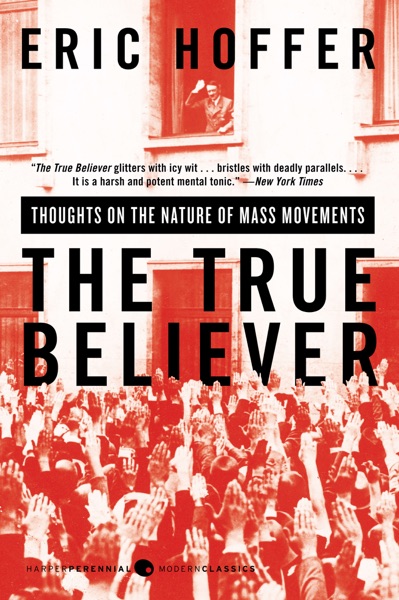
The True Believer by Eric Hoffer is a 1951 philosophy book about mass movements, fanaticism, identity. Mass movements attract people not because of their specific ideology but because of what they offer: belonging, certainty, escape from an unsatisfying individual self.
Summary
The True Believer, published in 1951, is Eric Hoffer's essay on the psychological makeup of the fanatic and the conditions under which mass movements arise. Hoffer was a self-educated longshoreman who wrote in his spare time, and the book has a distinctive compression — short numbered sections stacked into a sustained argument — that reads unlike academic social science and more like a long letter from someone who has thought very hard about a problem.
Hoffer's central claim is that the appeal of mass movements — religious, revolutionary, nationalist — is not primarily about the ideology they preach. What matters is the sense of belonging, purpose, and escape from a burdensome self that they offer. The person most susceptible to joining a mass movement is not the desperately poor, Hoffer argues, but the person who has risen just enough to feel the gap between what they are and what they hoped to be. The "true believer" is typically someone frustrated, personally disappointed, and looking for a cause large enough to submerge their individual failure in collective glory.
The book draws an unsettling equivalence across ideologically opposed movements. Hoffer argues that Christianity and Communism, nationalism and religious revival, share structural features that make conversion between them easier than outsiders would expect. A disaffected member of one movement is a recruit for another. What the true believer is loyal to is not a particular doctrine but the mass movement form itself — the solidarity, the certainty, the hatred of an enemy, the suspension of individual responsibility.
Hoffer was writing with Nazism and Stalinism fresh in mind, and the book's context is unmistakably mid-century. But its core observations have lost little force. The psychology he describes — the resentment of the almost-successful, the hunger for self-surrender, the need for a scapegoat — is recognizable in every era of political radicalization. The book's limitation is that it is entirely a theory of movement psychology and says little about when mass movements produce genuine historical change versus when they merely destroy. But as a diagnostic tool for understanding how ordinary people become fanatics, it remains one of the most concise and unsettling books written on the subject.
Talk to The True Believer like its author wrote you back.
Get the ideas that fit your life — not generic summaries.
- Chat with the book
- Audiobook-style main ideas
- Adapts to your life and goals
- Helps you take action
Key takeaways
- 1.
Mass movements attract people not because of their specific ideology but because of what they offer: belonging, certainty, escape from an unsatisfying individual self.
- 2.
The most susceptible recruit is not the desperately poor but the 'new poor' — people who have tasted improvement and feel the gap between their current state and their aspirations most acutely.
- 3.
Hoffer argues that faith, pride, and hope are interchangeable fuels. A person who can no longer sustain one of them is a recruit for a movement that offers another.
- 4.
The true believer's loyalty is to the mass movement form, not the doctrine. This explains why converts between opposed movements — from Communism to fascism, from religion to revolution — are common.
- 5.
Hatred of a common enemy unifies mass movements more reliably than love of a shared ideal. An external enemy is necessary scaffolding for internal solidarity.
- 6.
Individual achievement threatens mass movements because it gives people a stake in their own lives. Mass movements suppress individuality deliberately; they need the individual self to be valueless.
- 7.
Leaders of mass movements are often interchangeable between movements. Hoffer notes that the organizational skills and psychological insight needed to build a religious revival and a revolutionary cell are the same.
- 8.
Frustration, not poverty, is the precondition for fanaticism. Relative deprivation — feeling worse off compared to a reference group — is more radicalizing than absolute hardship.
Discussion questions
Use these on your own, with a book club, or as chat starters in Superbook. Book club version, ready to copy or print →
- 1.
Hoffer argues that the appeal of mass movements is not about ideology but about escape from self. Does that match your understanding of why people join extreme movements today?
- 2.
He claims the 'new poor' — people who have improved their position slightly and feel the gap most sharply — are the most susceptible recruits. Where do you see that dynamic playing out in contemporary politics?
- 3.
Hoffer draws equivalences between religious movements and secular ones, between left and right. Does that equivalence feel true to you, or does it erase important distinctions?
- 4.
The book argues that hatred of an enemy is more effective than love of a cause as a unifying force. What evidence can you think of that supports or contradicts this?
- 5.
Hoffer was a longshoreman who read widely but had no academic credentials. How does that background show up in the book? Does it make the argument stronger or weaker?
- 6.
If the true believer's loyalty is to the movement form rather than the content, what does that imply about how to respond to radicalization — is the argument or the community more important?
- 7.
Hoffer distinguishes the true believer from the 'man of words' (intellectuals who prepare movements) and the 'practical men of action' who eventually take control. Does that three-stage model match historical examples you know?
- 8.
The book was published in 1951 with Nazism and Stalinism in view. Which parts of Hoffer's analysis feel most applicable to political movements you've watched in your own lifetime?
- 9.
Hoffer argues that mass movements are interchangeable in their psychological appeal. Does that mean they are equally harmful, or does ideology still matter?
- 10.
What conditions in modern life — social isolation, economic anxiety, digital media — seem to create the vulnerabilities Hoffer describes?
- 11.
Hoffer wrote as someone who had once been drawn toward radical politics himself. How does that personal history seem to shape the book's tone and perspective?
Themes
Frequently asked questions
-
What is The True Believer about?
It's a study of the psychology behind mass movements — religious revivals, revolutions, nationalist crusades. Hoffer argues that the appeal of such movements is not their ideology but the sense of belonging, purpose, and self-surrender they offer to people whose individual lives feel inadequate.
-
Is The True Believer still relevant today?
Yes, perhaps more than ever. The psychological dynamics Hoffer describes — resentment of near-peers, the need for enemies, the interchangeability of radical movements — appear in contemporary political radicalization, online communities, and populist politics. The specifics date the book; the patterns do not.
-
Who was Eric Hoffer?
A self-educated American longshoreman who wrote philosophy in his spare time. He spent decades working on the San Francisco docks while publishing books on social psychology and mass movements. His unusual background gave him both distance from academic conventions and credibility as an observer of working-class life.
-
Is The True Believer a hard read?
No. It's short and dense rather than long and difficult. The numbered-section format means you can read it in pieces. The ideas are challenging but the prose is plain and direct. Most readers finish it in a few sittings.
-
Does Hoffer have sympathy for mass movement participants?
Complicated sympathy. He understands the psychological needs that mass movements meet, and he doesn't simply dismiss believers as foolish or evil. But his analysis is ultimately critical — he sees mass movements as escapist and often destructive, and he values the individual self that they require their followers to suppress.
Similar books
The Origins of Totalitarianism
Hannah Arendt
Obedience to Authority
Stanley Milgram
The Righteous Mind: Why Good People Are Divided by Politics and Religion
Jonathan Haidt
The Anatomy of Fascism
Robert O. Paxton
