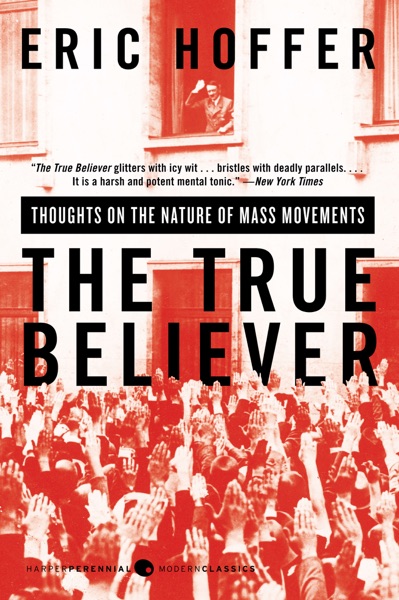
Talk to The True Believer like its author wrote you back.
Get the ideas that fit your life — not generic summaries.
- Chat with the book
- Audiobook-style main ideas
- Adapts to your life and goals
- Helps you take action
What it argues
The True Believer, published in 1951, is Eric Hoffer's essay on the psychological makeup of the fanatic and the conditions under which mass movements arise. Hoffer was a self-educated longshoreman who wrote in his spare time, and the book has a distinctive compression — short numbered sections stacked into a sustained argument — that reads unlike academic social science and more like a long letter from someone who has thought very hard about a problem.
Hoffer's central claim is that the appeal of mass movements — religious, revolutionary, nationalist — is not primarily about the ideology they preach. What matters is the sense of belonging, purpose, and escape from a burdensome self that they offer. The person most susceptible to joining a mass movement is not the desperately poor, Hoffer argues, but the person who has risen just enough to feel the gap between what they are and what they hoped to be. The "true believer" is typically someone frustrated, personally disappointed, and looking for a cause large enough to submerge their individual failure in collective glory.
What it gets right
- 1.
Mass movements attract people not because of their specific ideology but because of what they offer: belonging, certainty, escape from an unsatisfying individual self.
- 2.
The most susceptible recruit is not the desperately poor but the 'new poor' — people who have tasted improvement and feel the gap between their current state and their aspirations most acutely.
- 3.
Hoffer argues that faith, pride, and hope are interchangeable fuels. A person who can no longer sustain one of them is a recruit for a movement that offers another.
What it covers
Who wrote it
Eric Hoffer (1902–1983) was an American moral and social philosopher who spent most of his working life as a longshoreman on the San Francisco waterfront. Self-educated after a period of childhood blindness, he read voraciously and developed the aphoristic, essay-driven style that characterizes The True Believer and his subsequent books, including The Ordeal of Change and The Temper of Our Time. He received the Presidential Medal of Freedom in 1983. His unusual biography — a manual laborer writing serious social philosophy — gave his work an authority and plainspokenness rare in academic writing on mass movements.
