Talk to The True Believer like its author wrote you back.
Get the ideas that fit your life — not generic summaries.
- Chat with the book
- Audiobook-style main ideas
- Adapts to your life and goals
- Helps you take action
The True Believer, in detail
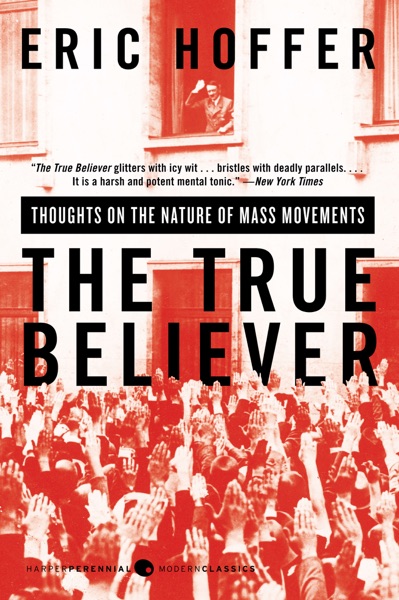
The True Believer, published in 1951, is Eric Hoffer's essay on the psychological makeup of the fanatic and the conditions under which mass movements arise. Hoffer was a self-educated longshoreman who wrote in his spare time, and the book has a distinctive compression — short numbered sections stacked into a sustained argument — that reads unlike academic social science and more like a long letter from someone who has thought very hard about a problem.
Hoffer's central claim is that the appeal of mass movements — religious, revolutionary, nationalist — is not primarily about the ideology they preach. What matters is the sense of belonging, purpose, and escape from a burdensome self that they offer. The person most susceptible to joining a mass movement is not the desperately poor, Hoffer argues, but the person who has risen just enough to feel the gap between what they are and what they hoped to be. The "true believer" is typically someone frustrated, personally disappointed, and looking for a cause large enough to submerge their individual failure in collective glory.
The book draws an unsettling equivalence across ideologically opposed movements. Hoffer argues that Christianity and Communism, nationalism and religious revival, share structural features that make conversion between them easier than outsiders would expect. A disaffected member of one movement is a recruit for another. What the true believer is loyal to is not a particular doctrine but the mass movement form itself — the solidarity, the certainty, the hatred of an enemy, the suspension of individual responsibility.
Hoffer was writing with Nazism and Stalinism fresh in mind, and the book's context is unmistakably mid-century. But its core observations have lost little force. The psychology he describes — the resentment of the almost-successful, the hunger for self-surrender, the need for a scapegoat — is recognizable in every era of political radicalization. The book's limitation is that it is entirely a theory of movement psychology and says little about when mass movements produce genuine historical change versus when they merely destroy. But as a diagnostic tool for understanding how ordinary people become fanatics, it remains one of the most concise and unsettling books written on the subject.
The big ideas
- 1.
Mass movements attract people not because of their specific ideology but because of what they offer: belonging, certainty, escape from an unsatisfying individual self.
- 2.
The most susceptible recruit is not the desperately poor but the 'new poor' — people who have tasted improvement and feel the gap between their current state and their aspirations most acutely.
- 3.
Hoffer argues that faith, pride, and hope are interchangeable fuels. A person who can no longer sustain one of them is a recruit for a movement that offers another.
