Historical fiction · Book club
The Underground Railroad book club questions
Here are 12 book club questions for The Underground Railroad by Colson Whitehead, ordered to open easily and end somewhere worth arguing about. Copy them, print them, or bring them up one at a time.
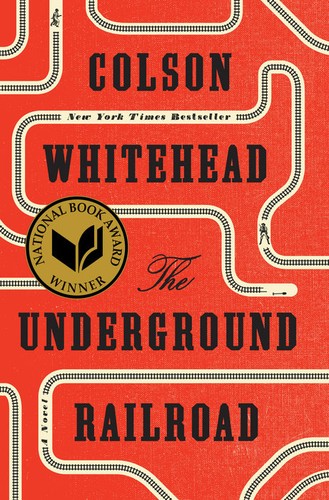
The Underground Railroad takes a central metaphor of American history — the network of safe houses and abolitionists that helped enslaved people flee north — and makes it literal: Colson Whitehead imagines the railroad as an actual underground train system, with tunnels, platforms, and conductors.
Colson Whitehead · 2016 · 6h 0m
Full summary and key takeaways →The 12 questions
- 1.
Whitehead makes the Underground Railroad literal. Does this choice clarify or distort our understanding of the actual historical network? What does the literalization allow him to do that realism couldn't?
- 2.
Each state represents a different American approach to race. Which of them felt most contemporary to you? Which one did you find most disturbing, and why?
- 3.
Ridgeway argues that he embodies the American spirit. Does the novel agree with him? Is he wrong, or is he just honest about something the novel suggests is true?
- 4.
Cora's mother Mabel escaped alone, leaving her daughter behind. How does the novel want us to judge that choice? How do you judge it?
- 5.
The South Carolina section depicts a kind of liberal progressivism that conceals something much worse. Is Whitehead suggesting that reform is always a cover, or something more nuanced?
- 6.
Caesar is the person who first persuades Cora to escape. What does his fate mean for the novel's argument about solidarity and individual survival?
- 7.
The novel won the Pulitzer and National Book Award. Does that institutional recognition change how you read it, or how you think it will age?
- 8.
Compare The Underground Railroad to Toni Morrison's Beloved (if you've read it). Both deal with slavery and its trauma. What different claims do they make? Which feels more essential to you?
- 9.
Freedom in the novel is always conditional and always precarious. Is there any moment in the novel where Cora is actually free? What would freedom even mean in her world?
- 10.
The alternate history means some readers approach this as a kind of dystopian fiction. Does that frame help or hurt? Is the novel more useful as history, as fantasy, or as something else?
- 11.
Whitehead's prose is restrained and controlled throughout. Do you think a more emotionally heightened style would have been more or less effective for this material?
- 12.
The ending is ambiguous. What do you think happens to Cora? Does the novel's argument require an open ending, or is it a cop-out?
How to run the discussion
- Pick six to eight, not all of them. An hour of real discussion covers fewer questions than anyone expects, and racing the list is what makes a book club feel like homework.
- Open with what people noticed, not what they concluded. Asking for a verdict first hardens opinions before anyone has heard each other.
- Let the disagreement run. The questions below that split a room are the ones worth the time; the ones everyone answers the same way can be skipped.
- Ask the quiet person a specific question. A direct, narrow question is far easier to answer than an open invitation to contribute.
Themes worth steering toward
If the conversation stalls, these are the threads that usually restart it.
Common questions
What are good book club questions for The Underground Railroad?
Here are 12 book club questions for The Underground Railroad by Colson Whitehead, ordered to open easily and end somewhere worth arguing about. The strongest openers ask what each reader noticed rather than what they concluded, and the discussion usually turns on slavery and its legacy, freedom and its cost, american myth and american reality.
How long should a book club discussion of The Underground Railroad last?
Most groups run 60 to 90 minutes of actual discussion. That is roughly six to eight questions, not all of them, so pick the ones that suit your group rather than working down the list in order.
What are the main themes in The Underground Railroad?
Slavery and its legacy, Freedom and its cost, American myth and American reality, Survival and self-determination, Race and power. Those are the threads most likely to divide a room, which makes them the useful places to steer a discussion that has gone quiet.
Picking the next one? See books like The Underground Railroad or questions for other book club picks.
