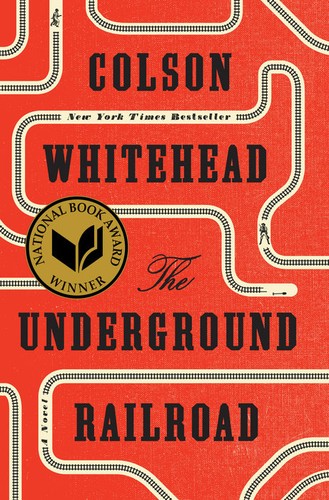
Talk to The Underground Railroad like its author wrote you back.
Get the ideas that fit your life — not generic summaries.
- Chat with the book
- Audiobook-style main ideas
- Adapts to your life and goals
- Helps you take action
What it argues
The Underground Railroad takes a central metaphor of American history — the network of safe houses and abolitionists that helped enslaved people flee north — and makes it literal: Colson Whitehead imagines the railroad as an actual underground train system, with tunnels, platforms, and conductors. The novel follows Cora, enslaved on a Georgia cotton plantation, as she escapes on this railroad and moves through a series of American states that each represent a different facet of the country's relationship to race, freedom, and violence.
The novel is not a historical novel in the conventional sense. Each state Cora passes through is a kind of alternate-history tableau: South Carolina has a progressive surface veneer concealing medical experimentation on Black bodies; North Carolina has abolished slavery by eliminating Black people entirely; Indiana allows a Black community to exist precariously while white resentment builds. Whitehead is mapping American history across Cora's journey — the shifting forms that white supremacy takes, the inadequacy of liberal reform, the persistence of the catcher Ridgeway who pursues her throughout.
What it gets right
- 1.
Making the Underground Railroad literal transforms a metaphor into a physical infrastructure of freedom — Whitehead uses this to ask what the actual conditions of Black freedom in America have ever looked like.
- 2.
Each state in the novel represents a different American historical strategy for managing Blackness: overt violence, liberal reform concealing exploitation, extermination, conditional tolerance. None of them offers actual freedom.
- 3.
Ridgeway embodies the American spirit as Whitehead defines it — a true believer who has made ideological peace with cruelty, which makes him more dangerous than a merely self-interested villain.
What it covers
Who wrote it
Colson Whitehead is an American novelist born in 1969 in New York City. He is the author of eight novels including The Intuitionist (1999), Zone One (2011), and Harlem Shuffle (2021). The Underground Railroad won both the National Book Award and the Pulitzer Prize for Fiction in 2016 and 2017 respectively, as did his subsequent novel The Nickel Boys (2019), making Whitehead one of only four authors to win the Pulitzer Prize for Fiction twice. He teaches at the NYU MFA program and lives in New York.
