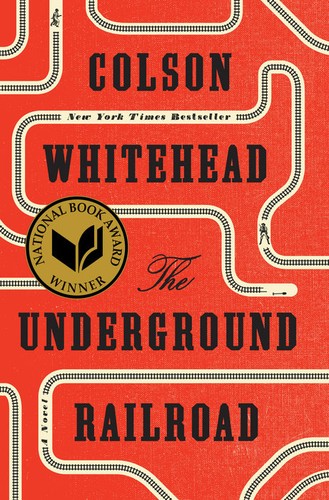
Talk to The Underground Railroad like its author wrote you back.
Get the ideas that fit your life — not generic summaries.
- Chat with the book
- Audiobook-style main ideas
- Adapts to your life and goals
- Helps you take action
The Underground Railroad, in detail
The Underground Railroad takes a central metaphor of American history — the network of safe houses and abolitionists that helped enslaved people flee north — and makes it literal: Colson Whitehead imagines the railroad as an actual underground train system, with tunnels, platforms, and conductors. The novel follows Cora, enslaved on a Georgia cotton plantation, as she escapes on this railroad and moves through a series of American states that each represent a different facet of the country's relationship to race, freedom, and violence.
The novel is not a historical novel in the conventional sense. Each state Cora passes through is a kind of alternate-history tableau: South Carolina has a progressive surface veneer concealing medical experimentation on Black bodies; North Carolina has abolished slavery by eliminating Black people entirely; Indiana allows a Black community to exist precariously while white resentment builds. Whitehead is mapping American history across Cora's journey — the shifting forms that white supremacy takes, the inadequacy of liberal reform, the persistence of the catcher Ridgeway who pursues her throughout.
The prose is controlled and precise in a way that makes the horror more rather than less effective. Whitehead doesn't flinch from the brutality of slavery, but he also doesn't wallow. He trusts the subject's weight and focuses on Cora — her decisions, her interior life, her accumulating knowledge of what America actually is and what it costs to survive in it. Ridgeway, the slave catcher, is the novel's most interesting secondary figure: a true believer in the American spirit as he defines it, which is to say a man who has made a coherent ideology out of cruelty.
This is a novel that demands engagement with American history while refusing to be simply a historical document. It won the Pulitzer Prize in 2017 and the National Book Award in 2016. Readers who want comforting arcs will struggle; readers who want a novel that takes American mythology seriously and dismantles it carefully will find this essential. The magical realism element is relatively restrained — it's a premise, not an atmosphere — so readers nervous about the genre have less to fear than the description implies.
The big ideas
- 1.
Making the Underground Railroad literal transforms a metaphor into a physical infrastructure of freedom — Whitehead uses this to ask what the actual conditions of Black freedom in America have ever looked like.
- 2.
Each state in the novel represents a different American historical strategy for managing Blackness: overt violence, liberal reform concealing exploitation, extermination, conditional tolerance. None of them offers actual freedom.
- 3.
Ridgeway embodies the American spirit as Whitehead defines it — a true believer who has made ideological peace with cruelty, which makes him more dangerous than a merely self-interested villain.
