Science · Book club
The Uninhabitable Earth: Life After Warming book club questions
Here are 12 book club questions for The Uninhabitable Earth: Life After Warming by David Wallace-Wells, ordered to open easily and end somewhere worth arguing about. Copy them, print them, or bring them up one at a time.
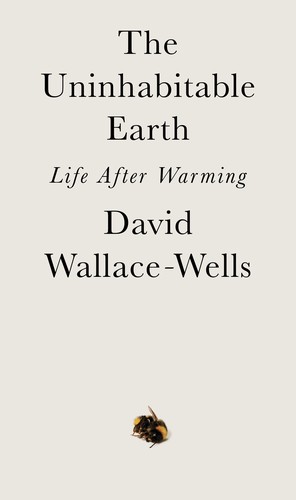
The Uninhabitable Earth is David Wallace-Wells's catalog of what climate change will do to human civilization if carbon emissions continue on or near their current trajectory.
David Wallace-Wells · 2019 · 5h 40m
Full summary and key takeaways →The 12 questions
- 1.
Wallace-Wells deliberately presents worst-case scenarios. Do you find that a responsible framing for climate communication, or does it risk inducing fatalism?
- 2.
The book argues that current policy frameworks are inadequate for the scale of the problem. What would adequate policy look like, and who would need to be persuaded to support it?
- 3.
How has reading this book changed, if at all, your emotional relationship to climate change as a problem — more anxious, more motivated, more resigned, or something else?
- 4.
Wallace-Wells is critical of techno-optimism but does not dismiss technology solutions entirely. Where do you place solar geoengineering or carbon capture in the realistic toolkit?
- 5.
The economic sections argue that climate change will cost far more than current models estimate. How should policymakers handle large uncertainty ranges in economic projections of harm?
- 6.
The book identifies specific regions — the Persian Gulf, South Asia — where heat death may become a regular feature of summer. What obligations do wealthy countries have to those populations?
- 7.
Wallace-Wells mentions that past climate communications may have focused too much on distant future scenarios. Do you think the framing of climate change in media has improved, worsened, or stayed roughly the same since this book was published?
- 8.
The chapter on climate and conflict argues that resource scarcity and heat stress increase violence. Does that causal claim seem convincing to you, and what would change your mind?
- 9.
Some climate scientists criticized the book for emphasizing catastrophic tail risks. Is there a meaningful difference between presenting the worst plausible science accurately and fearmongering?
- 10.
How much of your own lifestyle changes would you make — in diet, travel, or consumption — if you were confident they would make a meaningful collective difference?
- 11.
Wallace-Wells writes from New York. How differently might this book read if written from Bangladesh, the Sahel, or the Maldives?
- 12.
What is the most important fact you learned from this book that you think the average person doesn't know?
How to run the discussion
- Pick six to eight, not all of them. An hour of real discussion covers fewer questions than anyone expects, and racing the list is what makes a book club feel like homework.
- Open with what people noticed, not what they concluded. Asking for a verdict first hardens opinions before anyone has heard each other.
- Let the disagreement run. The questions below that split a room are the ones worth the time; the ones everyone answers the same way can be skipped.
- Ask the quiet person a specific question. A direct, narrow question is far easier to answer than an open invitation to contribute.
Themes worth steering toward
If the conversation stalls, these are the threads that usually restart it.
Common questions
What are good book club questions for The Uninhabitable Earth: Life After Warming?
Here are 12 book club questions for The Uninhabitable Earth: Life After Warming by David Wallace-Wells, ordered to open easily and end somewhere worth arguing about. The strongest openers ask what each reader noticed rather than what they concluded, and the discussion usually turns on climate change, extinction, politics.
How long should a book club discussion of The Uninhabitable Earth: Life After Warming last?
Most groups run 60 to 90 minutes of actual discussion. That is roughly six to eight questions, not all of them, so pick the ones that suit your group rather than working down the list in order.
What are the main themes in The Uninhabitable Earth: Life After Warming?
Climate change, Extinction, Politics, Economy, Human civilization. Those are the threads most likely to divide a room, which makes them the useful places to steer a discussion that has gone quiet.
Picking the next one? See books like The Uninhabitable Earth: Life After Warming or questions for other book club picks.
