Religion & Spirituality · Book club
The Untethered Soul book club questions
Here are 11 book club questions for The Untethered Soul by Michael A. Singer, ordered to open easily and end somewhere worth arguing about. Copy them, print them, or bring them up one at a time.
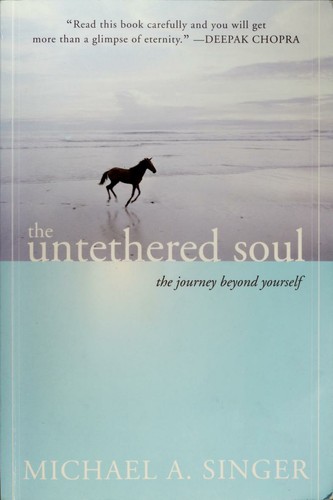
The Untethered Soul is Michael Singer's guide to liberation through the direct investigation of consciousness — specifically, the question of who or what is aware of the constant stream of thoughts, emotions, and sensations that constitute ordinary experience.
Michael A. Singer · 2007 · 4h 40m
Full summary and key takeaways →The 11 questions
- 1.
Singer says you are not the voice in your head — you are aware of it. Can you verify that distinction right now in your own experience?
- 2.
He describes the practice as staying open rather than contracting when difficult emotions arise. What specifically happens in your body and mind when you 'close' in response to something painful?
- 3.
The book argues that most of our lives are organized around avoiding encountering stored psychological pain. If that is true, what would your life look like without that organizing principle?
- 4.
Singer distinguishes between the temporary contents of consciousness and the witnessing consciousness itself. Is the witness really unchanging, or is that an idealization?
- 5.
The heart stays open or closes — that is presented as the most fundamental choice. How often in an ordinary day are you making that choice consciously?
- 6.
He says liberation doesn't require changing external circumstances but changing your relationship to consciousness. Is that a liberating or a potentially quietist teaching?
- 7.
Singer compares blocked emotional energy to a thorn you arrange your entire life around not touching. Is there a specific 'thorn' in your own psychology that fits that description?
- 8.
The teaching on death — that fear of death dissolves when you identify with consciousness rather than body-mind — is the book's most demanding claim. Does it seem true or is it a consolation?
- 9.
Singer's framework draws on Vedanta, yoga, and Buddhism without formal affiliation. Does the non-denominational framing help or hinder the teaching?
- 10.
He describes 'Mickey Singer' as a character he observes rather than identifies with. Is that level of detachment from your own personality achievable or even desirable?
- 11.
What one practice from this book could you implement immediately that would genuinely test its claims?
How to run the discussion
- Pick six to eight, not all of them. An hour of real discussion covers fewer questions than anyone expects, and racing the list is what makes a book club feel like homework.
- Open with what people noticed, not what they concluded. Asking for a verdict first hardens opinions before anyone has heard each other.
- Let the disagreement run. The questions below that split a room are the ones worth the time; the ones everyone answers the same way can be skipped.
- Ask the quiet person a specific question. A direct, narrow question is far easier to answer than an open invitation to contribute.
Themes worth steering toward
If the conversation stalls, these are the threads that usually restart it.
Common questions
What are good book club questions for The Untethered Soul?
Here are 11 book club questions for The Untethered Soul by Michael A. Singer, ordered to open easily and end somewhere worth arguing about. The strongest openers ask what each reader noticed rather than what they concluded, and the discussion usually turns on consciousness, the self, liberation.
How long should a book club discussion of The Untethered Soul last?
Most groups run 60 to 90 minutes of actual discussion. That is roughly six to eight questions, not all of them, so pick the ones that suit your group rather than working down the list in order.
What are the main themes in The Untethered Soul?
Consciousness, The self, Liberation, Presence, Inner energy. Those are the threads most likely to divide a room, which makes them the useful places to steer a discussion that has gone quiet.
Picking the next one? See books like The Untethered Soul or questions for other book club picks.
