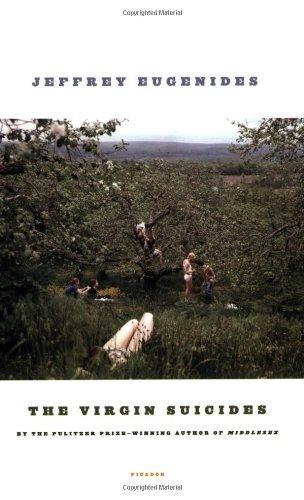
Talk to The Virgin Suicides like its author wrote you back.
Get the ideas that fit your life — not generic summaries.
- Chat with the book
- Audiobook-style main ideas
- Adapts to your life and goals
- Helps you take action
The Virgin Suicides, in detail
Five sisters. One year. A neighborhood still trying to make sense of it decades later. The Virgin Suicides is narrated by a collective "we" — a group of middle-aged men who were teenage boys in the suburb of Grosse Pointe, Michigan in the 1970s and who have spent their adult lives obsessively reconstructing the lives and deaths of the Lisbon girls: Cecilia, Lux, Bonnie, Mary, and Therese. The novel opens with the youngest girl's attempted suicide, and what follows is part mystery, part elegy, part case study in the impossibility of truly knowing another person.
The book is not really about suicide. It is about the stories we tell ourselves about the people we want but cannot understand. The boys collect objects, newspaper clippings, diary entries — evidence — and build an elaborate mythology around girls they never actually knew. Eugenides is precise about what the novel is doing: the Lisbon sisters remain opaque because the narrators are projecting onto them, and the act of projection is itself the subject. The girls' interiority is glimpsed in fragments, always through a filter. The mother who imprisons them, the father who recedes, the neighborhood that watches and waits — none of them see the sisters clearly either.
Eugenides's debut is formally inventive in an unshowy way. The collective narrator creates a strange dreamy distance, like a documentary assembled from survivors' testimonies. The prose is lush without tipping into sentimentality. The novel manages to be gorgeous and deeply unsettling at the same time, which is hard to do. Published to wide acclaim in 1993, it became a cult text partly because of Sofia Coppola's 1999 film adaptation, which captured its mood perfectly.
This is not a comfortable book, and it's not meant to be. Readers who want a clear explanation, resolution, or catharsis will be frustrated — deliberately so. Those who find that frustration meaningful, who are interested in what fiction can do with limited and unreliable perspectives, will find it haunting. It pairs well with books about the male gaze, about suburban America, about the distance between observers and observed.
The big ideas
- 1.
The collective male narrator is the real subject — the novel is about how young men mythologize women they barely know, not about the women themselves.
- 2.
Eugenides keeps the sisters' interiority almost entirely out of reach, which is formally central: we cannot understand them because the narrators never could.
- 3.
The suburb is a trap that predates the parents' restrictions. Grosse Pointe's manicured conformity is itself a form of suffocation.
