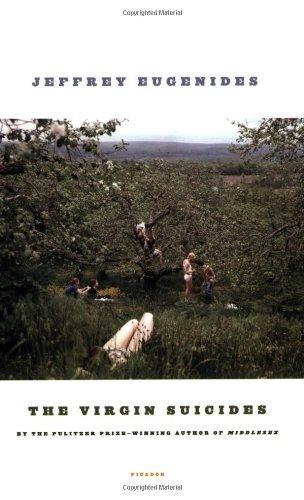
The Virgin Suicides by Jeffrey Eugenides is a 1993 literary fiction book about female adolescence, male gaze and projection, suburban entrapment. The collective male narrator is the real subject — the novel is about how young men mythologize women they barely know, not about the women themselves.
Summary
Five sisters. One year. A neighborhood still trying to make sense of it decades later. The Virgin Suicides is narrated by a collective "we" — a group of middle-aged men who were teenage boys in the suburb of Grosse Pointe, Michigan in the 1970s and who have spent their adult lives obsessively reconstructing the lives and deaths of the Lisbon girls: Cecilia, Lux, Bonnie, Mary, and Therese. The novel opens with the youngest girl's attempted suicide, and what follows is part mystery, part elegy, part case study in the impossibility of truly knowing another person.
The book is not really about suicide. It is about the stories we tell ourselves about the people we want but cannot understand. The boys collect objects, newspaper clippings, diary entries — evidence — and build an elaborate mythology around girls they never actually knew. Eugenides is precise about what the novel is doing: the Lisbon sisters remain opaque because the narrators are projecting onto them, and the act of projection is itself the subject. The girls' interiority is glimpsed in fragments, always through a filter. The mother who imprisons them, the father who recedes, the neighborhood that watches and waits — none of them see the sisters clearly either.
Eugenides's debut is formally inventive in an unshowy way. The collective narrator creates a strange dreamy distance, like a documentary assembled from survivors' testimonies. The prose is lush without tipping into sentimentality. The novel manages to be gorgeous and deeply unsettling at the same time, which is hard to do. Published to wide acclaim in 1993, it became a cult text partly because of Sofia Coppola's 1999 film adaptation, which captured its mood perfectly.
This is not a comfortable book, and it's not meant to be. Readers who want a clear explanation, resolution, or catharsis will be frustrated — deliberately so. Those who find that frustration meaningful, who are interested in what fiction can do with limited and unreliable perspectives, will find it haunting. It pairs well with books about the male gaze, about suburban America, about the distance between observers and observed.
Talk to The Virgin Suicides like its author wrote you back.
Get the ideas that fit your life — not generic summaries.
- Chat with the book
- Audiobook-style main ideas
- Adapts to your life and goals
- Helps you take action
Key takeaways
- 1.
The collective male narrator is the real subject — the novel is about how young men mythologize women they barely know, not about the women themselves.
- 2.
Eugenides keeps the sisters' interiority almost entirely out of reach, which is formally central: we cannot understand them because the narrators never could.
- 3.
The suburb is a trap that predates the parents' restrictions. Grosse Pointe's manicured conformity is itself a form of suffocation.
- 4.
Cecilia's diary, the one piece of genuine interiority in the book, frustrates the boys because it contains ordinary life, not the dark poetry they expected.
- 5.
The novel treats adolescent female experience as genuinely mysterious and resistant to interpretation — not mystically, but structurally.
- 6.
Memory and obsession are indistinguishable in the narrators' accounting. The decades-long project of reconstruction is its own form of possession.
- 7.
The parents' grief and their failures are rendered with unexpected compassion rather than villainy — the tragedy exceeds any single cause.
- 8.
The ending resists resolution precisely because resolution would betray the novel's core argument: some experiences are not interpretable from the outside.
Discussion questions
Use these on your own, with a book club, or as chat starters in Superbook. Book club version, ready to copy or print →
- 1.
The collective 'we' narrator is entirely male. How does that choice shape what the novel can and cannot tell us about the Lisbon sisters?
- 2.
Cecilia's diary disappoints the boys because it reads as mundane. What were they looking for, and what does that expectation reveal about them?
- 3.
The parents are often read as villains, but Eugenides gives them grief and bewilderment too. Do you read Mr. and Mrs. Lisbon as responsible, as failures, or as something more complicated?
- 4.
The novel was adapted into a film by Sofia Coppola in 1999. If you've seen it, how does it handle the male gaze problem compared to the book?
- 5.
Each Lisbon sister is given a rough personality — the intellectual, the rebel, the romantic — but they remain sketchy. Is that a flaw or a feature?
- 6.
The neighborhood watches and speculates throughout. What does the community's obsession with the Lisbon girls tell us about how adolescent girls are seen in American suburbia?
- 7.
Trip Fontaine's relationship with Lux is one of the few moments where the narrative perspective briefly opens up. What does that section change about how we read the rest?
- 8.
The novel treats the suburban setting as a kind of character. Is Grosse Pointe complicit in what happens, or is that too neat a reading?
- 9.
The boys grow into men and never fully move on. Is the novel critiquing that obsession, mourning it, or something in between?
- 10.
How does the form — collective narrator, documentary style, assembled evidence — shape your emotional response? Would the novel have worked in third-person?
- 11.
The book was published in 1993. Does it feel dated? Does the setting in the 1970s give it distance that allows it to explore things a contemporary setting couldn't?
- 12.
The title names the suicides before the story begins. How does knowing the ending from the first page change the reading experience?
Themes
Frequently asked questions
-
Is The Virgin Suicides based on a true story?
No. Eugenides has said the book was inspired by a news story about multiple suicides in a single family, but the characters and events are invented. The novel is set in a fictionalized version of suburban Michigan, and the period detail (1970s Grosse Pointe) is atmospheric rather than documentary.
-
Is the novel hard to read emotionally?
The subject matter is difficult, but the prose style — cool, elegiac, told from a retrospective distance — manages the emotional weight carefully. It's not a brutal read in the way that, say, a graphic psychological thriller is. The distance is the point: you're watching people watch other people, which creates a different kind of unease.
-
How does the book compare to Sofia Coppola's film?
The film captures the novel's dreamy melancholy well and respects the formal conceit. The book gives you more of the boys' interior voices and the documentary accumulation of evidence. Most readers who love one tend to appreciate the other, though the novel rewards re-reading in ways the film doesn't quite replicate.
-
Who shouldn't read The Virgin Suicides?
Readers who are sensitive to suicide as a subject matter should approach with care, though the treatment is not gratuitous. Those who want a plot-driven novel with answers and resolution will be frustrated — the book withholds explanation deliberately. It's a novel that rewards sitting with ambiguity.
-
Is it Eugenides's best novel?
Middlesex won the Pulitzer, but many readers consider The Virgin Suicides his most formally perfect book — tight, atmospheric, formally daring in a way his longer novels aren't. It depends what you're looking for: scope and ambition (Middlesex), or compression and unease (The Virgin Suicides).