Science · Book club
The Vital Question book club questions
Here are 12 book club questions for The Vital Question by Nick Lane, ordered to open easily and end somewhere worth arguing about. Copy them, print them, or bring them up one at a time.
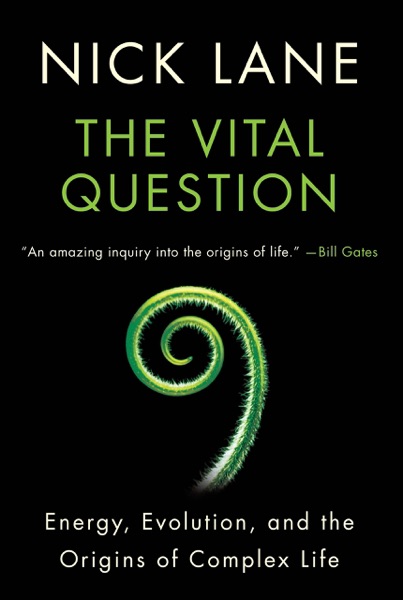
The Vital Question asks why life is the way it is — why all complex life is eukaryotic, why eukaryotes all have mitochondria, why sex exists, why organisms age and die, and why life may be exceedingly rare in the universe.
Nick Lane · 2015 · 6h 45m
Full summary and key takeaways →The 12 questions
- 1.
Lane argues the eukaryotic merger may have happened only once in four billion years. If that's right, what does it imply about the likelihood of complex life elsewhere in the universe?
- 2.
The book claims that energy constraints, not random mutation alone, explain the shape of evolution. How does that change your intuitive picture of how life evolves?
- 3.
Lane is explicit about which parts of his argument are established and which are speculative. Did that transparency make the book more or less compelling to you?
- 4.
If mitochondria are the reason sex exists, does that change how you think about the relationship between biological function and the behaviors or structures it produces?
- 5.
The book argues that bacteria have been energetically constrained for four billion years and have not evolved complexity despite the time available. What does that say about the popular idea that evolution inevitably produces progress?
- 6.
Lane's account of aging is essentially mechanical — mitochondrial damage accumulating over time. Does a mechanistic explanation of aging change how you think about it?
- 7.
The alkaline hydrothermal vent hypothesis for life's origins is not consensus science. How do you evaluate a popular science book that builds on contested hypotheses?
- 8.
Lane uses the energy per gene metric to compare bacteria and eukaryotes. Did you find that framing convincing, or did it feel too reductive?
- 9.
The book covers thermodynamics, geochemistry, evolutionary biology, and cell biology in one argument. Which domain did you find most difficult, and did Lane successfully carry you through it?
- 10.
If mitochondria explain aging, sex, and the rarity of complex life, what other biological puzzles might have a similar deep energetic explanation?
- 11.
Lane writes primarily for curious non-specialists. Where did you feel the book asked too much of the reader, and where did you want more depth?
- 12.
Lane's thesis is optimistic about science's ability to explain life's fundamental features from physical principles. Do you share that optimism, or does life feel irreducibly contingent to you?
How to run the discussion
- Pick six to eight, not all of them. An hour of real discussion covers fewer questions than anyone expects, and racing the list is what makes a book club feel like homework.
- Open with what people noticed, not what they concluded. Asking for a verdict first hardens opinions before anyone has heard each other.
- Let the disagreement run. The questions below that split a room are the ones worth the time; the ones everyone answers the same way can be skipped.
- Ask the quiet person a specific question. A direct, narrow question is far easier to answer than an open invitation to contribute.
Themes worth steering toward
If the conversation stalls, these are the threads that usually restart it.
Common questions
What are good book club questions for The Vital Question?
Here are 12 book club questions for The Vital Question by Nick Lane, ordered to open easily and end somewhere worth arguing about. The strongest openers ask what each reader noticed rather than what they concluded, and the discussion usually turns on evolution, bioenergetics, origins of life.
How long should a book club discussion of The Vital Question last?
Most groups run 60 to 90 minutes of actual discussion. That is roughly six to eight questions, not all of them, so pick the ones that suit your group rather than working down the list in order.
What are the main themes in The Vital Question?
Evolution, Bioenergetics, Origins of life, Cell biology, Complexity. Those are the threads most likely to divide a room, which makes them the useful places to steer a discussion that has gone quiet.
Picking the next one? See books like The Vital Question or questions for other book club picks.
