Memoir · Book club
The Warmth of Other Suns book club questions
Here are 11 book club questions for The Warmth of Other Suns by Isabel Wilkerson, ordered to open easily and end somewhere worth arguing about. Copy them, print them, or bring them up one at a time.
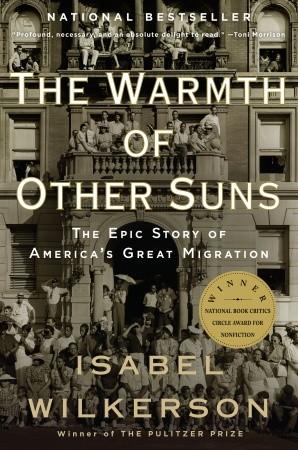
Isabel Wilkerson's account of the Great Migration — the movement of six million Black Americans from the South to the North and West between 1915 and 1970 — is one of the most important works of narrative nonfiction published in the twenty-first century.
Isabel Wilkerson · 2010 · 14h 40m
Full summary and key takeaways →The 11 questions
- 1.
Wilkerson uses three individual stories to represent six million. How well does this narrative strategy work? What might it miss?
- 2.
The Jim Crow system is rendered through physical and documentary specificity. Does Wilkerson's approach — showing rather than analyzing — make the system more or less understandable than a more analytical account would?
- 3.
Each of the three migrants chose a different city. How do their different destinations shape their different outcomes?
- 4.
Wilkerson is careful not to romanticize the North. Do you think she succeeds? Does the book ever suggest that the North was a kind of promised land?
- 5.
The book argues that the Great Migration transformed American culture. What specific cultural changes does it attribute to the migration?
- 6.
Robert Pershing Foster drove across the South to California and was refused lodging at every white motel en route. What does that episode say about the migration's conditions?
- 7.
The book took fifteen years. Does that investment show in the text? What do you attribute to the length of the research?
- 8.
Ida Mae Gladney, George Starling, and Robert Foster were alive when Wilkerson interviewed them and contributed their memories to the book. How does living-subject memoir differ from biographical reconstruction from archives?
- 9.
The title comes from Richard Wright. What does the image of the 'warmth of other suns' capture about the migration's motivations?
- 10.
The Great Migration happened within the living memory of older Americans. How does proximity to living witnesses change what narrative nonfiction can do?
- 11.
What does the book suggest about the relationship between individual choices and historical forces?
How to run the discussion
- Pick six to eight, not all of them. An hour of real discussion covers fewer questions than anyone expects, and racing the list is what makes a book club feel like homework.
- Open with what people noticed, not what they concluded. Asking for a verdict first hardens opinions before anyone has heard each other.
- Let the disagreement run. The questions below that split a room are the ones worth the time; the ones everyone answers the same way can be skipped.
- Ask the quiet person a specific question. A direct, narrow question is far easier to answer than an open invitation to contribute.
Themes worth steering toward
If the conversation stalls, these are the threads that usually restart it.
Common questions
What are good book club questions for The Warmth of Other Suns?
Here are 11 book club questions for The Warmth of Other Suns by Isabel Wilkerson, ordered to open easily and end somewhere worth arguing about. The strongest openers ask what each reader noticed rather than what they concluded, and the discussion usually turns on migration, race, identity.
How long should a book club discussion of The Warmth of Other Suns last?
Most groups run 60 to 90 minutes of actual discussion. That is roughly six to eight questions, not all of them, so pick the ones that suit your group rather than working down the list in order.
What are the main themes in The Warmth of Other Suns?
Migration, Race, Identity, American South, Freedom. Those are the threads most likely to divide a room, which makes them the useful places to steer a discussion that has gone quiet.
Picking the next one? See books like The Warmth of Other Suns or questions for other book club picks.
