Science · Book club
The Water Will Come: Rising Seas, Sinking Cities, and the Remaking of the Civilized World book club questions
Here are 12 book club questions for The Water Will Come: Rising Seas, Sinking Cities, and the Remaking of the Civilized World by Jeff Goodell, ordered to open easily and end somewhere worth arguing about. Copy them, print them, or bring them up one at a time.
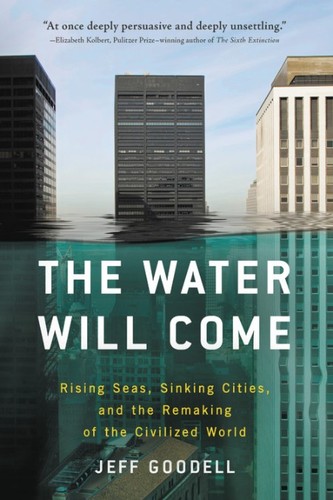
Jeff Goodell spent years traveling to the places most threatened by rising seas — Miami, Rotterdam, Lagos, Dhaka, Venice, the Marshall Islands — and The Water Will Come is the result of that reporting.
Jeff Goodell · 2017 · 5h 45m
Full summary and key takeaways →The 12 questions
- 1.
Goodell argues that retreat from flood zones is inevitable for many communities. What would make that process equitable, and who should pay for it?
- 2.
Miami developers continue selling coastal real estate while scientists warn of impending inundation. How do you explain that disconnect, and who bears responsibility for it?
- 3.
Rotterdam has invested massively in flood adaptation. What makes some cities capable of that kind of long-range planning while others can't manage it?
- 4.
The Marshall Islands face disappearance as a nation. What obligations do high-emitting countries have to those island nations?
- 5.
Goodell shows that the official sea level projections used for planning are often the conservative midpoint rather than the higher-end plausible scenarios. Is that appropriate, or is it a form of institutional denial?
- 6.
How has living near water — ocean, river, or lake — shaped your sense of place? Does reading about sea level rise change that relationship?
- 7.
The book documents how flood insurance creates perverse incentives. Are there other areas of public policy where insurance or subsidies are quietly making long-term problems worse?
- 8.
Goodell visits communities that have already been displaced by flooding. What does losing a place — a neighborhood, a city, a homeland — cost beyond the material?
- 9.
Which is the more honest response to sea level rise: aggressive emissions reduction, adaptation investment, or planned retreat? Can you make a case for prioritizing one?
- 10.
The book was published in 2017. How has the situation changed in the years since, in your view?
- 11.
Who do you think should bear the cost of relocating communities displaced by sea level rise — local governments, national governments, fossil fuel companies, or all consumers of carbon energy?
- 12.
Goodell suggests the hardest truth is that some coastal cities cannot be saved. If you lived in one of those cities, how would you want your leaders to communicate that reality?
How to run the discussion
- Pick six to eight, not all of them. An hour of real discussion covers fewer questions than anyone expects, and racing the list is what makes a book club feel like homework.
- Open with what people noticed, not what they concluded. Asking for a verdict first hardens opinions before anyone has heard each other.
- Let the disagreement run. The questions below that split a room are the ones worth the time; the ones everyone answers the same way can be skipped.
- Ask the quiet person a specific question. A direct, narrow question is far easier to answer than an open invitation to contribute.
Themes worth steering toward
If the conversation stalls, these are the threads that usually restart it.
Common questions
What are good book club questions for The Water Will Come: Rising Seas, Sinking Cities, and the Remaking of the Civilized World?
Here are 12 book club questions for The Water Will Come: Rising Seas, Sinking Cities, and the Remaking of the Civilized World by Jeff Goodell, ordered to open easily and end somewhere worth arguing about. The strongest openers ask what each reader noticed rather than what they concluded, and the discussion usually turns on climate change, sea level rise, urban vulnerability.
How long should a book club discussion of The Water Will Come: Rising Seas, Sinking Cities, and the Remaking of the Civilized World last?
Most groups run 60 to 90 minutes of actual discussion. That is roughly six to eight questions, not all of them, so pick the ones that suit your group rather than working down the list in order.
What are the main themes in The Water Will Come: Rising Seas, Sinking Cities, and the Remaking of the Civilized World?
Climate change, Sea level rise, Urban vulnerability, Environmental policy, Infrastructure. Those are the threads most likely to divide a room, which makes them the useful places to steer a discussion that has gone quiet.
Picking the next one? See books like The Water Will Come: Rising Seas, Sinking Cities, and the Remaking of the Civilized World or questions for other book club picks.
