Psychology · Book club
The Whole-Brain Child: 12 Revolutionary Strategies to Nurture Your Child's Developing Mind book club questions
Here are 12 book club questions for The Whole-Brain Child: 12 Revolutionary Strategies to Nurture Your Child's Developing Mind by Daniel J. Siegel and Tina Payne Bryson, ordered to open easily and end somewhere worth arguing about. Copy them, print them, or bring them up one at a time.
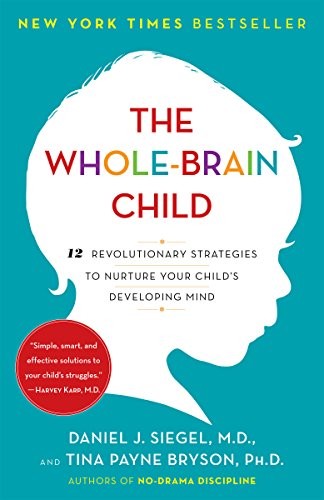
Daniel Siegel and Tina Payne Bryson's premise is that much of what frustrates parents — tantrums, defiance, emotional meltdowns — is best understood not as bad behavior but as immature brain function.
Daniel J. Siegel and Tina Payne Bryson · 2011 · 4h 15m
Full summary and key takeaways →The 12 questions
- 1.
Siegel and Bryson say that during an emotional meltdown, reasoning with a child is neurologically futile. Think of a time when someone tried to reason with you when you were emotionally overwhelmed. What would have helped instead?
- 2.
The concept of 'flipping the lid' applies to adults as well as children. When does your own upstairs brain go offline, and what triggers it?
- 3.
The book asks parents to see meltdowns as teaching opportunities rather than discipline problems. What does it take to make that shift in the moment, and what makes it hard?
- 4.
The authors distinguish between discipline that punishes behavior and discipline that builds brain capacity. How were you disciplined as a child, and how does that affect how you respond to children now?
- 5.
The left brain handles language and narrative; the right handles emotion and sensation. What does it mean in practice to connect with a child's right-brain experience before engaging their left brain?
- 6.
Siegel and Bryson argue that retelling a frightening experience in narrative form helps integrate it neurologically. Have you experienced something like this — a story that helped you make sense of something difficult?
- 7.
The book assumes parents have the capacity to stay regulated themselves in order to help a child regulate. What are the conditions under which that capacity fails, and what happens then?
- 8.
Which of the twelve strategies seems most immediately useful to you, and which seems hardest to implement in real circumstances?
- 9.
The book addresses early childhood primarily. How might the framework — upstairs/downstairs, left/right — apply to your interactions with adolescents or adults?
- 10.
Siegel and Bryson argue that brain integration is built in relationships. What does that suggest about children who lack consistent, regulated caregiving?
- 11.
The book does not address severe behavioral or developmental disorders. What are the limits of applying this framework to children whose neurological challenges are more significant?
- 12.
What aspect of your own upbringing do you now understand differently through the lens of brain development and integration?
How to run the discussion
- Pick six to eight, not all of them. An hour of real discussion covers fewer questions than anyone expects, and racing the list is what makes a book club feel like homework.
- Open with what people noticed, not what they concluded. Asking for a verdict first hardens opinions before anyone has heard each other.
- Let the disagreement run. The questions below that split a room are the ones worth the time; the ones everyone answers the same way can be skipped.
- Ask the quiet person a specific question. A direct, narrow question is far easier to answer than an open invitation to contribute.
Themes worth steering toward
If the conversation stalls, these are the threads that usually restart it.
Common questions
What are good book club questions for The Whole-Brain Child: 12 Revolutionary Strategies to Nurture Your Child's Developing Mind?
Here are 12 book club questions for The Whole-Brain Child: 12 Revolutionary Strategies to Nurture Your Child's Developing Mind by Daniel J. Siegel and Tina Payne Bryson, ordered to open easily and end somewhere worth arguing about. The strongest openers ask what each reader noticed rather than what they concluded, and the discussion usually turns on child development, parenting, neuroscience.
How long should a book club discussion of The Whole-Brain Child: 12 Revolutionary Strategies to Nurture Your Child's Developing Mind last?
Most groups run 60 to 90 minutes of actual discussion. That is roughly six to eight questions, not all of them, so pick the ones that suit your group rather than working down the list in order.
What are the main themes in The Whole-Brain Child: 12 Revolutionary Strategies to Nurture Your Child's Developing Mind?
Child development, Parenting, Neuroscience, Emotional regulation, Attachment. Those are the threads most likely to divide a room, which makes them the useful places to steer a discussion that has gone quiet.
Picking the next one? See books like The Whole-Brain Child: 12 Revolutionary Strategies to Nurture Your Child's Developing Mind or questions for other book club picks.
