Science · Book club
The Whole Shebang book club questions
Here are 12 book club questions for The Whole Shebang by Timothy Ferris, ordered to open easily and end somewhere worth arguing about. Copy them, print them, or bring them up one at a time.
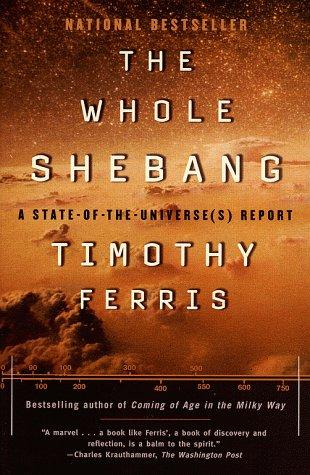
Timothy Ferris wrote The Whole Shebang in 1997 as a state-of-the-art survey of modern cosmology — what scientists knew, what they debated, and how they knew it.
Timothy Ferris · 1997 · 6h 45m
Full summary and key takeaways →The 12 questions
- 1.
Ferris captures cosmology at a transitional moment — before dark energy was confirmed. How does reading a scientific book that has since been partly updated change your relationship to its claims?
- 2.
The Big Bang means space itself expanded, not that matter exploded into pre-existing space. How does that distinction change how you think about the question 'What was there before the Big Bang?'
- 3.
Inflation theory was introduced to solve specific mathematical problems with the Big Bang model. Does knowing a theory was invented to solve a problem make you more or less confident in it?
- 4.
Dark matter has never been directly detected, only inferred from its gravitational effects. How comfortable are you accepting scientific consensus built on indirect evidence?
- 5.
The observable universe is bounded by the speed of light and the age of the universe. Does the existence of an observational horizon trouble you, or does it just feel like a practical limitation?
- 6.
Ferris distinguishes between what the evidence supports and what the mathematics permits. Where do you draw the line between science and speculation?
- 7.
Cosmology deals in scales — billions of years, billions of light-years — that no human experience can make intuitive. How do you personally handle knowledge that cannot be felt or visualized?
- 8.
The book was written when the question of whether the universe is open, flat, or closed was genuinely open. What does it mean to live in a time when such a fundamental question was unanswered?
- 9.
Ferris describes the scientific community's debates and disagreements in real time. Does seeing science as a process of argument and revision make it feel more or less trustworthy to you?
- 10.
The possibility of a multiverse appears in the book as a mathematical implication rather than an observed fact. What would it take for you to find a multiverse hypothesis credible?
- 11.
What does it do to your sense of meaning or purpose to seriously contemplate a universe that is roughly 93 billion light-years across and almost 14 billion years old?
- 12.
If you could ask one cosmological question that current science cannot answer, what would it be?
How to run the discussion
- Pick six to eight, not all of them. An hour of real discussion covers fewer questions than anyone expects, and racing the list is what makes a book club feel like homework.
- Open with what people noticed, not what they concluded. Asking for a verdict first hardens opinions before anyone has heard each other.
- Let the disagreement run. The questions below that split a room are the ones worth the time; the ones everyone answers the same way can be skipped.
- Ask the quiet person a specific question. A direct, narrow question is far easier to answer than an open invitation to contribute.
Themes worth steering toward
If the conversation stalls, these are the threads that usually restart it.
Common questions
What are good book club questions for The Whole Shebang?
Here are 12 book club questions for The Whole Shebang by Timothy Ferris, ordered to open easily and end somewhere worth arguing about. The strongest openers ask what each reader noticed rather than what they concluded, and the discussion usually turns on cosmology, big bang, dark matter.
How long should a book club discussion of The Whole Shebang last?
Most groups run 60 to 90 minutes of actual discussion. That is roughly six to eight questions, not all of them, so pick the ones that suit your group rather than working down the list in order.
What are the main themes in The Whole Shebang?
Cosmology, Big Bang, Dark matter, Scientific method, Universe origins. Those are the threads most likely to divide a room, which makes them the useful places to steer a discussion that has gone quiet.
Picking the next one? See books like The Whole Shebang or questions for other book club picks.
