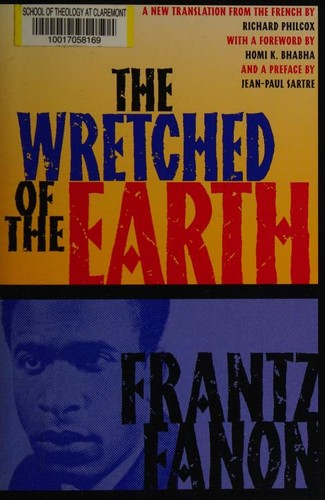
The Wretched of the Earth by Frantz Fanon is a 1961 history book about colonialism, decolonization, violence. Colonialism is not primarily economic — it is ontological: it constructs the colonized as sub-human and produces a psychic damage that political independence alone does not repair.
Summary
The Wretched of the Earth, published in 1961 shortly before Fanon's death from leukemia, is a political and psychiatric analysis of colonialism and the conditions required for genuine decolonization. Fanon was writing from his experience as a psychiatrist in Algeria during the independence war against France, and the book draws on both that clinical practice and his theoretical engagement with Marxism, phenomenology, and psychoanalysis. Jean-Paul Sartre's preface, which argued for the moral necessity of anti-colonial violence, made the book notorious in France and important in liberation movements globally.
Fanon's central argument is that colonialism is not primarily an economic arrangement but a psychological and ontological one. The colonial system creates a Manichean world — the colonized and the colonizer — in which the humanity of the native is systematically denied. The colonized person internalizes that denial, which produces what Fanon calls the inferiority complex: a fractured self-image built on the categories of the colonizer. Decolonization, for Fanon, cannot be merely a transfer of political power from European administrators to an African educated class. It must rupture the entire psychic architecture that colonialism built.
The book's most controversial section argues that violence is not simply a means to political ends but a cathartic and transformative force for the colonized. Fanon is not celebrating violence for its own sake — he is describing what he observed clinically and argues that the colonized person who is permitted no other form of agency experiences violence as the one area of total action available. This argument has been misread and misused, but it is inseparable from Fanon's broader analysis: the colonized are not just politically subordinate, they are denied the full status of human beings, and any adequate response must address that totality.
The later chapters on national consciousness and the pitfalls of national culture are, in some ways, Fanon's most prescient. He warns that political independence, if captured by a native bourgeoisie that simply replicates colonial structures with Black faces at the top, will be a betrayal of the revolution. He argues for a genuinely popular, broadly based decolonization that transforms economic and psychic conditions together. Many of his warnings about the post-independence state proved accurate in the decades following African independence movements.
Talk to The Wretched of the Earth like its author wrote you back.
Get the ideas that fit your life — not generic summaries.
- Chat with the book
- Audiobook-style main ideas
- Adapts to your life and goals
- Helps you take action
Key takeaways
- 1.
Colonialism is not primarily economic — it is ontological: it constructs the colonized as sub-human and produces a psychic damage that political independence alone does not repair.
- 2.
The Manichean division between colonizer and colonized is the structural foundation of the colonial world, and decolonization must rupture that division, not simply change who sits at the top.
- 3.
Violence, in Fanon's analysis, functions for the colonized not only as a means to political ends but as a reclamation of agency in a system that has denied all other forms of action.
- 4.
National consciousness, unless it develops into genuine social and economic transformation, will be captured by a native bourgeoisie that reproduces colonial hierarchies with new personnel.
- 5.
The colonial psychiatric patient's symptoms cannot be treated without addressing the colonial conditions that produced them — individual therapy and political change are inseparable.
- 6.
Culture under colonialism is systematically devalued; the recovery of pre-colonial cultural identity is part of decolonization, but it cannot substitute for material and political transformation.
- 7.
Fanon's warnings about post-independence Africa — that a comprador elite would reproduce colonialism under a national flag — proved accurate in many contexts within decades of the book's publication.
- 8.
The 'wretched of the earth' are not a fixed category but a political and historical one: the colonized masses whose collective action is the only force capable of genuine decolonization.
Discussion questions
Use these on your own, with a book club, or as chat starters in Superbook. Book club version, ready to copy or print →
- 1.
Fanon argues that colonialism is ontological, not just economic. What does he mean, and does that claim change how you think about political solutions?
- 2.
His argument about violence as cathartic has been both celebrated and condemned. What is the most accurate reading of what he is actually claiming?
- 3.
Fanon wrote from within the Algerian war. How does that specific context shape his generalizations about colonialism globally?
- 4.
He warns that national independence can be captured by a native bourgeoisie that replicates colonial structures. How accurate was that prediction in postcolonial Africa and Asia?
- 5.
The book draws on Marxism, phenomenology, and psychoanalysis simultaneously. Is that theoretical eclecticism a strength or does it create contradictions?
- 6.
Sartre's preface argued the book endorsed colonial subjects killing Europeans. Did you read it that way? What is the relationship between Sartre's framing and Fanon's own argument?
- 7.
Fanon describes specific psychiatric cases from the Algerian war. What does the clinical material add to the political analysis?
- 8.
The book was enormously influential in liberation movements from the Black Panthers to the Palestinian resistance. Does that reception affect how you evaluate the arguments?
- 9.
Fanon distinguishes between national consciousness and nationalism. Why does he make that distinction, and does it hold?
- 10.
He argues that genuine decolonization must transform the consciousness of the colonized, not just their political status. Is that a psychological argument, a political one, or both?
- 11.
Reading this in 2026, which of Fanon's diagnoses feel confirmed by history, and which feel dated or wrong?
- 12.
Fanon died at 36, before seeing most post-independence African history. How do you think he would have evaluated what followed?
Themes
Frequently asked questions
-
What is The Wretched of the Earth about?
It is a political and psychiatric analysis of colonialism, arguing that colonial rule produces psychological damage as well as material exploitation, and that genuine decolonization must transform the psychic and social architecture of the colonial world, not merely change its political leadership.
-
Is The Wretched of the Earth still relevant?
Yes. Its analysis of how political independence can fail to produce genuine decolonization has been borne out in many postcolonial contexts. Its vocabulary — colonized consciousness, national bourgeoisie, the pitfalls of national culture — remains active in political theory and activism.
-
How difficult is The Wretched of the Earth to read?
It is demanding. Fanon writes across political theory, psychiatry, and phenomenology, and some sections assume familiarity with Hegel, Marx, and Sartre. The opening chapter and the concluding chapter are accessible to most readers; the middle sections on national culture are denser.
-
Who should read The Wretched of the Earth?
Students of postcolonial theory, political science, African history, and the history of revolutionary thought. It is essential context for understanding liberation movements of the 1960s and their legacy.
-
What is Fanon's argument about violence?
He argues that for people denied all other forms of agency, violence functions as a reclamation of subjectivity — an area of total action in a world that has rendered them objects. He is not endorsing violence as a universal good but describing it as a psychic and political reality within specific colonial conditions.
Similar books
Between the World and Me
Ta-Nehisi Coates
The Souls of Black Folk
W.E.B. Du Bois

Bury My Heart at Wounded Knee: An Indian History of the American West
Dee Brown
Caste: The Origins of Our Discontents
Isabel Wilkerson
