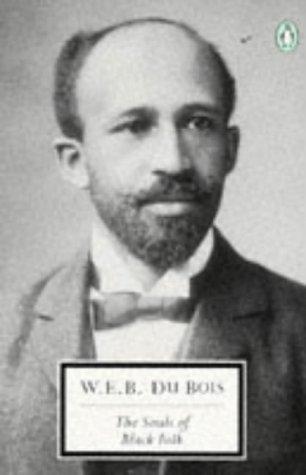
The Souls of Black Folk by W.E.B. Du Bois is a 1903 history book about double consciousness, race in america, reconstruction. Double consciousness describes the condition of living always behind a veil, seeing yourself through the hostile gaze of a white world and never through your own eyes alone.
Summary
The Souls of Black Folk, published in 1903, is W.E.B. Du Bois's attempt to describe the inner life of Black Americans at the dawn of the twentieth century — what he called the "problem of the color line." The book combines essays on Reconstruction history, sociology, education policy, and personal memoir with spiritual meditations and music. Each chapter is prefaced by a few bars of a Negro spiritual, placed alongside a quotation from white European verse — a formal choice that enacts the double consciousness Du Bois describes in the prose.
The concept of double consciousness is the book's most lasting contribution to American thought. Du Bois argues that Black Americans live behind a veil, always seeing themselves through the eyes of a white world that measures them by a standard they did not set. This produces a fractured self-awareness: to be American and to be Black is, in Du Bois's analysis, to hold two warring identities, two unreconciled selves. The gift — if it is a gift — is a second sight that comes from living in two worlds at once. The cost is exhausting.
Much of the book is historical and polemical. Du Bois provides a meticulous account of the Freedmen's Bureau and the betrayal of Reconstruction — the period after the Civil War when Black Americans briefly held political power before being systematically stripped of it. He argues directly against Booker T. Washington's program of industrial education and accommodation, insisting that political rights and higher education, not just vocational training, are essential to Black advancement. This debate — between Washington's pragmatic accommodationism and Du Bois's demand for full citizenship — was the defining political argument of the era.
The most intimate chapters are personal. Du Bois writes about teaching in rural Tennessee, about the death of his infant son, about what it means to grow up Black in New England. These passages bring the analytical arguments down to a human scale and make clear that what is at stake is not only policy but the psychic costs of living under a system designed to diminish you. Over a century later, the book retains both its sociological precision and its sorrow.
Talk to The Souls of Black Folk like its author wrote you back.
Get the ideas that fit your life — not generic summaries.
- Chat with the book
- Audiobook-style main ideas
- Adapts to your life and goals
- Helps you take action
Key takeaways
- 1.
Double consciousness describes the condition of living always behind a veil, seeing yourself through the hostile gaze of a white world and never through your own eyes alone.
- 2.
The 'problem of the color line' is Du Bois's framing for the defining political challenge of the twentieth century — and his prediction that it would be global, not just American, proved accurate.
- 3.
Reconstruction was not a failure born of Black incapacity — it was a deliberate political betrayal by white Southerners and Northern indifference, and its collapse had consequences that lasted a century.
- 4.
Du Bois's debate with Booker T. Washington turns on whether accommodation or full civic equality is the more realistic path to advancement — Du Bois argues you cannot build real security on a foundation of withheld rights.
- 5.
The Freedmen's Bureau was briefly powerful and ultimately undermined — a pattern that Du Bois traces as characteristic of American promises to Black citizens.
- 6.
Higher education, for Du Bois, is not a luxury or a symbol but a necessity: the 'talented tenth' of Black intellectuals must lead by developing the full capacities the system tries to suppress.
- 7.
The spirituals Du Bois calls 'sorrow songs' — the book's musical epigraphs — are not just cultural artifacts but a form of historical testimony and psychological survival.
- 8.
Personal grief and political analysis are not separable in Du Bois's writing: the chapter on his son's death is simultaneously an elegy and an indictment of the society that shaped the world the child would have entered.
Discussion questions
Use these on your own, with a book club, or as chat starters in Superbook. Book club version, ready to copy or print →
- 1.
Du Bois introduces double consciousness in the first essay. How does that concept hold up as a description of living with a marginalized identity — does it generalize, or is it specific to the Black American experience he describes?
- 2.
His debate with Booker T. Washington is a disagreement about tactics as much as principles. Under what conditions, if any, does accommodation make sense as a political strategy?
- 3.
Du Bois argues that the veil is a condition of knowledge as much as suffering — that it produces insight as well as pain. Do you find that argument convincing or does it romanticize an injury?
- 4.
The book mixes genres: history, essay, memoir, music. Does that mixture strengthen or weaken his argument?
- 5.
Du Bois writes about Reconstruction in detail. How does your sense of that period compare to what you learned in school?
- 6.
The spirituals are present throughout the book as epigraphs but rarely analyzed directly. What do you make of that formal choice?
- 7.
The chapter on his son's death is one of the most personal in the book. What does it contribute that the more analytical chapters cannot?
- 8.
Du Bois was writing in 1903 about a problem he described as global. Which parts of his analysis apply outside the United States?
- 9.
He argues that the talented tenth must lead Black advancement. That argument has been criticized as elitist. Is the criticism fair?
- 10.
The veil metaphor runs through the entire book. By the end, does Du Bois offer any way through or past it, or is it a permanent condition?
- 11.
What would Du Bois make of America in 2026? Which of his diagnoses would he consider confirmed, and which resolved?
- 12.
Between Du Bois's analytical voice and his personal voice, which do you find more persuasive? Which do you find more moving?
Themes
Frequently asked questions
-
What is The Souls of Black Folk about?
It is a collection of essays on the experience of Black Americans at the turn of the twentieth century, combining history, sociology, memoir, and cultural analysis. Du Bois introduces the concept of double consciousness and argues against Booker T. Washington's accommodationist politics.
-
How long is The Souls of Black Folk?
Around five hours at average reading pace. The prose is formal and dense in places, especially in the historical chapters, though the personal essays read more fluidly. Many readers return to it more than once.
-
Is The Souls of Black Folk still worth reading?
Yes. As history it documents the betrayal of Reconstruction with unusual precision. As philosophy it introduced double consciousness, a concept that remains active in sociology, cultural studies, and political theory. As writing it is often beautiful.
-
Who should read The Souls of Black Folk?
Anyone trying to understand the roots of American racial politics. It is especially useful as context for later writers like James Baldwin and Ta-Nehisi Coates who are in explicit conversation with Du Bois.
-
What is double consciousness?
Du Bois's term for the experience of always perceiving yourself through the hostile gaze of a society that refuses to see your full humanity — producing a fractured self-awareness that is both a burden and, sometimes, a form of insight.
Similar books
Between the World and Me
Ta-Nehisi Coates

The Autobiography of Malcolm X
Malcolm X and Alex Haley
Caste: The Origins of Our Discontents
Isabel Wilkerson
The New Jim Crow: Mass Incarceration in the Age of Colorblindness
Michelle Alexander
