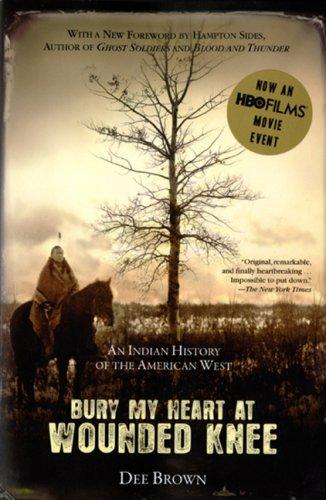
Bury My Heart at Wounded Knee: An Indian History of the American West by Dee Brown is a 1970 history book about indigenous history, conquest, american west. The dispossession of Native Americans in the West was not a series of isolated conflicts but a systematic policy, repeated across different peoples and regions with consistent methods and goals.
Summary
Bury My Heart at Wounded Knee, published in 1970, is Dee Brown's account of the systematic dispossession of Native American peoples across the American West between 1860 and 1890. The book is organized chronologically and geographically, covering the Navajo Long Walk, the destruction of the Sioux, the Apache wars, the subjugation of the Cheyenne, and ending at the Wounded Knee Massacre of 1890. Brown draws extensively on U.S. government documents, treaty texts, and recorded speeches by Native leaders, allowing the official record of the United States to indict itself.
The book was a conscious intervention. When Brown published it, the dominant narrative of westward expansion was still framed largely as progress and settlement — a story told from the perspective of white Americans. Brown wanted to tell the same period from the perspective of the people who were being dispossessed, killed, and forced onto reservations. He largely succeeds by using primary sources: the speeches of Sitting Bull, Red Cloud, Chief Joseph, Geronimo, and others are reproduced at length and with evident care. These men appear not as romantic figures or exotic obstacles but as political leaders making difficult calculations in a collapsing world.
What the book documents, carefully and without dramatic embellishment, is a pattern: a treaty would be signed; valuable land or resources would be discovered on the ceded territory; the treaty would be renegotiated or simply ignored; the people who resisted would be labeled as hostile and subjected to military force; survivors would be moved to smaller and less desirable land; and the cycle would repeat. Brown shows this happening to different peoples at different times with enough consistency that it becomes impossible to attribute to circumstance or individual bad actors. It was policy.
The book ends with Wounded Knee and a quotation from a Sioux holy man. It does not offer redemption or resolution. By 1890 the organized military resistance of Plains and Southwestern peoples was over. The losses Brown documents — of land, life, sovereignty, and cultural continuity — were not recovered by the century's end. That unresolved ending is part of the book's argument: this is not a story that is over.
Talk to Bury My Heart at Wounded Knee: An Indian History of the American West like its author wrote you back.
Get the ideas that fit your life — not generic summaries.
- Chat with the book
- Audiobook-style main ideas
- Adapts to your life and goals
- Helps you take action
Key takeaways
- 1.
The dispossession of Native Americans in the West was not a series of isolated conflicts but a systematic policy, repeated across different peoples and regions with consistent methods and goals.
- 2.
U.S. treaty obligations were routinely broken when new resource discoveries or political pressures made them inconvenient — a pattern so consistent it constitutes a de facto policy rather than a series of failures.
- 3.
Native American leaders were sophisticated political and military strategists, not romantic figures or primitive warriors — the book recovers their voices through extensive quotation from primary sources.
- 4.
The concept of 'hostile' Indians was largely constructed to justify military action: groups that resisted treaty violations were labeled hostile regardless of their legal standing.
- 5.
The Wounded Knee Massacre of 1890 was not a battle — it was the killing of a largely disarmed group of Sioux, including many women and children, after the ghost dance movement had been interpreted as a military threat.
- 6.
The reservation system was designed not as a permanent accommodation but as a transitional holding structure, subject to reduction and renegotiation whenever white interests required it.
- 7.
Brown's methodological choice — to use U.S. government documents and treaty texts as primary sources — allows the historical record to speak against the conventional narrative without requiring Brown to argue.
- 8.
By the book's end, the losses are not redeemed or resolved. Brown resists the temptation to frame genocide as prologue to later justice.
Discussion questions
Use these on your own, with a book club, or as chat starters in Superbook. Book club version, ready to copy or print →
- 1.
Brown uses U.S. government documents as his primary sources. What is the effect of that methodological choice on the book's argument?
- 2.
He covers many different peoples in many different regions. Does treating them as a collective 'Indian history' risk erasing the differences between nations and cultures?
- 3.
The treaty pattern Brown documents — signed, then broken — repeats across chapters. At what point does that repetition become its own argument?
- 4.
Native American leaders appear throughout the book as political strategists. Which speeches or decisions struck you as most revealing of the choices available to them?
- 5.
The book was published in 1970, during the American Indian Movement's rise. How might its historical moment have shaped what Brown included and emphasized?
- 6.
Brown largely avoids making moral arguments explicitly — he lets the record speak. Is that restraint a strength or a limitation?
- 7.
Wounded Knee 1890 is the book's end point. Why there and then? What is gained or lost by ending with that event?
- 8.
The book has been criticized for some historical inaccuracies and for romanticizing Native life. Are those criticisms fair, and do they affect the book's value?
- 9.
Brown writes from outside the communities he documents — he is white, and his access to Native perspectives is mediated through translation and transcription. How does that affect your reading?
- 10.
What do you know about what happened to these communities after 1890 that the book doesn't address?
- 11.
The book's subtitle is 'An Indian History of the American West' — note the article 'an,' not 'the.' What does that humility in the title signal?
- 12.
Has reading this book changed how you think about any aspect of American history you learned in school?
Themes
Frequently asked questions
-
What is Bury My Heart at Wounded Knee about?
It is a history of the systematic dispossession of Native American peoples in the American West between 1860 and 1890, told using U.S. government documents, treaty texts, and speeches by Native leaders. It covers the Navajo, Sioux, Cheyenne, Apache, and many other nations.
-
Is Bury My Heart at Wounded Knee still relevant?
Yes. The historical record it documents has not changed, and debates about treaty rights, Indigenous sovereignty, and the legacies of the reservation system remain active political questions. The book is also a methodological model for using official sources against official narratives.
-
Is the book historically accurate?
It is based primarily on U.S. government documents and is generally reliable on major events. Some historians have noted specific inaccuracies and argue that Brown's emotional framing occasionally shapes his presentation of evidence. These criticisms are worth knowing but do not invalidate the book.
-
How long is the book?
Around eight to nine hours at average reading pace. The book is nearly 500 pages and covers a lot of territory, though the chapters are organized clearly enough that it is possible to read it in focused sections.
-
Who should read Bury My Heart at Wounded Knee?
Anyone interested in American Western history who wants to encounter that period from perspectives other than European settlement. It is especially valuable alongside Empire of the Summer Moon, which covers some of the same period with different emphasis.
Similar books
Empire of the Summer Moon: Quanah Parker and the Rise and Fall of the Comanches
S. C. Gwynne

Guns, Germs, and Steel
Jared Diamond
Sapiens: A Brief History of Humankind
Yuval Noah Harari
Long Walk to Freedom
Nelson Mandela
