Science · Book club
This Is Your Brain on Music: The Science of a Human Obsession book club questions
Here are 12 book club questions for This Is Your Brain on Music: The Science of a Human Obsession by Daniel J. Levitin, ordered to open easily and end somewhere worth arguing about. Copy them, print them, or bring them up one at a time.
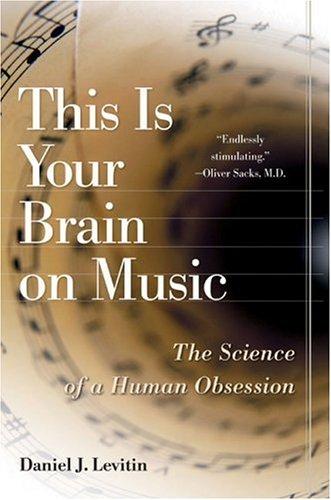
Daniel Levitin came to neuroscience from the music industry — he was a record producer who worked with Stevie Wonder, the Grateful Dead, and Blue Öyster Cult before getting a PhD in psychology and cognitive neuroscience.
Daniel J. Levitin · 2006 · 6h 0m
Full summary and key takeaways →The 12 questions
- 1.
Levitin argues that music works partly through the brain's prediction system. Think of a song that gives you physical chills. Can you identify the specific moment of expectation violation or resolution that triggers it?
- 2.
Why do songs from your adolescence feel emotionally different from songs you hear now? Based on what Levitin describes about memory, does this make sense?
- 3.
The book is partly a defense of music as an evolutionary adaptation. Do you find the evolutionary argument convincing? What would need to be true for music to be merely a byproduct?
- 4.
Levitin describes how Alzheimer's patients retain musical memory long after losing other kinds. What does this suggest about how music is stored relative to language and episodic memory?
- 5.
Think of a piece of music that reliably changes your mood. Is the effect consistent, or does it depend on the context?
- 6.
Levitin comes from the music industry before neuroscience. How does his background shape what he notices about music versus what a pure scientist might emphasize?
- 7.
The ten-thousand-hours concept appears here in the context of musical expertise. Does the way Levitin presents expertise research change how you think about your own skills or learning?
- 8.
If musical expectation is part of why music is pleasurable, does familiarity with a genre train you to appreciate it more? Have you experienced this?
- 9.
Levitin argues that music communicates emotion across cultures. Can you think of a piece from an unfamiliar musical tradition that moved you? What made it accessible?
- 10.
What would it mean if music is hardwired into human cognition? Does that change how you think about music education, or its place in child development?
- 11.
The book was published in 2006. What has changed in music listening — streaming, algorithmic recommendation, headphone culture — that Levitin couldn't have anticipated, and how might it affect the neuroscience he describes?
- 12.
Levitin wrote this book as both a scientist and a music industry veteran. Where do you notice those two perspectives pulling in different directions?
How to run the discussion
- Pick six to eight, not all of them. An hour of real discussion covers fewer questions than anyone expects, and racing the list is what makes a book club feel like homework.
- Open with what people noticed, not what they concluded. Asking for a verdict first hardens opinions before anyone has heard each other.
- Let the disagreement run. The questions below that split a room are the ones worth the time; the ones everyone answers the same way can be skipped.
- Ask the quiet person a specific question. A direct, narrow question is far easier to answer than an open invitation to contribute.
Themes worth steering toward
If the conversation stalls, these are the threads that usually restart it.
Common questions
What are good book club questions for This Is Your Brain on Music: The Science of a Human Obsession?
Here are 12 book club questions for This Is Your Brain on Music: The Science of a Human Obsession by Daniel J. Levitin, ordered to open easily and end somewhere worth arguing about. The strongest openers ask what each reader noticed rather than what they concluded, and the discussion usually turns on music, neuroscience, perception.
How long should a book club discussion of This Is Your Brain on Music: The Science of a Human Obsession last?
Most groups run 60 to 90 minutes of actual discussion. That is roughly six to eight questions, not all of them, so pick the ones that suit your group rather than working down the list in order.
What are the main themes in This Is Your Brain on Music: The Science of a Human Obsession?
Music, Neuroscience, Perception, Emotion, Evolutionary psychology. Those are the threads most likely to divide a room, which makes them the useful places to steer a discussion that has gone quiet.
Picking the next one? See books like This Is Your Brain on Music: The Science of a Human Obsession or questions for other book club picks.
