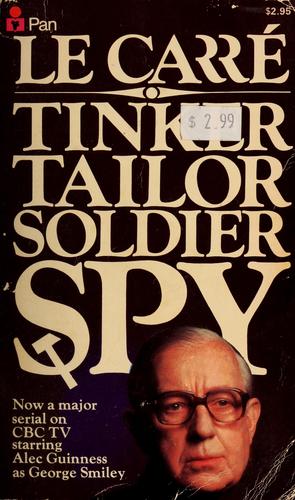
Talk to Tinker, Tailor, Soldier, Spy like its author wrote you back.
Get the ideas that fit your life — not generic summaries.
- Chat with the book
- Audiobook-style main ideas
- Adapts to your life and goals
- Helps you take action
Tinker, Tailor, Soldier, Spy, in detail
George Smiley, a rumpled, semi-retired British intelligence officer, is pulled back from the cold to investigate a claim that a Soviet mole has burrowed into the very top of MI6 — the Circus, as insiders call it. The mole is code-named Gerald. Smiley's task is to work through a short list of four suspects, each a senior officer, any of whom could have spent decades feeding secrets to Moscow. The novel moves slowly, deliberately, at the pace of memory and inference rather than action.
What the book is really about is the emotional and moral cost of working inside institutions built on lies. Le Carré shows you the Circus from the inside: its small jealousies, its class snobberies, its appetite for self-deception. The betrayal at the center is not just a professional catastrophe — it is a personal one. Smiley's investigation keeps circling back to his own past, his marriage to the faithless Lady Ann, and his long rivalry with Control, the former chief who died without naming the mole. The Cold War is the backdrop; the real subject is what loyalty means when the institution you serve may itself be corrupt.
Published in 1974, the novel draws on le Carré's own experience inside British intelligence, and the Philby scandal — Kim Philby, the Cambridge spy who defected to Moscow in 1963 — hangs over every page without being named. The writing is extraordinarily dense; le Carré invented an entire vocabulary (lamplighters, scalphunters, babysitters) that rewards patient readers and punishes impatient ones. There is almost no action in the conventional sense. The climax is a single tense confrontation in a safe house, and the satisfaction it provides is entirely retrospective.
Readers who want plot mechanics and forward momentum will find this book exhausting. Readers who love fiction that treats intelligence work as a moral and psychological study — the atmosphere of Graham Greene, the precision of Len Deighton — will find it one of the finest spy novels ever written. The BBC series starring Alec Guinness (1979) and the 2011 film with Gary Oldman are both exceptional adaptations, but the novel's full texture doesn't compress cleanly into either.
The big ideas
- 1.
Le Carré's Circus is a portrait of institutional rot: an organization so dedicated to secrets that it has become incapable of knowing the truth about itself.
- 2.
The mole hunt is as much an excavation of the past as an investigation of the present — Smiley works almost entirely through memory, inference, and patience.
- 3.
Betrayal here operates at multiple levels: professional, personal, and ideological. The novel refuses to rank them.
