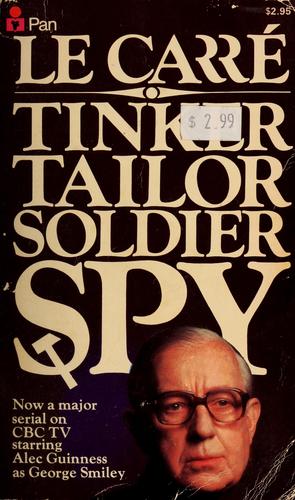
Tinker, Tailor, Soldier, Spy by John le Carré is a 1974 thriller book about betrayal, cold war paranoia, institutional loyalty. Le Carré's Circus is a portrait of institutional rot: an organization so dedicated to secrets that it has become incapable of knowing the truth about itself.
Summary
George Smiley, a rumpled, semi-retired British intelligence officer, is pulled back from the cold to investigate a claim that a Soviet mole has burrowed into the very top of MI6 — the Circus, as insiders call it. The mole is code-named Gerald. Smiley's task is to work through a short list of four suspects, each a senior officer, any of whom could have spent decades feeding secrets to Moscow. The novel moves slowly, deliberately, at the pace of memory and inference rather than action.
What the book is really about is the emotional and moral cost of working inside institutions built on lies. Le Carré shows you the Circus from the inside: its small jealousies, its class snobberies, its appetite for self-deception. The betrayal at the center is not just a professional catastrophe — it is a personal one. Smiley's investigation keeps circling back to his own past, his marriage to the faithless Lady Ann, and his long rivalry with Control, the former chief who died without naming the mole. The Cold War is the backdrop; the real subject is what loyalty means when the institution you serve may itself be corrupt.
Published in 1974, the novel draws on le Carré's own experience inside British intelligence, and the Philby scandal — Kim Philby, the Cambridge spy who defected to Moscow in 1963 — hangs over every page without being named. The writing is extraordinarily dense; le Carré invented an entire vocabulary (lamplighters, scalphunters, babysitters) that rewards patient readers and punishes impatient ones. There is almost no action in the conventional sense. The climax is a single tense confrontation in a safe house, and the satisfaction it provides is entirely retrospective.
Readers who want plot mechanics and forward momentum will find this book exhausting. Readers who love fiction that treats intelligence work as a moral and psychological study — the atmosphere of Graham Greene, the precision of Len Deighton — will find it one of the finest spy novels ever written. The BBC series starring Alec Guinness (1979) and the 2011 film with Gary Oldman are both exceptional adaptations, but the novel's full texture doesn't compress cleanly into either.
Talk to Tinker, Tailor, Soldier, Spy like its author wrote you back.
Get the ideas that fit your life — not generic summaries.
- Chat with the book
- Audiobook-style main ideas
- Adapts to your life and goals
- Helps you take action
Key takeaways
- 1.
Le Carré's Circus is a portrait of institutional rot: an organization so dedicated to secrets that it has become incapable of knowing the truth about itself.
- 2.
The mole hunt is as much an excavation of the past as an investigation of the present — Smiley works almost entirely through memory, inference, and patience.
- 3.
Betrayal here operates at multiple levels: professional, personal, and ideological. The novel refuses to rank them.
- 4.
The Cold War, for le Carré, is a moral draw — both sides corrupt, both sides capable of the same crimes in the name of different abstractions.
- 5.
Smiley's marriage to the promiscuous Lady Ann is a structural mirror of his relationship to the Circus: loyal to something that was never loyal to him.
- 6.
The prose is dense and demanding. Le Carré builds a private argot for the intelligence world — it functions as a test of whether you're willing to belong to this world on his terms.
- 7.
The reveal lands not with a bang but with a quiet, devastating recognition — le Carré's point is that the worst betrayals are the ones you already suspected.
- 8.
Control, the dead chief whose investigation launched the mole hunt, is a ghost haunting the novel — authority without presence, certainty without resolution.
Discussion questions
Use these on your own, with a book club, or as chat starters in Superbook. Book club version, ready to copy or print →
- 1.
Smiley is the opposite of a thriller hero — slow, methodical, personally humiliated. Why does le Carré choose this kind of protagonist, and does it work for you?
- 2.
The Circus is rotten at the top whether or not there's a mole. Does the mole's identity change how you read the institution, or just confirm what was already apparent?
- 3.
The novel argues, implicitly, that the West and the Soviet Union are morally equivalent. Do you agree with that framing, or does it feel like Cold War-era false balance?
- 4.
How much does knowing about Kim Philby change how you read this novel? Can it be read cleanly without that historical context?
- 5.
Smiley's loyalty to the Circus survives every betrayal. Is that loyalty admirable, pathetic, or something else?
- 6.
Lady Ann barely appears, yet she shapes every major relationship in the book. What is le Carré doing with her character?
- 7.
The vocabulary le Carré invented — lamplighters, babysitters, scalphunters — creates a feeling of initiation. Is that a flaw or a feature?
- 8.
Jim Prideaux's storyline runs parallel to Smiley's investigation. How does his experience of betrayal differ from Smiley's?
- 9.
The ending gives Smiley the professional victory he was denied. Does he actually win anything that matters?
- 10.
The novel was written in 1974. Which aspects feel most dated, and which feel uncomfortably current?
- 11.
Karla, the Soviet spymaster, appears only briefly but looms over everything. How does le Carré characterize the enemy without ever letting him speak?
- 12.
If this is a novel about loyalty, who in the book actually earns the word? Who merely performs it?
Themes
Frequently asked questions
-
Is Tinker, Tailor, Soldier, Spy hard to read?
Yes, by most thriller standards. Le Carré uses a dense, indirect style and an invented vocabulary for the intelligence world. The plot requires careful attention — this is not a book to read on a plane. Most readers find the density rewarding, but it demands patience in the first hundred pages.
-
Do I need to read the other Smiley novels first?
No. Tinker, Tailor is the best entry point. Some background on Smiley's marriage and career is mentioned in passing, but nothing that requires prior knowledge. The trilogy continues with The Honourable Schoolboy and Smiley's People.
-
What is Tinker, Tailor, Soldier, Spy actually about, without spoilers?
A retired British intelligence officer is recalled to identify a Soviet mole who has penetrated the highest level of MI6. The novel is less a thriller than a psychological study of loyalty, betrayal, and institutional decay.
-
Is the BBC series or the 2011 film worth watching?
Both are excellent. The 1979 BBC miniseries with Alec Guinness is the more faithful and fully realized version. The 2011 film with Gary Oldman is visually stunning and compresses well, though it loses some of the novel's texture. Purists prefer the series; film-goers are well served by either.
-
Who shouldn't read this book?
Readers who want plot momentum, action sequences, or a clear good-versus-evil structure will find this frustrating. Le Carré moves slowly and refuses easy resolution. If you bounced off Graham Greene or found Patricia Highsmith too quiet, this may not be for you.
Similar books
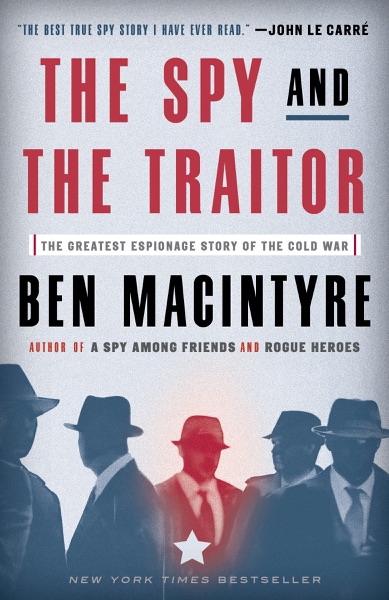
The Spy and the Traitor: The Greatest Espionage Story of the Cold War
Ben Macintyre
Agent Zigzag: A True Story of Nazi Espionage, Love, and Betrayal
Ben Macintyre
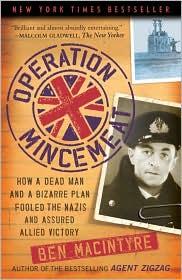
Operation Mincemeat: How a Dead Man and a Bizarre Plan Fooled the Nazis and Assured an Allied Victory
Ben Macintyre
In Cold Blood
Truman Capote
