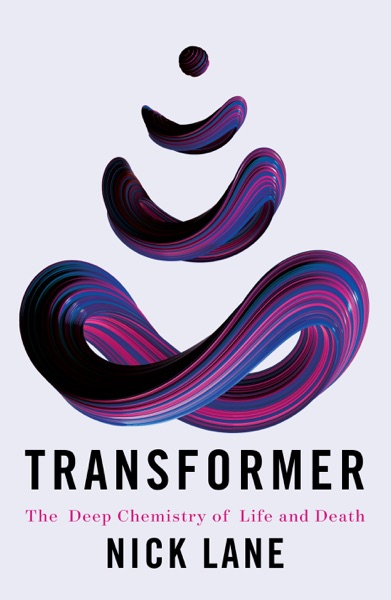
Transformer by Nick Lane is a 2022 science book about metabolism, evolution, origins of life. The Krebs cycle does two distinct things: it extracts energy from food and it provides carbon building blocks for biosynthesis. Both functions are essential and may explain why it became universal.
Summary
Transformer is Nick Lane's investigation of the Krebs cycle — a metabolic pathway discovered in the 1930s that every living cell on Earth runs — and his argument that this cycle is not merely the engine of cellular energy but a chemical record of how life first emerged from inorganic chemistry. The title refers to the cycle's dual role: it both oxidizes food to generate energy and provides the carbon skeletons that the cell uses to build everything else. Lane argues that these two functions together make it uniquely central to biology.
Lane begins by laying out the cycle itself — with genuine care for readers who are not biochemists — and then pivots to the deeper question: why does every form of life we know use essentially the same set of core reactions? His answer draws on the hydrothermal vent theory of life's origin. He argues that the Krebs cycle running in reverse, in conditions that mimic alkaline hydrothermal vents, could produce organic molecules from CO2 and hydrogen without needing enzymes or genetic machinery. This reversal — the reductive TCA cycle — may have been the original chemistry of life, and forward-running metabolism evolved from it.
The second half of the book moves from evolutionary origins to medicine. Lane draws on emerging research showing that metabolic reprogramming — cells switching how they run their chemistry — is central to cancer, inflammation, and aging. The Warburg effect, where cancer cells preferentially metabolize glucose even in the presence of oxygen, has been known since the 1920s but remained poorly understood. Lane argues it reflects a deep evolutionary logic: under stress, cells revert to more ancient metabolic patterns that prioritize biosynthesis over energy efficiency.
Lane writes with unusual clarity for a subject this technical. He does not hide complexity, but he also does not write for specialists alone. The book requires genuine engagement — Lane does not simplify the biochemistry to the point of distortion — but readers who stay with it come away understanding not just the Krebs cycle but why the chemistry of life is the way it is. The implications for cancer treatment and for understanding consciousness are speculative but grounded in serious biology.
Talk to Transformer like its author wrote you back.
Get the ideas that fit your life — not generic summaries.
- Chat with the book
- Audiobook-style main ideas
- Adapts to your life and goals
- Helps you take action
Key takeaways
- 1.
The Krebs cycle does two distinct things: it extracts energy from food and it provides carbon building blocks for biosynthesis. Both functions are essential and may explain why it became universal.
- 2.
Lane argues the cycle running in reverse, driven by hydrogen and CO2, could have been the original chemistry of life before enzymes or genes existed.
- 3.
All living things share the same core metabolic reactions, suggesting life originated once and all descended from the same chemical beginning.
- 4.
Alkaline hydrothermal vents on the seafloor provide conditions — proton gradients, mineral catalysts, warm temperatures — that may have driven the emergence of the first metabolic cycles.
- 5.
The Warburg effect in cancer cells reflects a shift toward ancient metabolic logic: when cells are stressed, they prioritize building materials over energy efficiency.
- 6.
Metabolic reprogramming — cells changing how they run their chemistry — is now understood to drive inflammation, aging, and cancer, not just be a symptom of these conditions.
- 7.
The link between metabolism and gene expression is bidirectional: metabolites directly regulate which genes are turned on, making metabolism central to how organisms respond to their environment.
- 8.
Understanding metabolism at this level suggests new therapeutic approaches to cancer that target the chemical environment of cells rather than just genetic mutations.
Discussion questions
Use these on your own, with a book club, or as chat starters in Superbook. Book club version, ready to copy or print →
- 1.
Lane argues that the Krebs cycle's universality is evidence for a single origin of life. How strong is that argument, and what would it take to disprove it?
- 2.
The alkaline hydrothermal vent hypothesis replaces the warm little pond with a very specific geological setting. Does that feel like progress in understanding life's origins, or just a different guess?
- 3.
Lane's writing assumes readers are willing to learn actual biochemistry. How much technical density is too much for popular science, and where does Transformer fall on that spectrum?
- 4.
The link between metabolism and cancer has been known since the 1920s but was largely ignored for decades in favor of genetic models. What does that history say about how science works?
- 5.
Lane suggests that inflammation and aging share metabolic logic with cancer. If that is right, what does it imply about how we should approach preventive health?
- 6.
The reductive TCA cycle could produce organic molecules without enzymes or genes. Does the plausibility of this pathway change how you think about the probability of life elsewhere in the universe?
- 7.
Lane writes that metabolites regulate gene expression directly. Most people think of the causal arrow running from genes to everything else. How does reversing that change the picture?
- 8.
How do you weigh the speculative elements of this book against its well-established biochemistry? Where does Lane clearly signal the difference?
- 9.
The book argues that understanding the Krebs cycle matters for medicine, not just for evolutionary biology. Do you find those medical implications convincing?
- 10.
Lane has written several books building toward this one, including Life Ascending and The Vital Question. Does Transformer feel like a culmination of a long research program?
- 11.
What would it mean for our understanding of consciousness if the metabolic logic Lane describes turns out to be fundamental to all cognitive processes, not just energy production?
Themes
Frequently asked questions
-
Is Transformer accessible to non-scientists?
It requires more effort than most popular science books. Lane does not assume biochemistry knowledge but does not avoid technical detail either. Readers willing to engage carefully will follow the argument; those expecting easy reading will find it demanding.
-
How long is Transformer by Nick Lane?
Around 300 pages with notes, taking roughly seven hours to read. The density varies — the explanatory chapters move slower than the narrative and historical sections.
-
What makes the Krebs cycle so important?
Every living cell on Earth uses it. It sits at the intersection of energy metabolism and biosynthesis, which means it is involved in almost every aspect of cellular life. Lane argues it is also a chemical record of how life first emerged.
-
Do I need to read Lane's previous books first?
No, but The Vital Question covers the hydrothermal vent theory in more depth and makes a good companion. Transformer can be read alone; Lane reintroduces the key ideas where needed.
-
Why does the cancer connection matter?
If cancer involves metabolic reprogramming to ancient biochemical states rather than simply genetic mutation, it opens therapeutic approaches that target the cellular chemistry directly. Several research groups are pursuing this; Lane explains why it might work.
Similar books
A Brief History of Time
Stephen Hawking
The Selfish Gene
Richard Dawkins
A Crack in Creation: Gene Editing and the Unthinkable Power to Control Evolution
Jennifer A. Doudna and Samuel H. Sternberg
The Double Helix
James D. Watson
